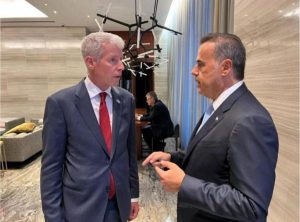
Greece’s Energy Minister, Stavros Papastavrou, announced that the country will take center stage in the global energy agenda this week, as Athens prepares to host the Partnership for Transatlantic Energy Cooperation (P-TEC) on Nov. 6–7, bringing together top government officials and energy leaders from the U.S., Australia, and Europe at a pivotal moment for global geopolitics, following new U.S. and EU sanctions on Moscow and a preliminary U.S.-China agreement.
A Message of Trust and Strategic Importance
Speaking to the public broadcaster ERT News, Papastavrou described the strong U.S. presence as a “message of confidence toward the Greek government”, emphasizing that it reflects Greece’s importance as an energy hub for the wider region.
“Greece, with confidence and a clear plan, is taking initiatives and helping shape the regional energy strategy,” he said.
The minister confirmed that discussions will include new investments in gas pipelines and liquefied natural gas (LNG) terminals, hinting that fresh agreements could be unveiled on Nov. 7.
“We are very close to seeing positive surprises, with U.S. participation in key energy projects,” he noted.
Expanding Infrastructure and Energy Links
Papastavrou highlighted Greece’s existing LNG infrastructure in Revithoussa and Alexandroupoli, revealing that a third LNG terminal is under consideration. The country’s geographic position, political stability, and pro-investment climate, he said, make it an ideal gateway for American natural gas to Europe.
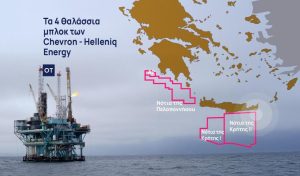
On hydrocarbons, he confirmed that seismic surveys have been completed, and that the government is expediting plans for exploratory drilling.
“It may take four, five, or six years,” he said, “but utilizing our natural wealth is a top priority.”
Visionary Projects with Egypt and Cyprus
Turning to regional cooperation, Papastavrou described the power interconnections with Egypt and Cyprus as “visionary but absolutely essential.”
“The energy from Egypt will be primarily wind-generated, providing abundant and affordable power—vital for the growth of emerging technologies like artificial intelligence,” he said.
He added that progress has finally been made on the Greece–Cyprus interconnection after two years of stagnation, following license transfers and renewed bilateral commitment.
Water, Power, and Prices
The minister also detailed 2.5 billion euros in water management projects, with 1 billion euros from the European Commission and 250 million euros from the EIB, promising low tariffs and plans to merge 50 utilities.
On electricity, he said Greece remains among Europe’s cheapest markets, with a 20% wholesale hike leading to only a 7.1% retail rise.
Ahead of the EU Environment Council, he confirmed Greece’s backing of 2040 emission goals, seeking flexibility and a review clause to safeguard national interests.