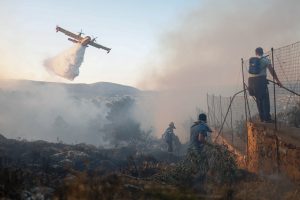
Flames tore through the pine-covered hills of Rhodes, sending smoke billowing toward the beaches below. From the air, the fire twisted into towering tornado-like columns that seemed to drive the flames forward toward the sea.
Along the island’s narrow coastal roads, tourists hurried on foot toward evacuation points where buses waited and small boats were gathered offshore. Some carried suitcases. Others had come straight from the beach, still in their bathing suits, holding only a phone or a small child.
The wildfires of July 2023 necessitated what Greek authorities described as the largest evacuation ever carried out in Greece, with more than 19,000 people fleeing hotels, villages and beaches by land and sea.
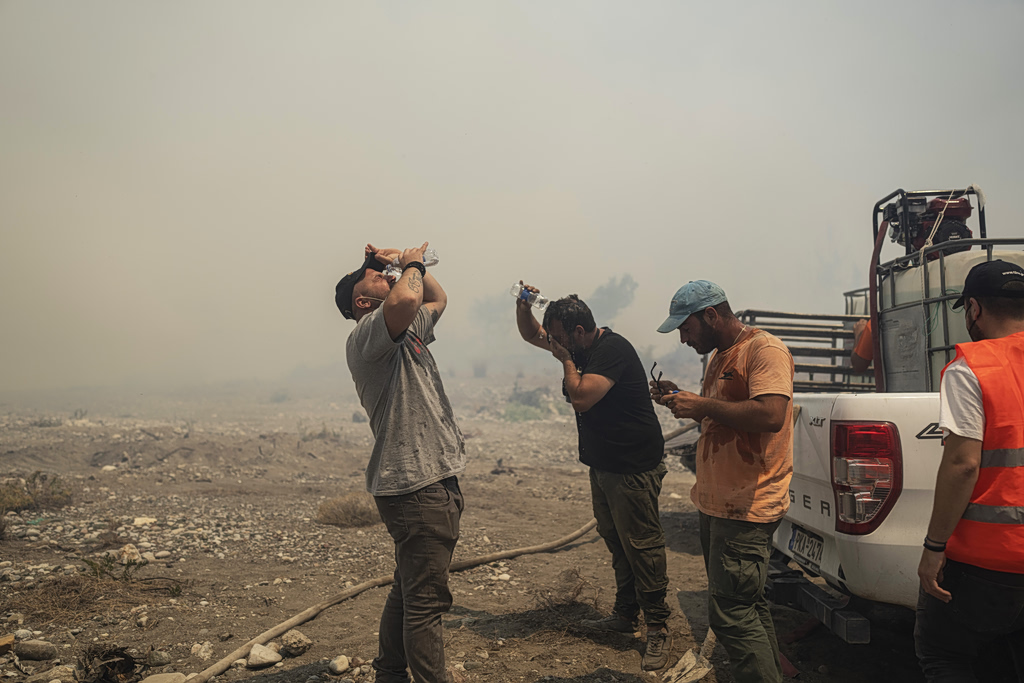
Volunteers cool themselves during a wildfire in Vati village, on the Aegean Sea island of Rhodes, southeastern Greece, on Tuesday, July 25, 2023. A third successive heat wave in Greece pushed temperatures back above 40 degrees Celsius (104 degrees Fahrenheit) across parts of the country Tuesday following more nighttime evacuations from fires that have raged out of control for days. (AP Photo/Petros Giannakouris)
The blaze ultimately burned about 17,773 hectares, damaging homes and hotels and destroying large stretches of forest across one of Greece’s most important tourism destinations, an island that receives millions of visitors each year.
Rhodes was not alone that summer. Across the Northern Hemisphere, prolonged heat and drought created the conditions for one of the most destructive wildfire seasons in recent years. Weeks later, on the Hawaiian island of Maui, fast-moving fires swept through the town of Lahaina, killing more than one hundred people. In retrospect, Rhodes was lucky.
Nearly three years later, the smoke has long since cleared from Rhodes’ coastal hills, but the fire’s path remains visible. Blackened tree trunks still stand where forest once covered the slopes.
In some places, however, volunteers are beginning the slow work of restoration—felling unstable trees into terraced retaining walls, planting fence-protected saplings and installing irrigation systems.
Organizing the “next day”
Much of the restoration work now underway is being coordinated by Common Nature (Gia ti Fysi), a local environmental cooperative that has become an organizing hub for post-fire regeneration.
The organization was founded in 2019 with a practical goal: to bring structure to environmental actions in burned ecosystems on Rhodes.
Tree planting campaigns had taken place on the island before. But they often ended once saplings were put in the ground.
“The problem was not planting trees,” Nektarios Kalogirou from Common Nature tells To BHMA International Edition. “The problem was everything that comes after.”
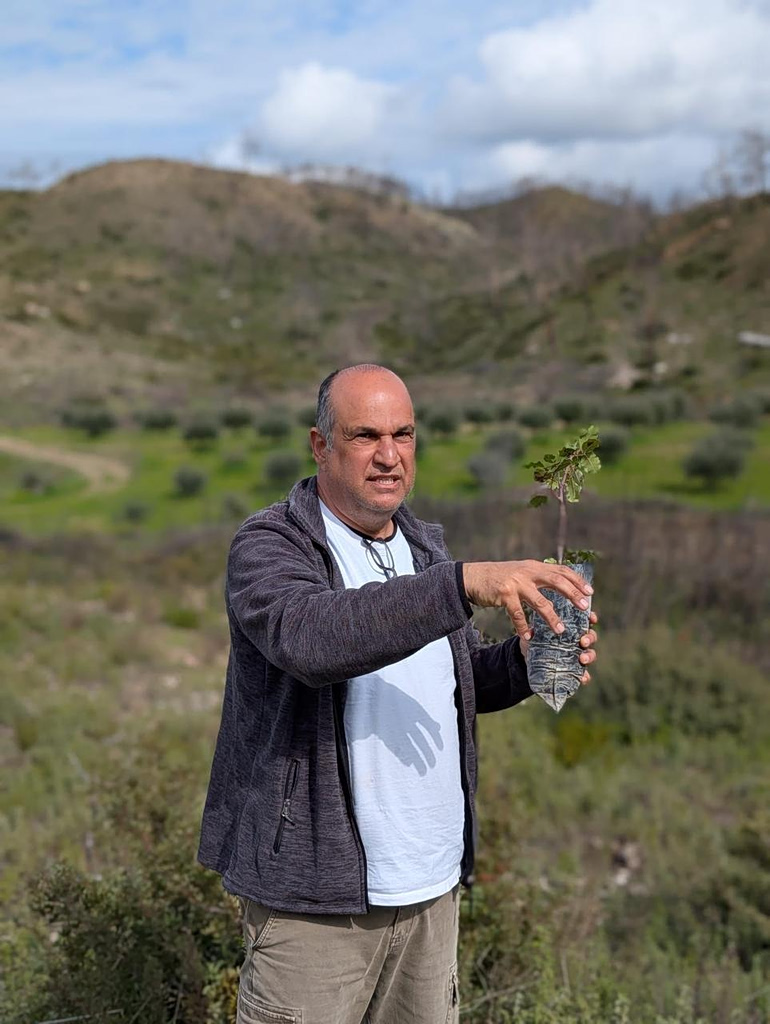
Head of Common Nature, Nektarios Kalorigou, informs volunteers of proper tree-planting techniques.
Young trees require fencing to protect them from grazing animals, irrigation during dry periods, and ongoing monitoring to determine whether they survive their first years. Without those steps, planting efforts often fail.
From the beginning, the cooperative worked with scientists and universities to design restoration projects, and with local tourism businesses to support them. Hotels and tourism agencies helped finance studies and provided staff to assist with work in the field.
Yet, “after the large wildfire, everything changed,” Kalogirou says.
Today Common Nature operates as an environmental coordination hub, working with public authorities, universities and private businesses across a range of conservation projects.
A surge in volunteers
The wildfire triggered a surge in civic participation across the island.
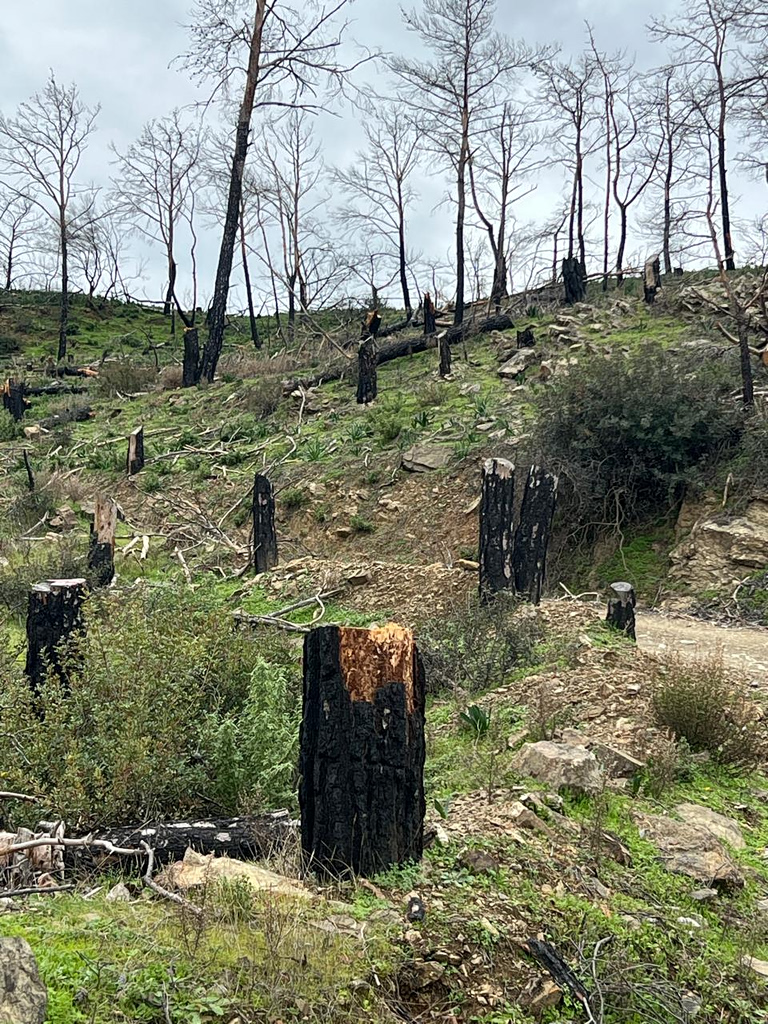
Forest ravaged by 2023 fires, near Holy Monastery Panagia Ypseni, Rhodes.
Thousands of residents have taken part in environmental activities organized by the cooperative. Some work directly in burned areas, planting and maintaining saplings. Others contribute through administrative or logistical support.
Kalogirou relates how a volunteer with heart problems offered to help from home. “‘Even if my job is scanning documents,’ he wrote to the group, ‘I want to participate.’”
The organization attributes this response partly to the collective shock caused by the fire.
“At that time, the wildfire created a deep collective trauma,” Kalogirou explains. “The forest landscape still bears a large wound.”
At the same time, Kalogirou cautions against assuming the disaster transformed environmental attitudes across the island.
“I have concluded that the large wildfire managed to increase the need for action—but only among those who already had this type of sensitivity. The rest, those who were indifferent, have remained indifferent.”
A morning on the burned hillside
On a cool winter morning in the hills above the coast, volunteers gather beside a narrow dirt road which once ran through woodland.
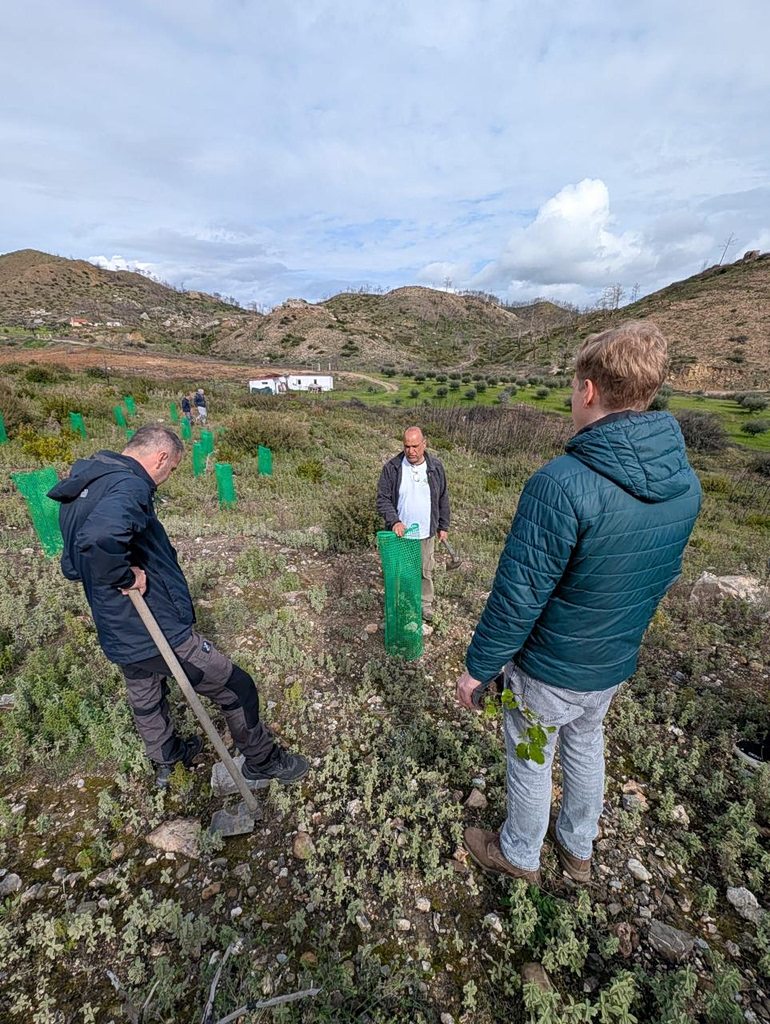
They move slowly across the slope, carrying small saplings, shovels and plastic containers filled with water. An expert walks among them, checking planting distances and soil depth. Some volunteers kneel beside shallow holes in the ground, while others install protective fencing around newly-planted trees.
The work is quiet and methodical. The soil between the rocks can be dry even in winter. Young trees must be placed carefully so their roots can reach moisture deeper in the ground.
Tourism businesses join the effort
One distinctive feature of Rhodes’ recovery effort is the participation of the island’s tourism sector.
Hotels, tourism agencies and other businesses have contributed both funding and personnel to environmental initiatives coordinated by Common Nature.
According to the organization, 36 hotel groups representing 107 hotels are now involved.
Their support has financed scientific studies, irrigation systems, equipment and operational costs. Employees from tourism companies often join volunteer groups working in burned areas.
“Local tourism businesses have played a decisive role,” Kalogirou says.
However, their cooperation extends beyond forests. Volunteers and businesses also assist in monitoring marine wildlife and sea turtle nesting along the island’s coastline, as well as supporting environmental education programs.
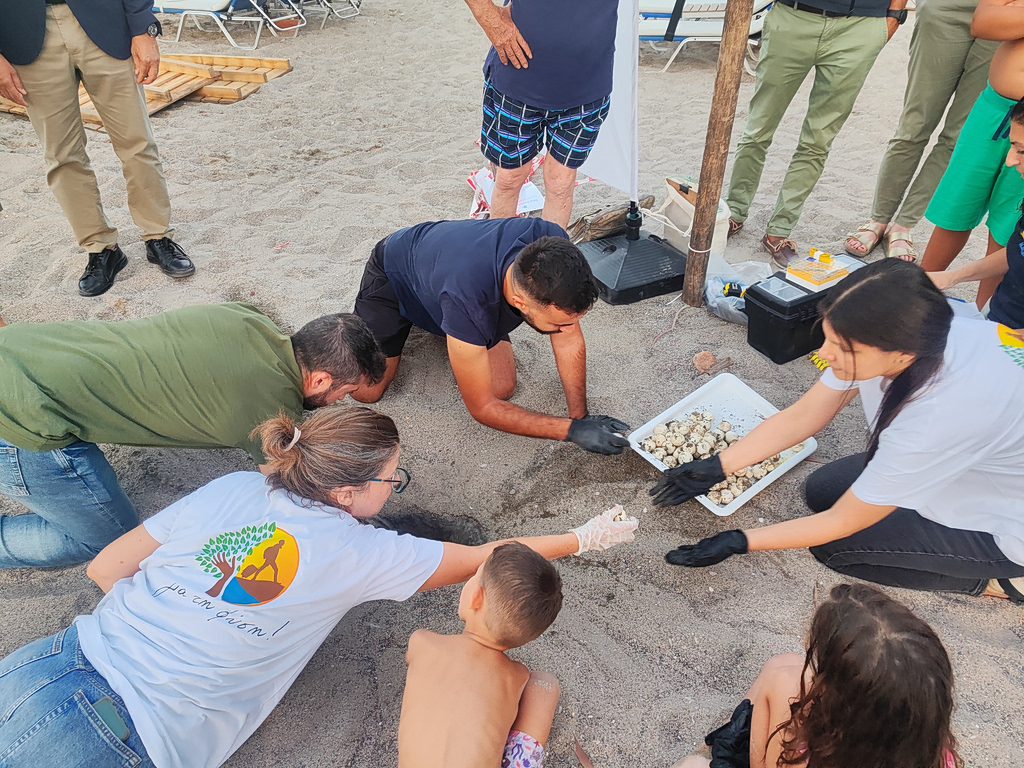
Common Nature conducting turtle nest conservation measures.
And while many companies participate through their environmental, social and governance (ESG) initiatives, the organization emphasizes that hands-on participation is often more valuable than financial contributions alone.
“The work in the field is labor-intensive,” he explains.
When tourists want to help
Visitors frequently ask whether they can participate in restoration activities.
In practice, that is not always easy.
Tree planting generally takes place outside the summer tourist season, and burned forest areas can be difficult to navigate safely.
In one early effort pre-dating the wildfire, the organization invited tourists to join in tree-watering activities.
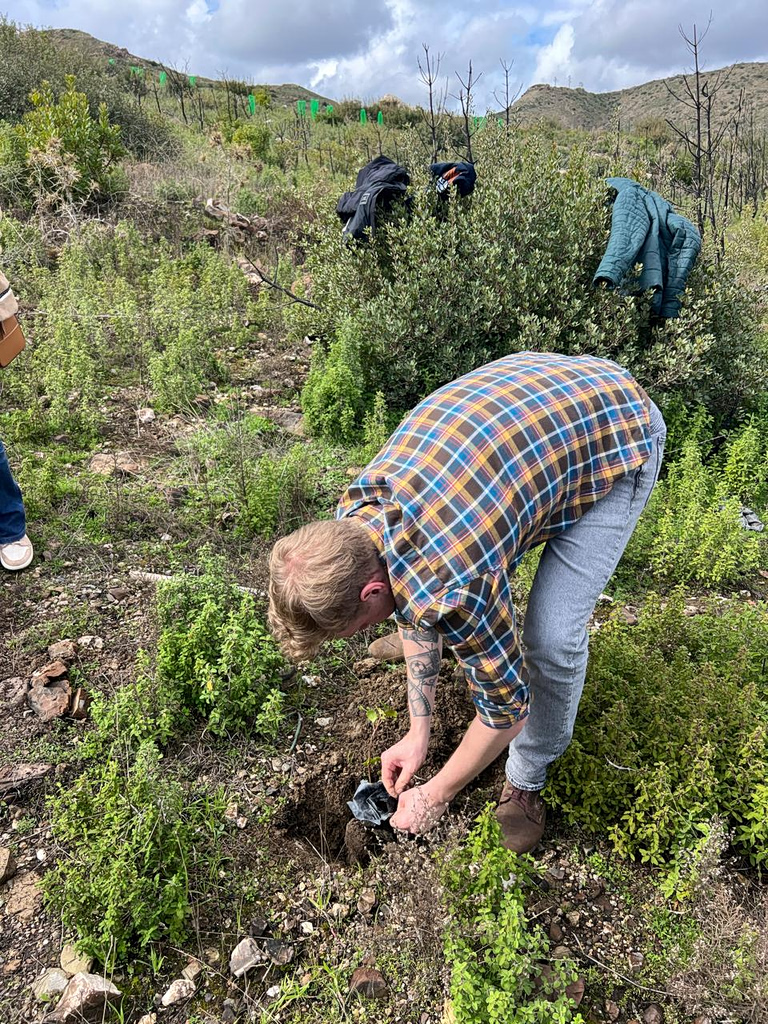
Tree planting with volunteers and Common Nature on Rhodes.
Some arrived prepared with proper footwear and clothing. Others came wearing beach sandals.
“They couldn’t take so much as a single step through the dry shrubland,” Kalogirou recalls.
Coastal conservation work has proved more accessible. In partnership with the Rhodes Hydrobiological Station, volunteers—including visitors—help monitor marine wildlife and nesting activity along the island’s beaches.
Tourists also play another role: as observers of environmental change.
“They are often the first to notice the effects of the climate crisis.”
Regeneration in a changing climate
Restoring a burned forest in the Mediterranean is not simply a matter of planting trees.
Greek forestry policy traditionally prioritizes natural regeneration, allowing ecosystems time to recover before taking action.
In forests that have burned only once, scientists often recommend waiting about three years before planting new trees. Areas that have burned repeatedly may require interventions sooner.
But climate conditions are altering the assumptions behind those models.
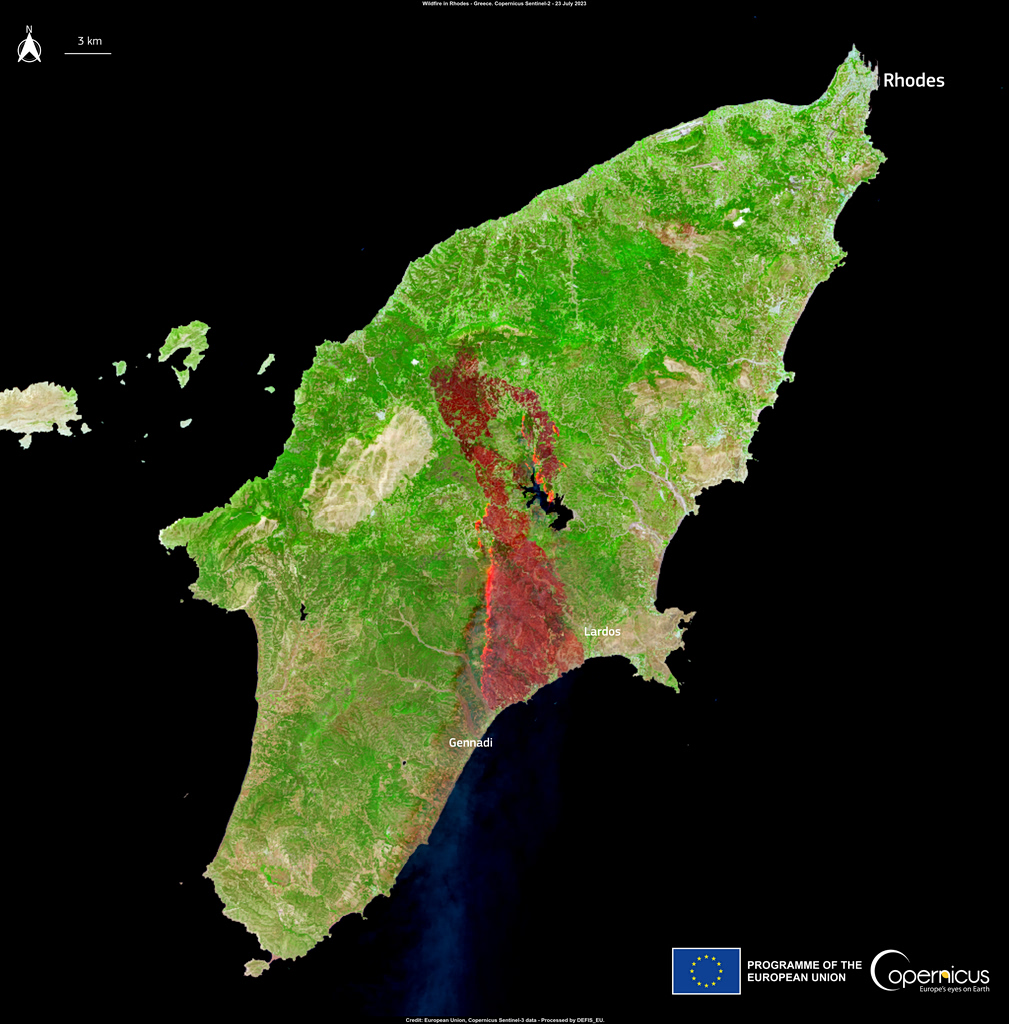
This image, acquired by one of the Copernicus Sentinel-2 satellites on 23 July at 9:00 UTC, shows the burn scar of the Rhodes wildfire and active fires.
New sprouts must now survive intense sunlight, scorching soil temperatures and prolonged drought. Grazing animals—particularly goats and deer—can destroy young plants before they establish themselves.
Protective fencing can help, but it requires constant maintenance. Winter rains may erode soil beneath fences, allowing animals to enter protected areas.
“Continuous human presence is essential,” the organization says.
Choosing the right species
Debate about reforestation often focuses on which trees should be planted.
Mediterranean pine forests are sometimes criticized as being particularly vulnerable to fire. Some observers suggest replacing them with more fire-resistant species.
But Common Nature says species selection follows strict scientific guidelines determined through formal reforestation studies.
Public opinion, Kalogirou says, cannot override ecological realities.
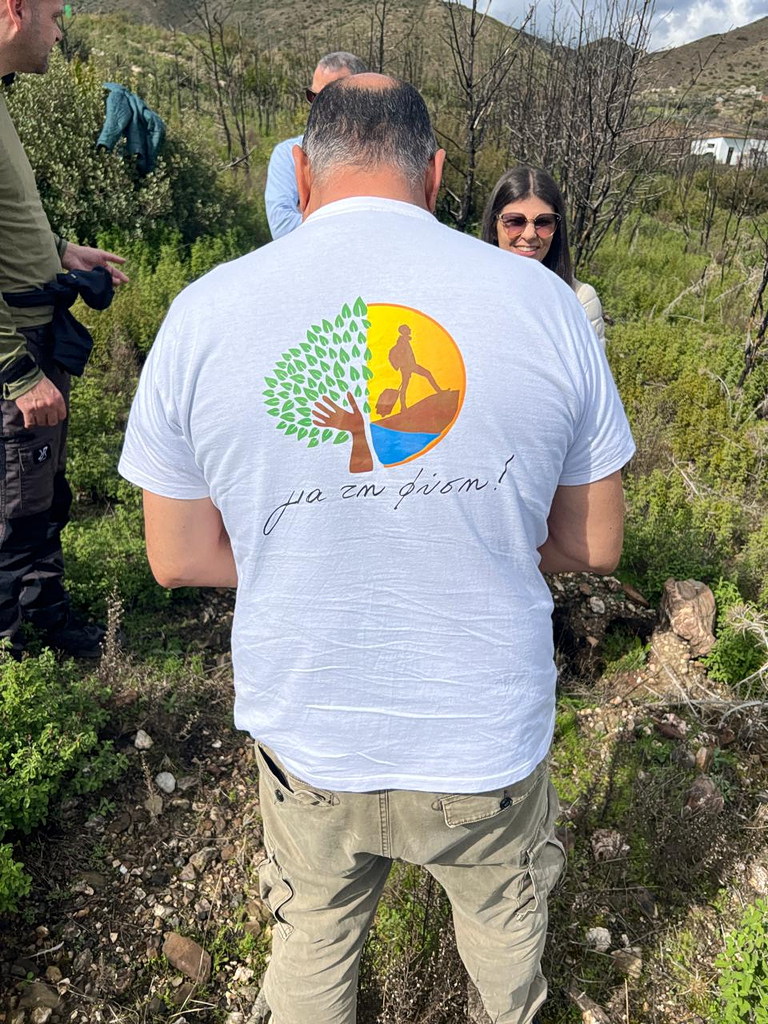
Tree planting with volunteers and Common Nature on Rhodes.
Working with authorities
The organization says it maintains close cooperation with the local Forest Service, which approved its first reforestation study following the wildfire and is currently reviewing a second.
Common Nature also collaborates with the Region of South Aegean, the Municipality of Rhodes, the Dodecanese Chamber of Commerce, and the Rhodes Hoteliers Association.
Still, the group believes Greece’s forestry departments need more staff and resources to manage post-fire landscapes effectively.
The challenge ahead
Asked about the greatest obstacle to recovery, Kalogirou answers without hesitation:
“Excessive heat.”
High temperatures intensify drought, increase fire risk and place additional stress on young vegetation.
Preventive work, such as clearing forest fuel and managing landscapes, remains essential but expensive to implement nationwide.
For that reason, the organization believes a civil society with enhanced ecological awareness and knowledge will play an increasingly important role in environmental protection.
Recovery or transformation?
Nearly three years after the fires, parts of Rhodes are slowly beginning to regenerate.
But scientists are increasingly warning that Mediterranean ecosystems are entering a period of profound change. Rising temperatures, repeated fires and prolonged drought are reshaping landscapes that evolved under very different climatic conditions.
Whether the burned hillsides of Rhodes will once again become forests—or gradually transform into something new—remains uncertain.
For now, volunteers continue planting, watering, fencing, and hoping that the small saplings they have planted can survive another scorching Mediterranean summer.