A remarkable archaeological discovery is casting new light on a lesser-known chapter of Byzantine activity in the western Mediterranean. In the region of Elda, in southeastern Spain, researchers have uncovered a Byzantine fortress attributed to a military garrison of the Eastern Roman Empire, confirming its presence along the frontier with the Visigothic kingdom.
The find comes from the archaeological site of El Monastil, now definitively identified with the ancient Roman city of Elo. Its significance is twofold: it substantiates the strategic foothold established by Emperor Justinian I in the Iberian Peninsula, while also highlighting the area’s role as a key control point along the Vinalopó River corridor.
Perched on naturally fortified high ground, the fortress featured imposing defensive walls up to three meters thick. Access to the acropolis was secured through a monumental gate constructed with carefully hewn stone and fitted with iron hinges. Inside, a central thoroughfare was lined with small two-story chambers, believed to have served as monastic cells.
At the highest point of the complex, archaeologists identified a modest yet highly significant church. Its architectural features clearly reflect the Eastern Christian tradition. Covering approximately 84 square meters, the structure included a semicircular apse and a rock-cut baptistery. Its limited capacity aligns with the scale and function of Byzantine monastic churches.
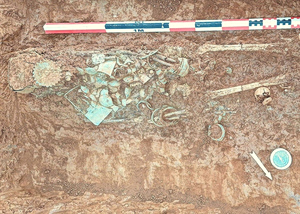
Among the most notable finds are fragments of a marble altar crafted from white Parian marble and an octagonal column base with a special cavity designed for the preservation of relics—further underscoring the site’s religious importance. In addition, everyday objects, military equipment, and official weights have been recovered, offering concrete evidence of an organized Byzantine military presence.
This discovery fits into the broader context of Justinian I’s ambitious campaign to reclaim the western territories of the former Roman Empire, during a period marked by sustained conflict with the Visigoths.