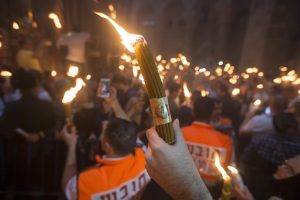
Growing concerns are emerging over whether the Holy Fire, a central symbol of Orthodox Easter, will reach Greece this year as ongoing conflict in the Middle East disrupts normal life in Jerusalem.
Reports indicate that the Old City of Jerusalem, typically crowded with pilgrims during the Easter period, now resembles a ghost town due to strict security restrictions linked to the war. Entry to the area is currently prohibited, while shops, monasteries and museums remain closed.
Restrictions ahead of major religious holidays
The tensions come as major religious holidays approach in the region. Jewish Passover begins on April 1 and lasts until April 9, followed shortly afterward by Orthodox Easter on April 12.
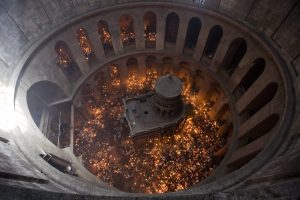
Under normal circumstances, thousands of believers gather in the Church of the Holy Sepulchre, where the Holy Fire ceremony takes place at the tomb of Christ. The flame is then transported to several Orthodox countries, including Greece, where it plays a central role in Easter celebrations.
This year, however, curfews and security measures imposed because of the war have significantly altered the situation.
Diplomatic coordination underway
Greek authorities are working with Israeli officials to ensure that the Holy Fire can still be transported to Greece.
According to reports, Greece’s Ministry of Foreign Affairs, the Greek embassy in Israel and Israeli authorities are in continuous communication to coordinate the necessary arrangements. Officials say it is still too early to determine exactly how the transfer will take place, but they stress that the Holy Fire will reach Greece “by any possible means,” including a special flight if necessary.
Since the start of the conflict, Israel’s airspace has opened and closed periodically, raising uncertainty over flight schedules. Authorities believe there may still be a window allowing the ceremonial transfer.
Gathering limits in Jerusalem
At the same time, strict limits on public gatherings remain in place in the Old City. Authorities currently allow up to 100 people in outdoor spaces and up to 50 indoors, preventing the large crowds that usually attend the ceremony.
Some observers say that, for the first time since the tradition of transporting the Holy Fire to Greece began in 1988, the flame in its physical form might not be able to make the journey.
A long-standing Easter tradition in Greece
Every year on Holy Saturday, the Holy Fire is lit during a ceremony at the Church of the Holy Sepulchre and passed from the Patriarch of Jerusalem to worshippers.
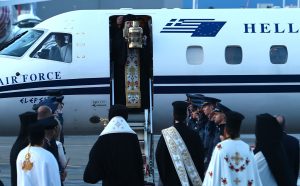
The flame is placed in special safety lanterns and handed to a Greek government and church delegation that travels to Jerusalem for the event. It is then flown to Athens International Airport, where it is officially received before being distributed across Greece.
From Athens, the flame is transported by scheduled or special flights to major cities such as Thessaloniki, Heraklion, Chania, Rhodes, Corfu, Mytilene, Ioannina, Kos, Santorini, Mykonos, Kalamata and Alexandroupoli, before local church authorities deliver it to parishes across the country in time for the midnight Easter service.
The organized air transfer of the Holy Fire to Greece began in 1988, while since 2002 the Greek state has officially coordinated the process in cooperation with the Church of Greece.
Whether the tradition will unfold as usual this year remains uncertain as the conflict in the region continues.