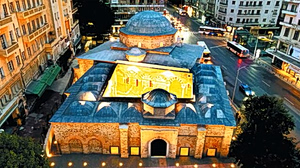
The Hamza Bey Mosque, known to generations of residents as the Alcazar, had been largely absent from the urban landscape during years of conservation work. Its reopening brings back a building whose history reflects the successive layers of Thessaloniki’s past, from Ottoman rule to the rhythms of modern city life.
The complex was founded in 1467-68 by Hafsa, daughter of Hamza Bey. It was expanded during the 16th century, when a portico, minaret and striking three-sided arcade were added. Together, these features created a quadrilateral courtyard and an architectural composition regarded as exceptional in the wider Balkan region.
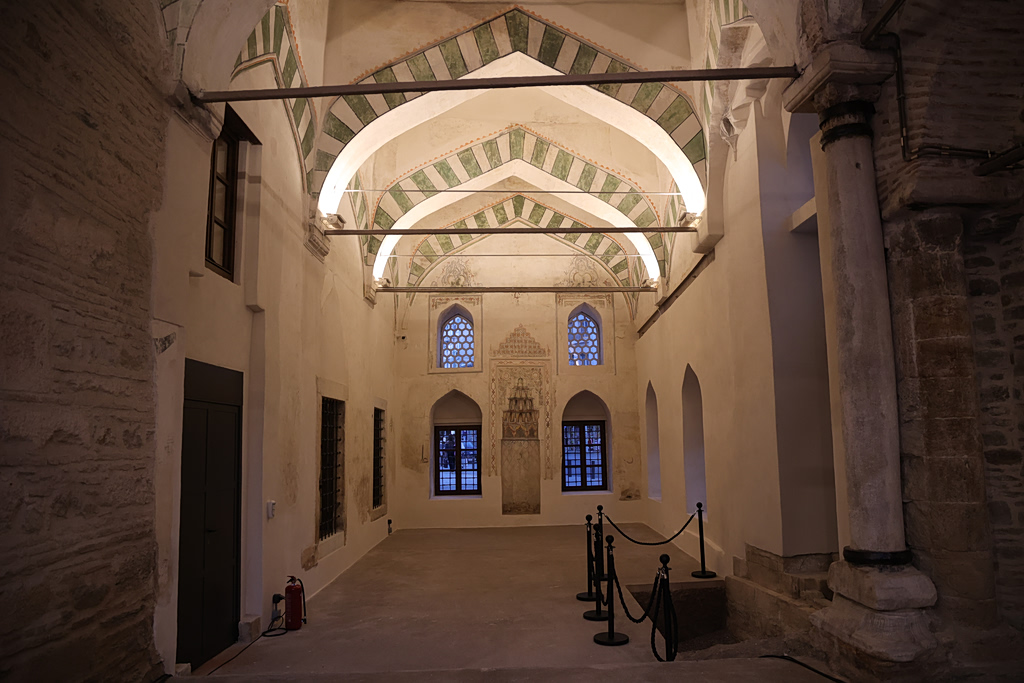
Reopening of the Hamza Bey Mosque in Thessaloniki – October 10, 2026 / Άνοιγμα Τέμενους Χαμζά Μπέη Θεσσαλονίκη 10 Οκτωμβρίου
The monument’s more recent history is closely tied to the city’s popular culture. Its courtyard once housed the Alcazar cinema, making the site a familiar part of everyday life for Thessaloniki residents.
Management and the organization of events will be shared by the Metropolitan Organization of Museums of Visual Arts of Thessaloniki (MOMus) and the Ephorate of Antiquities of Thessaloniki City.
The mosque has opened with a photography exhibition by Thessaloniki-born Pete Marifoglou. Entitled “Thessaloniki: The Imprint of Transition (1960-1980),” the exhibition captures two decades of rapid modernisation and urban transformation, offering a visual record of a city reshaped by social and economic change.
Culture Minister Lina Mendoni has placed the restoration within a broader programme of urban interventions intended to improve both the appearance and functionality of the surrounding area. The plans include linking archaeological sites, illuminating the city walls and the White Tower, and restoring the former FIX brewery as part of Thessaloniki’s evolving cultural infrastructure.
The venue will be open daily from 10 a.m. to 6 p.m., except Mondays. Admission will be free for the first two weeks, after which a nominal fee is expected to be introduced.
The relics will remain on display until Nov. 5, after which they are due to be returned to the monasteries and ecclesiastical institutions to which they belong.