“At Eternity’s Gate” was the title Vincent van Gogh gave to one of his works, first conceived as a lithograph depicting an elderly resident of a nursing home in The Hague. In November 1882, Van Gogh portrayed the 72-year-old Adrianus Zuyderland, his side-whiskered face buried in his clenched fists, head bowed in despair. After passing through various hands over the decades, the drawing now lies in the underground storage of the Tehran Museum of Contemporary Art, shielded — for now — from bombardment and newly charged with symbolism in the wake of war in the Middle East.
Writing in The Art Newspaper on the occasion of the museum’s closure immediately after the American and Israeli attack of February 28, Van Gogh specialist Martin Bailey traced the story of the work. “We hope that Van Gogh’s lithograph is being kept somewhere safe within the museum,” he wrote. “It is obvious, however, that all Iranian museums, historic buildings and archaeological sites are now at risk.”
Van Gogh had given the signed lithograph to his Dutch friend, the artist Anthon van Rappard. After moving through several private collections, it was acquired in the early 1970s by the New York businessman Nelson Rockefeller and his wife, Mary. Rockefeller, then vice-president of the United States, soon sold the Van Gogh to the art dealer Eugene Thaw. In 1975, the New York dealer in turn sold it for $65,000 to Farah Pahlavi, wife of the Shah of Iran, who had played a central role in establishing the Tehran Museum of Contemporary Art.
The museum opened its doors in October 1977. But after the Shah was overthrown in February 1979, Ayatollah Khomeini’s regime ordered that most of the museum’s collection — including the Van Gogh — be consigned to storage. The decision reflected the new government’s anti-Western stance, with some of the works deemed morally offensive.
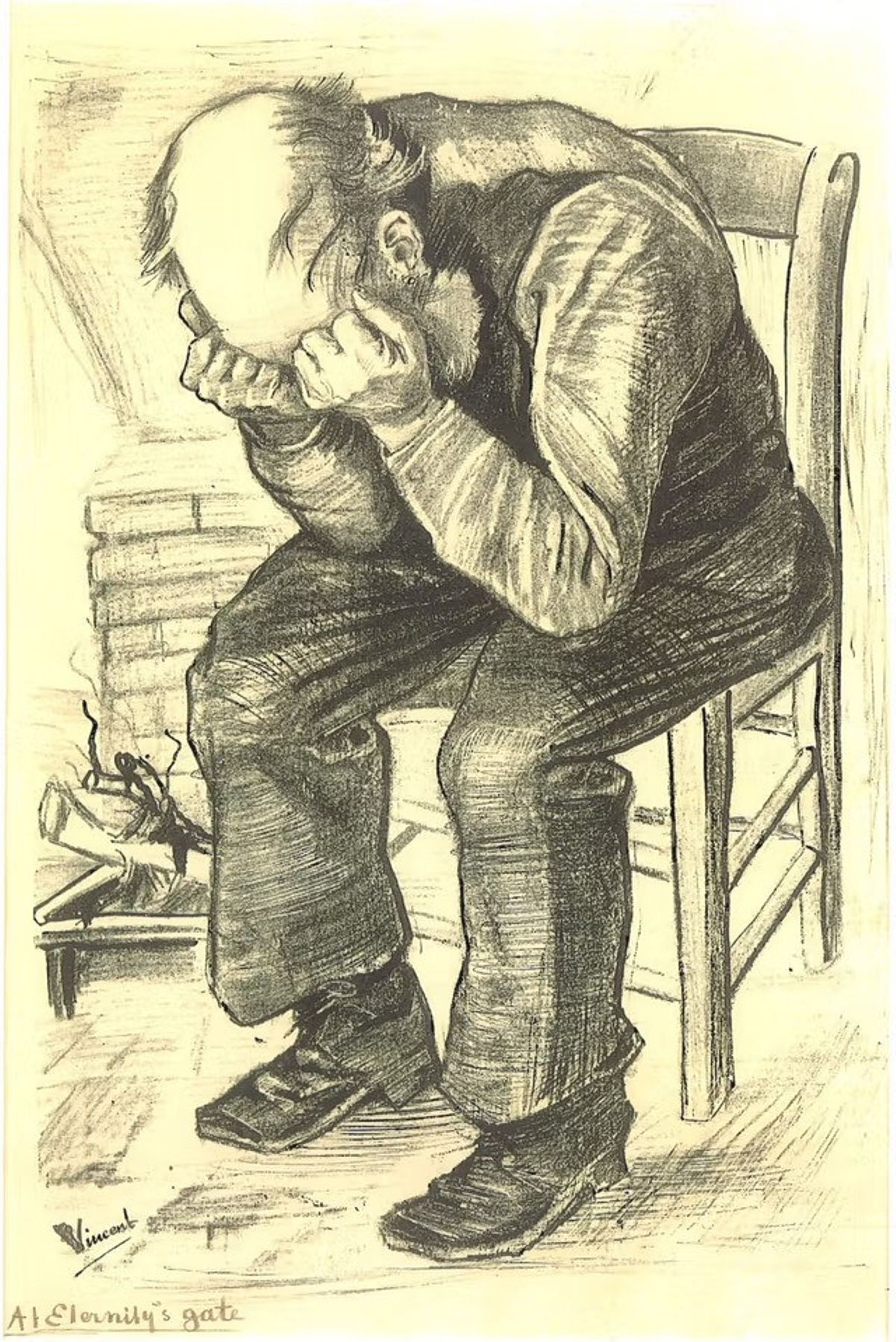
source: The Art Newspaper
And then to canvas
In May 1890, seven years after creating the print, Van Gogh decided to revisit the image in paint and transfer it to canvas. It became one of the last works he completed at the asylum where he was being treated on the outskirts of Saint-Rémy-de-Provence.
Two weeks before he began work on the painting, the institution’s director, Dr Théophile Peyron, wrote to the artist’s brother Theo, noting that Vincent remained deeply depressed: “He usually sits with his head in his hands, and if someone speaks to him, it seems to cause him pain, and he gestures to be left alone.”
It was this very image that the artist and filmmaker Julian Schnabel used as a point of departure for his 2018 biographical film At Eternity’s Gate, with Willem Dafoe portraying Van Gogh, his emotional turmoil and his final flashes of creative brilliance. Out of that turmoil came the painting At Eternity’s Gate, in which Van Gogh seemed to narrate his own psychic despair.
Three months after completing the work, the painter shot himself.