When Greece’s very first animated film timidly appeared on the big screen in 1945, no one could have imagined it would open a path lasting eight decades. A rugged path that was built from scratch and helped forge a new cinematic language. Today, 80 years on, Greek animation is not just an artistic experiment, it is a living part of the country’s cultural identity.
Marking this symbolic anniversary, the Animasyros International Animation Festival, pays tribute to the trailblazers of the art of animation with the special program “The Great Greek Masters,” curated by Kleopatra Korai and Dimitris Bellos.
The Festival which is returning to Syros, the Cycladic island that serves as its home, between September 22 and 28, has unveiled its most ambitious program yet while the main focus of this year’s event is titled “Animated Cosmos”. Amongst the highlights of this year’s Animasyros is a retrospective honouring five pioneers of Greek animation. Yiannis Koutsouris, Aggelos Chatziandreou, Iordanis Ananiadis, Anta Ganosi, and Yiorgos Sifianos all left an indelible mark on this new medium and paved the way for generations to come.
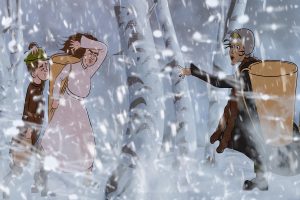
Tracing the roots of Greek animation, the festival will screen films from the 1940s through the 1980s, alongside shorts, commercials, and vignettes of all kinds, some of which have been restored by Animasyros. An accompanying exhibition will showcase rare material from the artists: sketches, animation cels, storyboards, and studio photographs. The result: a vivid recreation of a time when makeshift techniques, experimentation, long hours, and passion were the norm at a time when there were no formal structures and institutions mediating.
“It was tough back then, but there was real love and determination, and the results proved that. We won awards at Cannes, New York, London. Personally, I’ve received over 100 awards for Greek and international productions,” recalls Aggelos Chatziandreou, one of the honoured “Greek Masters”, speaking to Nsyn. Chatziandreou, studied under Antonis Efthymiades, himself a pioneer of Greek animation. In 1968 he became one of the first animators at the newly formed Aronis-Efthymiades studio, where he eventually rose to the level of artistic director. Later, he co-founded the company Kino where he directed live-action films, commercials, and corporate videos. Like many of his contemporaries, he found advertising provided an unexpected but fertile ground to develop his animation craft.
The advertising boost
“Advertising pushed production forward. When you make an ad, you start from scratch, which isn’t the case when you create your own film. Advertising brought a level of professionalism missing from Greece at the time, and through it we built the profile of Greek animation. The roles of designers, pencillers and inkers, letterers and writers as well as narrators and voice over artists appeared as real specialties within advertising,” explains Iordanis Ananiadis, who began his career as a creator of commercials in Thessaloniki
He later moved to Athens and opened his own studio, where he developed films such as “Pandaisia” that won an award at the Thessaloniki Film Festival—and Adam, which was shortlisted for an Academy Award in the category of Best Animated Short.
Despite the worldwide recognition of this work, Greek audiences were not always ready for his vision. “You’d hear people ask: ‘How are your little karagiozakia doing?’confusing animation with Karagiozis, the traditional Greek shadow-puppet theater. Of course animation and Karagiozis have nothing to do with each other,” he notes.
Today, Ananiadis is finishing his eleventh personal film, still insisting on hand-drawn animation.
“I think computer-made films often look the same. They use the same features, so the result is flawless, but it’s too perfect. You start seeking the human imperfection, the flaw that comes from working with your hands. That’s what gives another dimension to our work,” he says.
Fellow animator Anta Ganosi agrees: “On the computer, things are easier. But the finished drawing is not like a work of art that you can hold and smell the paint. Digital images lack the “sweetness”, the freshness of hand-drawn work. You can work differently with the faces, the expressions and the movements of your subjects, when you work by hand. The imperfections add beauty and bring us closer to what is natural, to our humanity”.