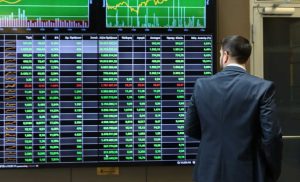
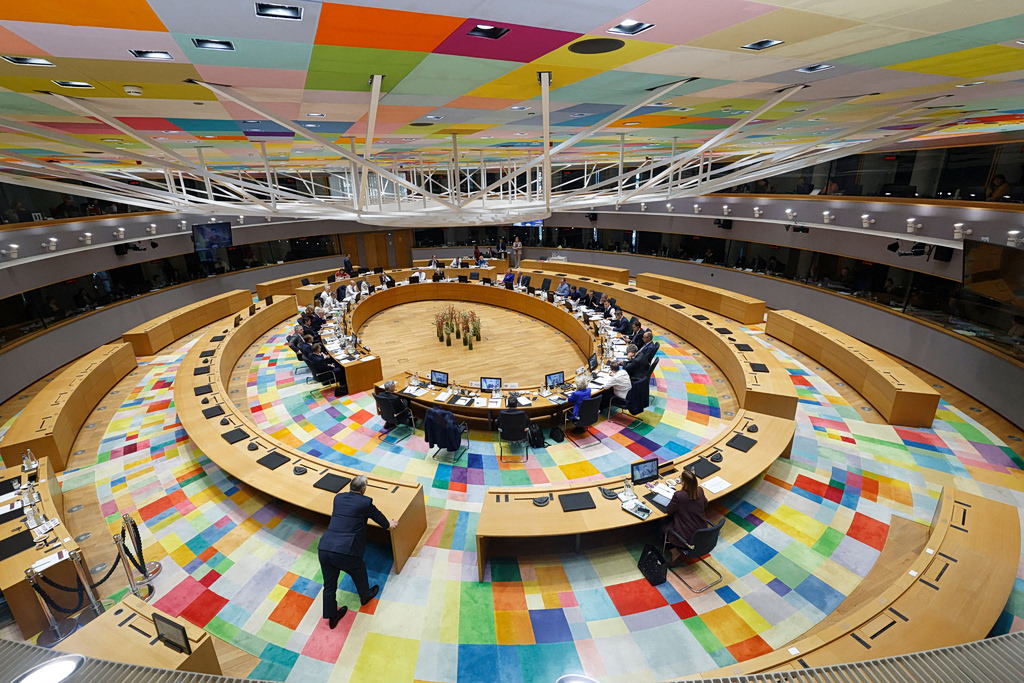
The Athens Stock Exchange (ASE) opened the week with a modest decline, echoing the cautious tone across European markets after U.S. President Donald Trump announced a sweeping 30% tariff on imports from the European Union. While the move escalates the ongoing U.S.-EU trade tensions, markets across the continent have so far avoided panic-driven sell-offs.
European Markets React Cautiously to Tariff Escalation
Investors across Europe are closely watching developments, hoping for a diplomatic breakthrough despite the sharp rhetoric. European Commissioner for Trade Maroš Šefčovič expressed optimism that the two sides could still reach a resolution, suggesting that negotiations remain ongoing.
In Athens, the General Index fell 0.32%, landing at 1,953.86 points, with total turnover at €12.3 million and a trading volume of 2.9 million shares. The blue-chip FTSE 25 index slipped 0.36% to 4,909.01 points, while the banking index posted losses of 0.37%, settling at 2,103.18 points.
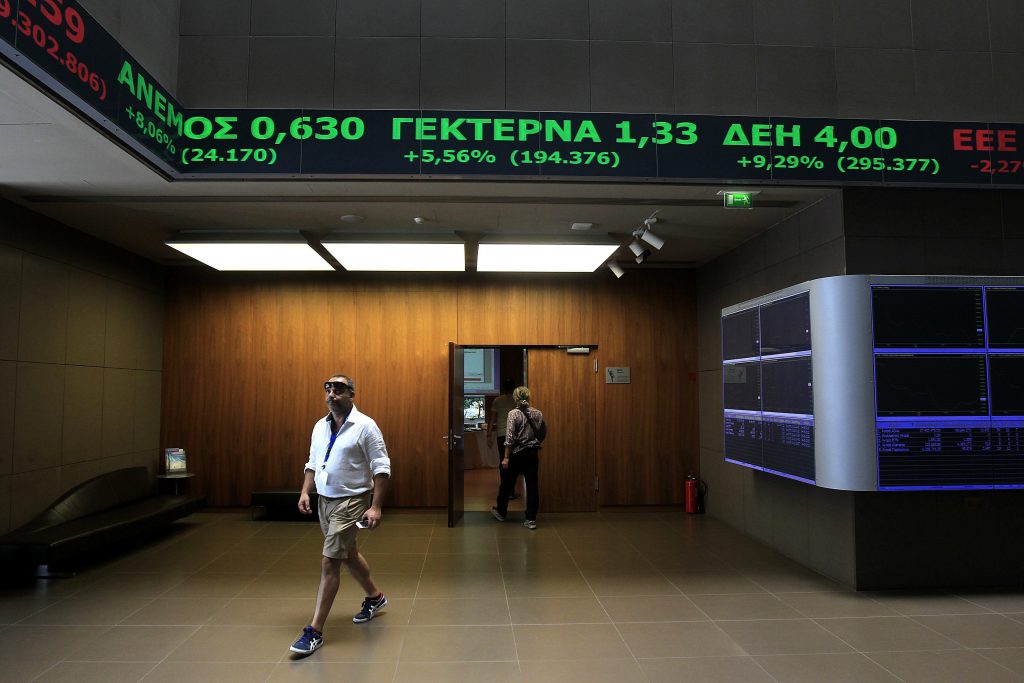
epa04871539 A man walks under an electronic board showing share prices at the Stock Exchange in Athens, Greece, 04 August 2015. Equity prices were falling on 04 August on the Athens Stock Exchange (ASE or ATHEX), with the basic share price index down 3.83 percent, standing at 642.49 points at 11.00 am and turnover at 16.26 million euros. The Greek stock exchange opened on 03 August after a month as part of the capital controls imposed by the Greek government on 29 June to prevent money from fleeing the country and a collapse of the banking system. EPA/ORESTIS PANAGIOTOU
The market decline is attributed to two key factors: a natural wave of profit-taking after recent gains, and investor wariness amid the newly announced tariffs. Nevertheless, trading remains orderly, with no indication of panic, suggesting that markets view the developments as manageable—at least for now.
A New Phase of Trade Uncertainty
President Trump’s decision to impose the 30% tariff throws U.S.-EU trade relations into a fresh period of uncertainty. The two economic blocs collectively account for about 30% of global trade in goods and services and 43% of global GDP. In 2024 alone, trade between them reached €1.7 trillion, equivalent to €4.6 billion per day, according to EU data.
Analysts identify the pharmaceutical, automotive, and aerospace sectors as the most vulnerable to the tariffs. Germany and Ireland are considered the most exposed economies, with nearly one-quarter and one-third of their exports, respectively, destined for the U.S. market.
Commissioner Šefčovič warned that the 30% tariffs could “practically eliminate” trade between the two powers, yet he also noted that negotiations had been progressing and a deal may be close.
European Stocks in the Red, UK Market Holds Steady
On Monday, the pan-European Stoxx 600 index was down 0.37%. Germany’s DAX fell 0.70% to 24,085 points, and France’s CAC 40 lost 0.51% to 7,789 points. The UK’s FTSE 100, however, bucked the trend, gaining 0.21% to reach 8,959 points.
Asian Markets Mixed as Chinese Exports Beat Expectations
Asian stock markets closed with mixed results. China’s Hang Seng gained 0.29% to 24,210 points, while the Shanghai Composite rose 0.38%. South Korea’s Kospi climbed 0.83%, but Japan’s Nikkei lost 0.28%, ending at 39,459 points. Australia’s ASX 200 dipped 0.11%.
Chinese exports were a bright spot, exceeding expectations with a 5.8% year-on-year increase in June. The jump is partly attributed to exporters accelerating shipments ahead of a looming tariff deadline in August.
Meanwhile, Japan’s 10-year government bond yield rose 5.5 basis points to 1.554%, reaching a seven-week high.
Bitcoin Surges Past $120,000 for the First Time
In a historic milestone, Bitcoin surpassed $120,000 for the first time, reaching a peak of $121,207.55 during Asian trading hours. It was last seen trading 1.5% higher at $120,856.34.

FILE PHOTO: Republican presidential nominee and former U.S. President Donald Trump gestures at the Bitcoin 2024 event in Nashville, Tennessee, U.S., July 27, 2024. REUTERS/Kevin Wurm/File Photo
The rally, which has seen Bitcoin surge 29% year-to-date, is fueled by investor optimism ahead of key U.S. legislative discussions this week. The House of Representatives is expected to review a set of bills that could create a long-awaited regulatory framework for the digital asset sector.
President Trump, who has described himself as “the crypto president,” has signaled support for more favorable regulation, giving crypto markets an additional boost despite broader trade tensions.
Earnings Season Looms with Tariffs in Focus
As earnings season kicks off, markets are bracing for the impact of tariffs on corporate profitability. Five major European firms, each valued at over €50 billion, are scheduled to report this week.
According to data from LSEG I/B/E/S, earnings per share for companies in the Stoxx 600 are projected to decline by 0.2% year-on-year in Q2. This marks a stark contrast from April 1 expectations, which forecast a 7.2% increase before Trump’s latest trade stance was announced.
If confirmed, this would be the first earnings contraction for the index since Q2 2024. Analysts from Bank of America also highlight the rising euro—up 8% against the U.S. dollar since early April—as a headwind for European firms with strong U.S. sales exposure, including consumer goods, pharmaceutical, and media companies.