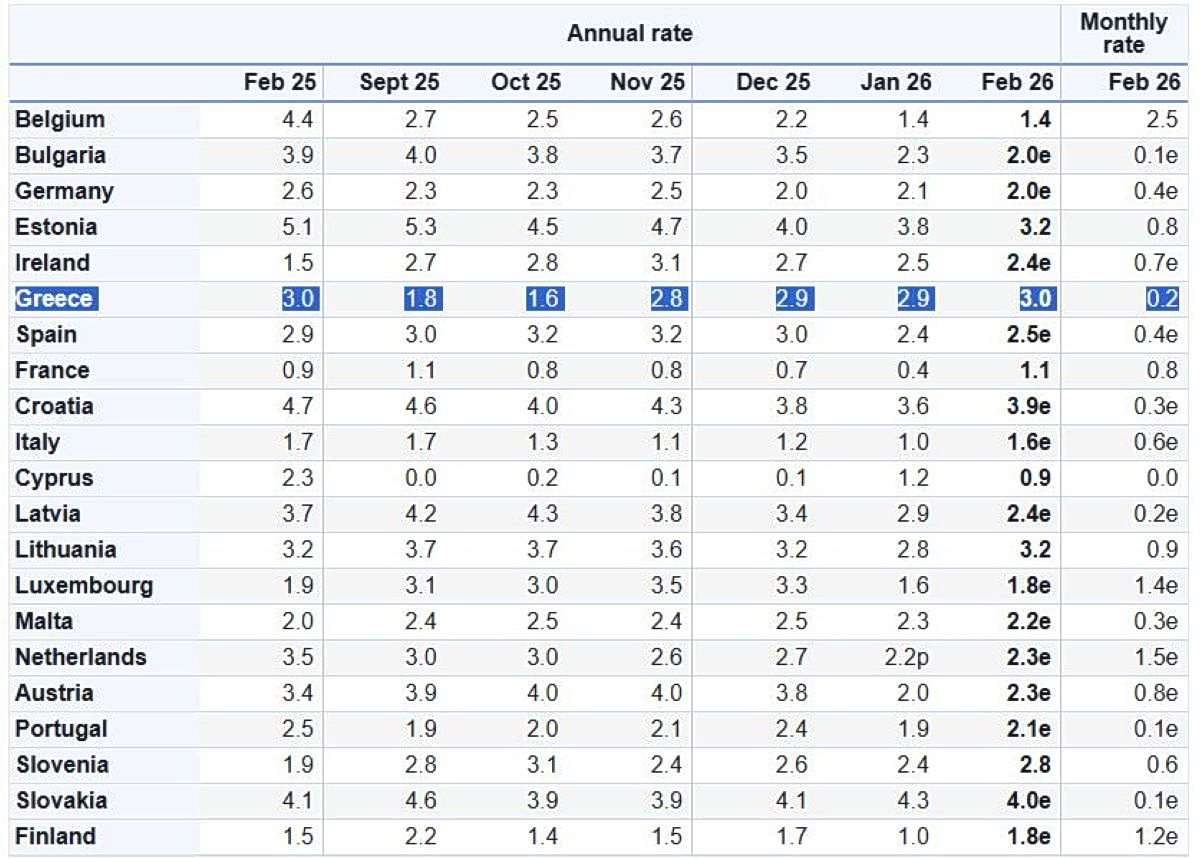
Inflation in Greece rose to 3% in Feb., up from 2.9% in Jan., according to preliminary Eurostat data.
In the eurozone, inflation climbed to 1.9%, higher than Jan.’s 1.7%, defying expectations that it would remain stable.
Among the main components, services posted the fastest annual growth at 3.4% in Feb., up from 3.2% in Jan. Food, alcohol, and tobacco remained steady at 2.6%, while non-energy industrial goods rose to 0.7% from 0.4%. Energy prices continued their decline, but at a slower pace, falling 3.2% compared with a 4.0% drop in Jan.
Core inflation, which excludes volatile fuel and food prices, increased to 2.4% from 2.2%, driven by faster-than-expected growth in service prices.
Despite the unexpected rise, the figures carry only limited weight for policymakers, who are focusing instead on how the Middle East conflict and a more than 10% jump in oil prices could affect inflation and growth, Reuters reports. With fuel retailers typically passing on higher costs within days, any prolonged disruption to energy production or transport could quickly feed through to consumer prices.
France and Spain: Inflation in France rose more than anticipated, while Spain saw an unexpected acceleration in Feb. Consumer prices in France jumped 1.1% year-on-year, following a 0.4% increase in Jan., well above the 0.8% median forecast from a Bloomberg survey of economists. In Spain, inflation edged up from 2.4% to 2.5%, exceeding analysts’ forecast of a drop to 2.3%.
Germany’s Surprise: Inflation in Germany came in below expectations at 2%, slightly easing from economists’ projection that it would remain unchanged at 2.1%, providing a welcome surprise for the market.