Greece’s Public Power Corporation (PPC), the country’s dominant electricity utility company, is pressing ahead with an ambitious strategic plan that aims to redefine both its own business model and the economic future of Western Macedonia, a region long associated with lignite-fired power generation.
As Greece accelerates its energy transition, PPC’s investment program in Western Macedonia is moving from planning to execution. Over the coming months, the group is set to complete renewable energy projects totaling 2 gigawatts (GW) of installed capacity, either fully or partially owned by PPC. At the same time, the construction of electricity storage facilities with a combined capacity of 150 megawatts (MW) is underway, strengthening system flexibility as renewable generation expands.
A Data Center at the Core of the Plan
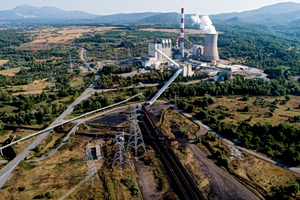
A cornerstone of PPC’s strategy is the development of a large-scale data center on the site of the former Agios Dimitrios lignite power plant, one of the largest such facilities in Greece. Preparatory studies are ongoing and the project is progressing through the permitting phase, positioning it as a flagship investment in the region’s post-coal era.
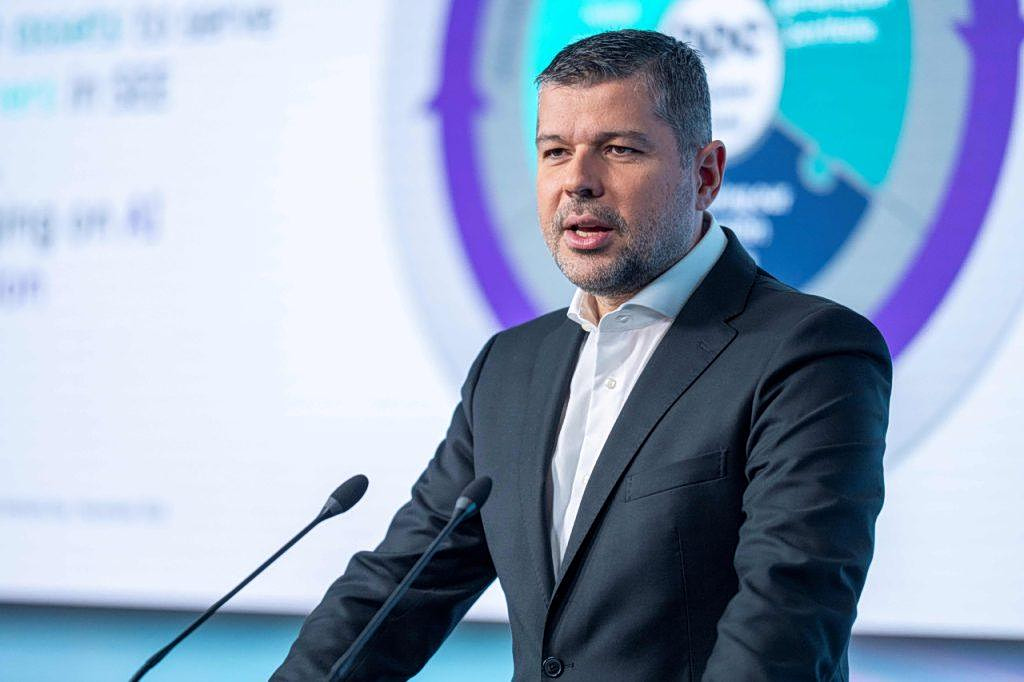
PPC Chairman and CEO Georgios Stassis highlighted the project while outlining the company’s broader strategy for energy transition and business transformation at the World Economic Forum Annual Meeting 2026 in Davos, Switzerland, during a closed-door session of the “Coal to Clean Energy” initiative.
Construction of the data center is expected to begin once agreements are finalized with hyperscalers (global technology companies that operate large-scale cloud and data infrastructure). With an initial capacity of 300 MW, the facility would rank among the largest data centers in Europe and is designed to anchor a wider technology ecosystem in Western Macedonia.
A key feature of the project is its “behind-the-meter” energy supply. Electricity will be provided directly from PPC’s own generation assets, ensuring that the data center’s significant power needs do not place additional strain on Greece’s national grid. The initial investment, estimated at approximately €2.3 billion, could be completed within two years of securing a hyperscaler commitment. The design also allows for future expansion to 1,000 MW, which would require an additional €5.4 billion in investment.
From Power Supplier to Energy and Digital Player
According to PPC’s leadership, the rationale behind these investments goes beyond replacing fossil fuels with renewables. Speaking in Davos, Stassis described the Western Macedonia plan as “a statement of transformation,” emphasizing that the company is turning the region’s coal legacy into a platform for innovation, competitiveness, employment and long-term regional growth.
This approach reflects a broader shift in PPC’s role. Traditionally focused on electricity generation and supply, the group is repositioning itself at the intersection of energy and the digital economy, where power generation, storage, networks and data infrastructure increasingly converge.
However, Stassis also stressed that capital availability alone will not determine the success of the transition. Speed and regulatory clarity, particularly in licensing and grid development, remain critical. While global investment capital is plentiful, he noted, it flows toward projects where execution risks are limited and timelines are clear.
Public Infrastructure and a “Just Transition”
PPC’s strategy is unfolding alongside public-sector planning for what Greece calls the “Just Development Transition” of lignite-dependent regions. At a recent meeting of the interministerial committee overseeing this effort, which was chaired by Deputy Prime Minister Kostis Hatzidakis, officials outlined key milestones for Western Macedonia’s energy infrastructure.
By the end of 2027, the Ptolemaida 5 power unit is expected to begin operating using natural gas, marking a transitional step away from coal. Its full development as a combined-cycle gas plant is projected to be completed by the end of 2029.
In parallel, a combined heat and power (CHP) plant is scheduled to enter operation by the end of this year, alongside the installation of dual-fuel boilers at the Kozani municipal water and sewage utility. These projects aim to secure affordable district heating for local residents, a critical issue in a region with long cold winters for Greek standards and a long reliance on lignite-based heat supply.
Storage, Hydrogen and Grid Stability
Innovation and energy storage form another pillar of PPC’s regional strategy, according to its CEO. Battery storage systems are planned across Western Macedonia, while two pumped hydro storage projects, which have been licensed at capacities of 304 MW and 240 MW, will repurpose former lignite mines at Kardia and the South Field. These facilities will store energy using gravitational water systems, providing large-scale flexibility for the power system.
Further diversifying the energy mix, the town of Amyntaio is set to host Greece’s first industrial-scale hydrogen production unit powered by renewable energy. Meanwhile, at the former Kardia lignite-fired power plant, old generators will be converted into modern synchronous condensers, supporting the stability of Greece’s ultra-high-voltage transmission system.
Together, these projects aim to transform former coal sites into a green and technologically advanced energy hub, aligning regional redevelopment with national and European climate goals.
Local Benefits and Social Impact
According to PPC’s transition strategy, these projects will also produce measurable benefits for local communities. In 2024, the company distributed €3.29 million in compensatory fees to residents and local authorities in Western Macedonia, derived from operating renewable energy plants in the area.
Of this amount, €1.32 million was credited directly to household electricity bills, while €1.98 million was allocated to local governments for environmental initiatives, local development projects and social support programs. The process for distributing compensatory fees for 2025 is expected to begin in the coming period.
Source: ot.gr