In times of global turbulence, a state’s true power is not measured in terms of geography or size alone. It is gauged by its ability to guarantee flows: of energy, goods, food, investment, and trust. In this, the overarching equation of the 21st century, shipping is far more than just another productive sector of the Greek economy. It is the vital infrastructure through which Greece translates its geography into strategic added value. For this reason, Greek shipping is not just an economic asset: it is national capital.
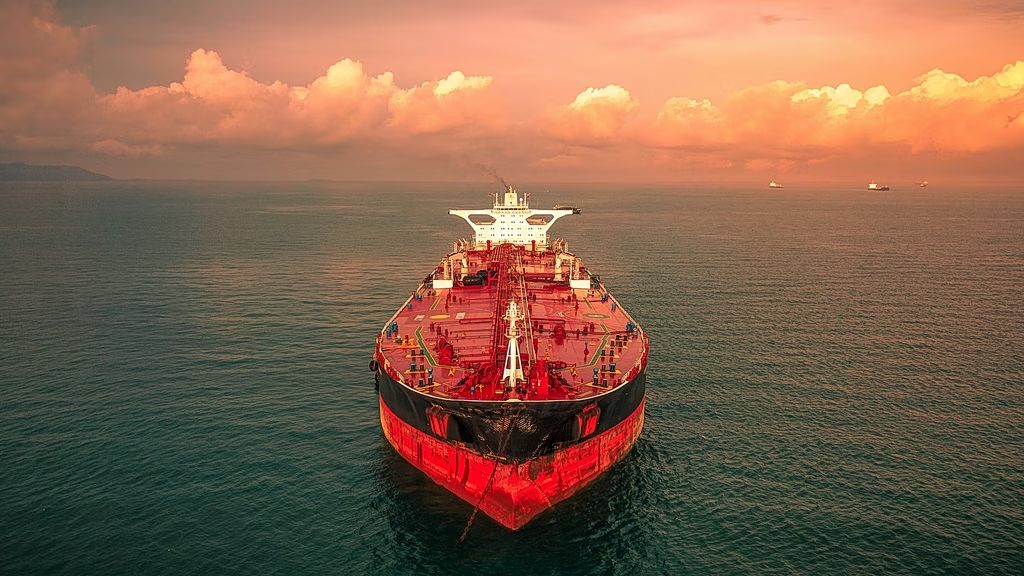
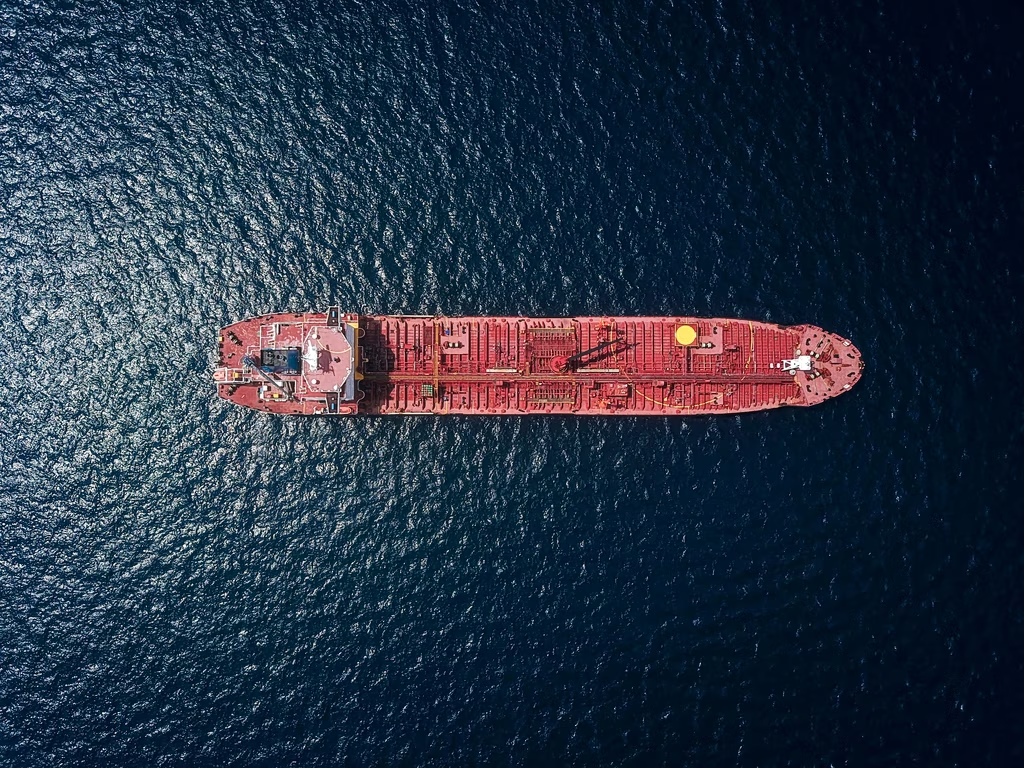
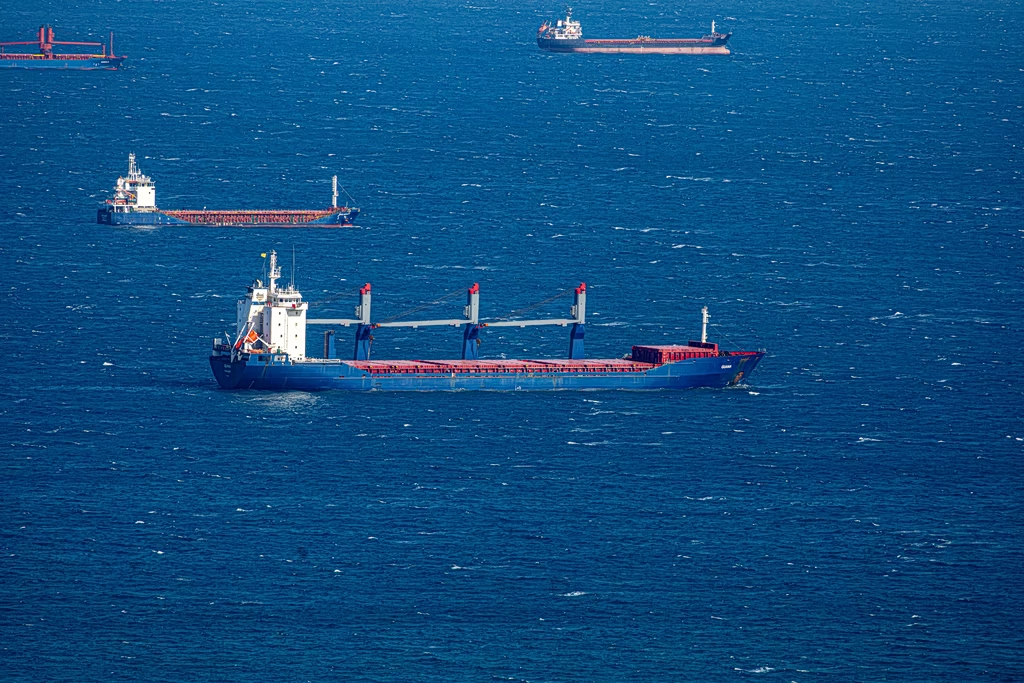
Greece remains the world’s pre-eminent maritime power in terms of owned tonnage. The Greek-owned merchant fleet boasts roughly 5,700 vessels which account for 20% of global and a staggering 61% of European capacity. Crucially, this is a fleet with a profoundly global footprint, as over 98% of its carrying capacity is deployed in cross-trading between third countries. This means Greece isn’t just reaping the rewards of a massive domestic industry; it plays an active, daily role in keeping the global economy ticking over, and in safeguarding the resilience of international supply chains.
On the domestic front, the industry’s contribution stretches far beyond what is typically captured in the public discourse. Its total economic footprint hovers between 7% and 8% of GDP, with foreign exchange inflows topping €150 billion over the past decade. The sector supports roughly 160,000 jobs, both directly and indirectly, and accounts for nearly 10% of the country’s total private-sector payroll. The impact doesn’t stop there, however, because shipping wealth is continuously being reinvested in energy, hospitality, real estate, media, and sports. This makes the shipping sector a low-key, yet formidable, growth multiplier across the entire Greek economy.
Still, the true significance of shipping today cannot be measured in macroeconomic indicators alone. Shipping has become the unseen geopolitical front line. In a world where the Red Sea and the Suez and Panama canals are increasingly becoming vulnerable chokepoints, freedom of navigation and the security of sea lanes have become of paramount importance for global stability.
As UNCTAD (the United Nations Conference on Trade and Development) notes, over 80% of global trade is seaborne, meaning any disruption at key maritime transit points sends shockwaves through costs, consumer prices, food security, and energy supplies. So, when we talk about Greek shipping, we are not just talking about ships; we are talking about a critical anchor of stability in an era defined by asymmetric threats and endless geopolitical realignments.
This reality becomes even clearer in the light of European strategic autonomy. Shipping handles 75% of the EU’s extra-union trade. Europe relies on imports for 95% of its oil and petroleum product needs, 90% of its natural gas needs, and 41% of its solid fossil fuel needs. Of these imports, ships transport 89% of the oil and petroleum products, 47% of the natural gas, and 93% of the solid fuels. In this European reality, Greek shipping is not merely a national success story; it is a fundamental pillar of European resilience.
This is precisely where a more modern, and perhaps innovative, interpretation of its role shines through: shipping is a form of economic diplomacy in motion. Every Greek vessel that connects markets, energy flows, and supply chains is acting, in practice, as an ambassador for the country’s credibility. Greece possesses the rare capability to simultaneously serve as a maritime power, an energy gateway, an investment destination, and a pillar of stability in the Eastern Mediterranean. The challenge for the period ahead will lie in linking these four roles more organically, ensuring that shipping is no longer viewed as an isolated ecosystem, but rather as the very core of the nation’s international presence.
At the same time, shipping is at the forefront of the green transition. In 2025, the IMO (International Maritime Organization) adopted the Net-Zero Framework, the first global system in which binding emission limits have been combined with an economic carbon pricing mechanism for an entire industry. The Framework is now slated for implementation, starting in 2027 for large ocean-going vessels. This transition will be neither simple nor free of cost–it is, however, necessary. And Greece has every reason to play a leading role in it, and proactively rather than defensively. This is because the Greek-owned fleet is already the world’s largest in terms of vessels capable of running on alternative fuels, boasts the largest scrubber-fitted fleet globally, and invests systematically in more modern, efficient, and technologically advanced ships.
So, it is worth recalling something at this point that is often overlooked: shipping isn’t just part of the climate crisis problem; it is also part of the solution. According to data released three years ago by the Union of Greek Shipowners, international shipping accounted for a mere 1.4% of global emissions, while remaining by far the most energy-efficient mode of transport. The real challenge, therefore, is not to weaken shipping, but to accelerate its transition with realism, international coordination, and technological innovation.
The Posidonia International Shipping Exhibition serves as a timely reminder of precisely this: shipping is not merely a Greek tradition being carried forward; it is a national asset and capability that has always to be kept cutting-edge. In an era in which the seas are once again becoming an arena of competition, security, energy, and technology, Greece has a duty to view its shipping industry not just as a source of wealth, but as a pillar of strategic self-confidence. Because, for our country, shipping carries far more than mere cargo—it is the flagship of our national prestige, credibility, influence, and future.
Mr. Harry Theoharis is the Deputy Minister of Foreign Affairs for Economic Diplomacy and Openness.”