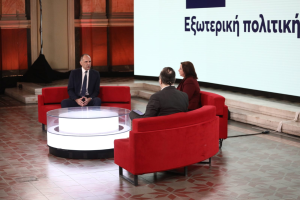
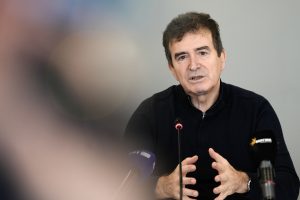
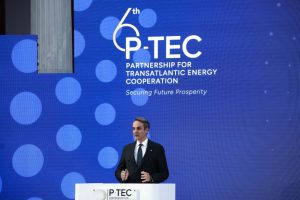
The Energy Summit at Zappeion turned out to be an important event—there’s no doubt about that.
Important in every respect. Not only for the deals with energy giants that preceded it and which are sure to follow. Nor simply because of the number of international participants and their outstanding quality. Three members of the American Cabinet don’t quit their home comforts to visit Greece in winter, if there isn’t a good reason to do so.
But mainly because our country is carving out a distinct niche for itself in the new geopolitical equilibria that are emerging. A role as an energy hub. And that’s a result of a plan we have pursued as a nation.
Yet Greek society has been left shaken at one and the same time by shocking tales of family feuds and truces, bombs and the bloody settling of accounts that turn the clock back a few centuries.
How can our dynamic 21st-century energy diplomacy sit alongside such repulsive and socially anachronistic savagery?
Well, the answer to that is crystal clear. It can’t.
At some point, the future is going to have to get the upper hand. Otherwise, the past is sure to keep “pulling at out sleeve” as Savvopoulos sang.
And I don’t believe that pushing back the past is a matter of statements, or of good intentions—which I don’t doubt for a moment. It is a matter of will, pure and simple.
The will of the coordinated, organized state to change century and confront the lawlessness, just as Europe’s democracies have on Corsica and Sicily, in Calabria and elsewhere.
And when we say ‘coordinated state’, we don’t just mean the government, which actually has the least to do. Because there are also the security authorities and the judiciary, local government and the Church. Without excluding the local communities themselves, of course.
We can’t simply shrug and concede defeat while others stand up to evil. We can’t whistle, as if nothing is happening.
I hear a lot of talk about “political costs”. Tripe. No government has ever paid at the ballot box for cracking down on crime.
And a load more about “localism”. Which is just more nonsense. Do they mean to say other European countries don’t produce MPs or regional governors or political leaders? How come they can do their job, even when it means coming down hard on people from their home towns or islands?
So the question is whether the state, and all of us in its immediate vicinity, realize the full importance and urgency of the issue, and prioritize it accordingly.
If you want to become an international energy hub, if you want to claim a distinct niche for yourself on the new geopolitical map, you cannot welcome the future with Kalashnikovs and clans on Crete.
Above all, you can’t tolerate “a past that will not pass”.