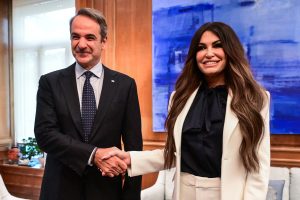
The first days of Kimberly Gilfoyle in Athens did not resemble a diplomat arriving to take up a new post. They more closely resembled an influencer or travel blogger, one of those videos that start with “Hello Greece!” and end with smiles, smartphones, and a nice frame of the Acropolis.
Her first post in Greek, together with her son, was a signal: the new U.S. ambassador did not come to stay behind the heavy desks of the embassy. She came to be visible, outgoing, and highly communicative.
This is not necessarily something we should find strange. It is a new approach, certainly different from what we are used to, but Donald Trump has his own logic—and above all, his own agenda—in everything, including the representation of the American brand in Greece. And once again, the traditional route was not chosen. Clearly, the transition from George Tsounis to Kimberly Gilfoyle is somewhat like Paros to Naxos, with the new ambassador more reminiscent of the hype-filled Paros and less of the gastronomic, family-oriented Naxos.
Gilfoyle is not a classic diplomat with briefcases and somber suits. She prefers high heels and striking dresses. She is a product of the television stage, political communication, and public relations. An ambassador who wants to work both in substance and in image. She knows the image very well. The substance is apparent, and they say she handles it with confidence.
Judging by her first statements regarding Greece’s energy role, her references to Piraeus, and the ambitious period she promises for Greek-American relations, those who say she is not just here for selfies—but also for deals—are probably right.
The truth is that we are living in times of substance in diplomatic relations. The 5×5 played out in the Mediterranean, Greek-Turkish relations, and the new energy maps being redesigned: all are in a phase of redefinition.
The danger? That Greece becomes a follower of developments, swept along by influencer marketing, which has also invaded political news. We are not an equal interlocutor of the U.S.—that is certain. But that does not mean we must play only by their rules. If politics is the art of the feasible, diplomacy is the management of the impossible. And we are called to manage balances that a few decades ago would have seemed unthinkable.
Gilfoyle’s entry onto the Greek stage somewhat recalls Kate Wheeler in The Diplomat. With one major difference: the director. Because when the director is named Donald Trump, you never know what will happen in the next episode.