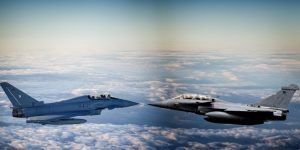
The final word belonged to the Germans – more precisely, to the government of Friedrich Merz. According to a recent report from the well-informed German weekly Der Spiegel, the German government has given the green light for the sale of 40 Eurofighter Typhoon jets to Turkey.
The high-tech aircraft is produced by a European consortium, whose members must unanimously approve any export deal. Spain, Italy, and the United Kingdom had already endorsed the transaction with President Recep Tayyip Erdoğan. Now that Germany has joined them, the move signals a notable shift in Berlin’s policy toward Ankara.
Weapons exports often serve as a telling barometer of diplomatic relations – and the German-Turkish relationship has experienced considerable ups and downs in recent years. After Turkey’s 2016 military incursion into Syria, Berlin significantly scaled back its defense exports to the country.
Yet those restrictions have steadily eroded. By the end of last year, German arms deliveries to Turkey reached €231 million – their highest level in two decades.
A clear turning point emerged in early May with the swearing-in of Germany’s new government. In the coalition agreement between the Christian Democrats (CDU/CSU) and the Social Democrats (SPD) – which outlines the administration’s strategic orientation for the next four years – Turkey is described as “an important strategic NATO partner, an EU neighbor, and a key actor in the Middle East.”
The document states that Germany seeks to cooperate with Ankara on “shared geopolitical challenges, from security policy to migration.”
Chancellor Friedrich Merz underscored this message during his inaugural visit to NATO headquarters, pledging to do “everything possible” to deepen the partnership with Turkey.
Concerns over Turkey’s declining democratic standards or its turn toward authoritarianism appear to hold little weight in Merz’s geopolitical calculus. Expressions of solidarity with jailed Istanbul mayor Ekrem İmamoğlu and other critics of Erdoğan – voiced by members of the governing SPD – are largely symbolic and carry minimal foreign policy consequence.
The Eurofighter deal, estimated by experts to exceed €5 billion in value, has been on Ankara’s agenda since 2023. The aim: to modernize its aging air force. Up to now, the lack of German export approval had blocked the deal. Diplomatic sources in both Athens and Berlin suggest that Greek concerns over a shift in the regional military balance were one reason for the delay.
German diplomats have been quick to emphasize that the recent rapprochement between Greek Prime Minister Kyriakos Mitsotakis and President Erdoğan helped ease the decision-making process.
According to Der Spiegel, Turkey reportedly pledged during negotiations that the jets would be used strictly within the framework of NATO alliance commitments. In plain terms: the Eurofighters would not be deployed against another NATO member – namely, Greece.
An official confirmation from the Greek government of this report would be too much to expect.
However, if Erdoğan has indeed provided a written assurance that the Eurofighters will never be used against Greece, it would represent a considerable success – not only for German, but also for Greek diplomacy.
Dr. Ronald Meinardus is a senior research fellow at the Hellenic Foundation for European and Foreign Policy (ELIAMEP).