Much has been said these days about “historic agreements.” And indeed, what the governments of Greece and the United States concluded late last week goes beyond diplomatic routine. It marks what can be described as a dramatic upgrading of bilateral relations – one whose impact will be felt well beyond Greece’s borders. The field in question is energy – or, more precisely, fossil fuels – which, thanks largely to the United States, are experiencing an unexpected revival.
In interviews with policymakers, the phrase “win-win situation” has been repeated like a mantra – a reference to deals said to benefit both sides. There is no doubt that the American energy giants, now secured by long-term contracts, count among the immediate winners. Whether Greece – and the Eastern European countries connected to its energy network, which will be paying dearly for liquefied gas shipped across the Atlantic for years to come – will share in that victory is another matter. At this moment of self-congratulatory triumph, few seem inclined to ask the question.
What we are witnessing also carries historic weight for another reason. The comparatively small nation of Greece, blessed with a favorable geostrategic position and a government willing to capitalize on it, is poised to become the first member state of the European Union to fully embrace and implement the American president’s energy doctrine: “Drill, baby, drill.” Despite public reassurances to the contrary, it is increasingly clear that climate change – and the effort to combat it – no longer ranks among political priorities.
There is a certain irony in the timing. As the Greek government met in Athens with three visiting U.S. cabinet secretaries – a level of representation that alone deserves a footnote in the annals of Greek diplomacy – world leaders were gathering in Brazil’s Amazon region for the opening of the COP30 climate summit. There, U.N. Secretary-General António Guterres delivered an emotional appeal to halt exploration and drilling for fossil fuels – coal, oil, or gas alike.
“America is back — and drilling in the Ionian Sea,” as the newly arrived U.S. ambassador, who came to Athens with a detailed plan in hand, succinctly put it. For Washington, this is about the big picture – and Greece appears to fit neatly into it. According to official statements, the goal is to replace oil and gas imports from Russia. That sounds like a noble cause, intended to deprive Moscow of the revenues fueling its war against Ukraine. On this point, Washington and Brussels are united: by 2027, no Russian liquefied natural gas (LNG) should flow into Europe.
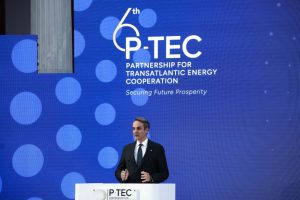
Greek Prime Minister Kyriakos Mitsotakis was right to urge that Putin’s oil and gas must not reenter Europe through the back door – namely, via well-connected Turkey. To prove that he means business about cutting off Russian supplies, Mitsotakis could now move against the shadowy operations of the so-called Russian “dark fleet,” whose tankers, often Greek-owned, continue to profit from these clandestine trades.
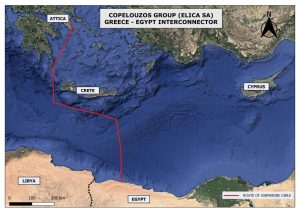
In Greece, the new energy alignment with the United States is being celebrated as a strategic victory in the country’s ongoing maritime rivalry with Turkey. The fact that the two largest American oil companies are investing south of Crete to extract natural resources is more than symbolic. The contracts with Chevron and ExxonMobil serve as a political bulwark against Turkish – and Libyan – territorial claims and could, in the best-case scenario, spell the end of the illegal Turkish Libyan maritime memorandum of 2019.
Athens and Washington have also revived the “3+1” diplomatic framework – Greece, Cyprus, Israel, plus the United States – giving America’s broader Eastern Mediterranean strategy new momentum. From a Greek perspective, that seems like good news. Yet one must not overlook the player conspicuously absent from these arrangements: Turkey. It is hard to imagine President Recep Tayyip Erdogan, who aspires to regional dominance, remaining silent. Ankara is certain to act to avoid being sidelined in the Eastern Mediterranean.
How the man who currently seems to hold all the strings – Donald Trump – intends to keep Turkey either calm or engaged remains unclear. One can only hope that he will find a solution to this problem – the very heart of the problem – so that in the end, there really will be a “win-win situation.”
Dr. Ronald Meinardus is a Senior Research Fellow at the Hellenic Foundation for European and Foreign Policy (ELIAMEP).