Greenland is in fashion among strategists, and for predictable reasons. The Arctic is warming. Sea lanes flirt with viability. Minerals sparkle in briefing slides. Rivals show interest. It’s tempting to turn the world’s largest island into a simple story where territory equals power. That story is indeed comfortable. It is also incomplete.
Greenland matters because modern power runs on sensors, links, timing, and the ability to keep those alive under pressure. The island sits at a strategic junction where missile-warning geometry, satellite command infrastructure, North Atlantic access, and fragile connectivity converge. If you want to understand Greenland, stop thinking like a cartographer and start thinking like an engineer.
Begin with geometry. The shortest routes between Eurasia and North America cross the pole. That shapes air routes, missile trajectories, and early-warning timelines. In an era of compressed decision cycles, minutes are strategic currency. Greenland buys time. Time buys options. Options buy deterrence.
Pituffik Space Base in northwest Greenland embodies this. It is easy to describe it as remote. After all, ’remote’ is what people say when they don’t want to pay attention. Strategically, Pituffik is close to the polar routes that define warning and response. It hosts the Upgraded Early Warning Radar, a phased-array system used for ballistic missile warning and space surveillance. It has been modernized repeatedly over the years because its mission is operational. That is the familiar layer: homeland defense and warning.
The less discussed layer explains why Greenland is becoming the meeting point of geopolitics and what might be called astropolitics. Pituffik also hosts a Satellite Control Network remote tracking station operated by the U.S. Space Force. Its job isn’t to admire space. It’s to run it. To provide telemetry, tracking, and commanding power for U.S. and allied government satellite programs.
Space power does not live only in orbit. It’s an instrument of state power, and ground nodes are the connective tissue. High latitudes amplify the value of these nodes. Polar and near-polar orbits pass over the Arctic repeatedly. This increases the operational significance of Arctic ground infrastructure, especially as space becomes more contested, more congested, and more central to military and economic performance. Modern war and modern governance increasingly rely on satellites for communications, navigation and timing, weather, intelligence, and targeting support. Those functions are only as resilient as the networks that sustain them.
Now, missile defense is an architecture problem. Meaning integrated sensing and tracking across domains, with space-based layers increasingly emphasized for advanced threats that stress legacy sensors. Greenland sits inside that architecture. When tracking and warning depend on layered sensing and fast decision chains, forward nodes in the Arctic matter more.
Greenland’s gravity also pulls horizontally across the North Atlantic. The GIUK gap (Greenland, Iceland, the United Kingdom) remains a strategic corridor between the Arctic and the Atlantic. The modern contest in that corridor is shaped by persistent awareness and resilience (surveillance systems, autonomous platforms, undersea activity, and the ability to keep communications and logistics functioning).
Here, the seabed is the system. Greenland’s external connectivity runs through a small number of submarine cable systems. In temperate waters, cable faults are disruptive. In Arctic waters, they can become prolonged exposure. Repairs depend on ice, weather, and narrow operating windows. The same environment that gives Greenland strategic value imposes a maintenance penalty that turns routine failures into national resilience events. Connectivity underpins government services, emergency response, business continuity, and the credibility of any crisis posture. In the Arctic, repair time is not technical. It is political time. It shapes confidence. It shapes decision-making. It shapes the room for maneuver in a tense moment.
Economically, Greenland’s mineral potential is real, but the “resource rush” narrative is often a projection. Mining in Greenland is a financing and infrastructure problem before it is a geology one. Capital expenditures are large. Logistics are punishing. Permitting takes time. Power supply is constrained. Downstream processing bottlenecks sit between ore and strategic value. Minerals do not become leverage because someone points at a map. They require a chain of finance, infrastructure, extraction, processing, shipping, and social license.
Meanwhile, in the present-day economy, fisheries dominate Greenland’s exports by an overwhelming margin. That fact shapes fiscal stability, public expectations, and political bargaining power more than any speculative deposit. To understand Greenland’s strategic posture, one should look at what sustains it today.
Shipping also demands discipline. Arctic routes indeed reduce distance and time in certain comparisons. That is meaningful, not decisive on its own. Global trade runs on reliability; insurance, ice-class costs, port infrastructure, search-and-rescue reach, and schedule integrity. Arctic routes, while growing for certain bulk flows, are unlikely to replace established corridors for container trade without a step-change in predictability and supporting infrastructure. Greenland’s role in this story is not to become a northern Singapore, but a governance and resilience actor.
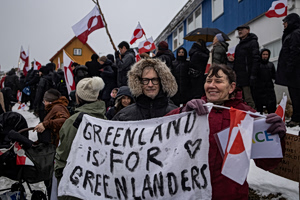
All of this leads to the point of access, which depends on legitimacy. Greenland is self-governing within the Kingdom of Denmark, with a political trajectory rooted in self-determination and an insistence on agency in security decisions. The Cold War left political residue as well, including forced relocations around the Pituffik area that still shape trust. In a region where access is more valuable than symbolism, legitimacy functions like infrastructure. It is silent when it holds, but decisive when it breaks.
A serious strategy should not be complicated: Respect your partner, since access without consent is a lease that expires. Greenland’s relevance is rising because power is increasingly a contest of networks and time. It turns the island into a junction. Treat it like one, or watch a crisis teach the lesson for you.