For much of the EU’s history, power has flowed northward. The new Migration and Asylum Pact, which is set to come into effect in less than a year from now, will not only change how the EU manages its borders. It will redefine the Union’s political power balance and shift it to the South.
As 2025 draws to a close, Southern Europe is emerging as the decisive force within the EU. The region now combines economic weight with political leverage. Spain’s economy grew faster than any of its euro-zone peers in the second quarter surpassing initial forecasts, while at the same time it is the leading force for Social Democrats in the Council and the European Parliament. In Italy, Prime Minister Giorgia Meloni’s government announced in August that the country’s GDP per capita had surpassed that of the United Kingdom for the first time in over two decades, a symbolic sign of recovery and renewed confidence in the Italian economy. Concurrently, Meloni has been assuming an increasingly prominent political role, strengthening Italy’s influence within the EU and serving as a key link between Brussels and President Trump. In Greece, Prime Minister Mitsotakis maintains a leading role within the center-right European People’s Party (EPP) and the country has become one of the Union’s most dynamic post-crisis performers. The IMF projects 2 percent growth for both 2025 and 2026, above the eurozone average, while unemployment continues to decline. Together with Portugal, Cyprus, and Malta, the Mediterranean countries represent nearly one-third of the EU’s population and more than a quarter of its GDP. But their collective leverage lies not only in markets but in geography, as they form the Union’s external frontier.
That geography, gains new strategic weight under the Migration and Asylum Pact. The new framework establishes a mandatory solidarity system requiring all EU members to share responsibility either by hosting relocated asylum seekers, contributing €20,000 per person they decline to take in, or providing operational assistance to countries under migratory pressure. The Pact provides a fixed mechanism of bargaining power turning the southern border from a pressure point into a position of power as Europe’s migration system depends on the cooperation and capacity of its Mediterranean members to function effectively.
Greece should strategically capitalize on this shift, as the growing interdependence gives Athens new leverage in Brussels that extends well beyond migration policy. In Council negotiations, it can link its cooperation to areas of strategic national priority such as defence financing and investments in Eastern Mediterranean energy corridors.
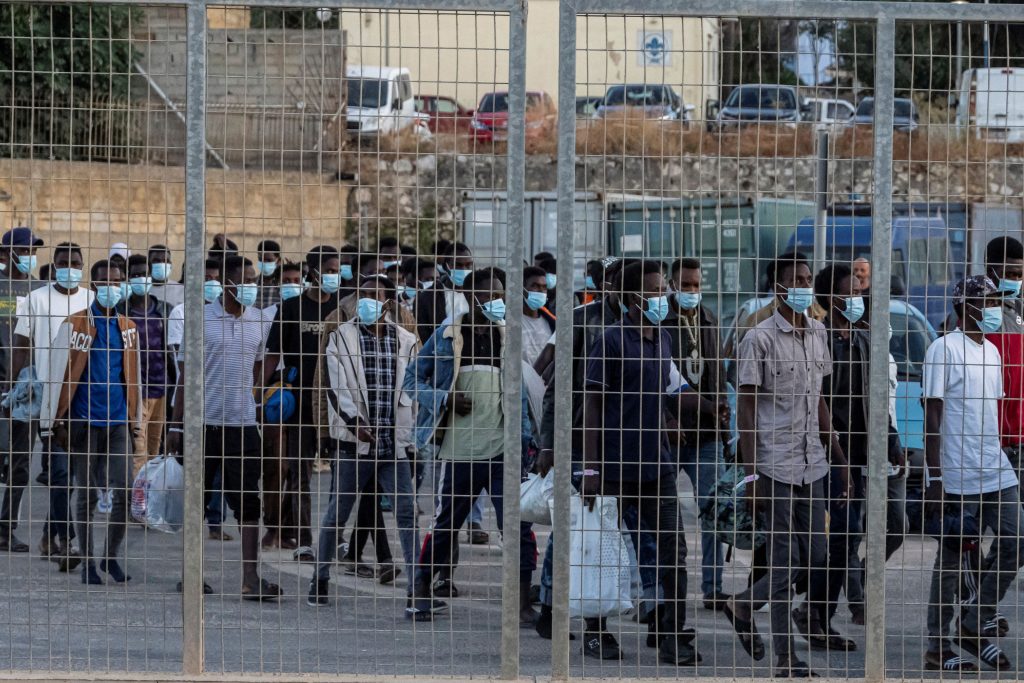
A group of newly-arrived migrants walk in the port of Souda, on their way to be transferred to mainland Greece by ferry, in Souda, on the island of Crete, Greece, July 11, 2025. REUTERS/Nicolas Economou
With migration still largely managed at the national level, Greece brings more operational experience than almost any other EU member. In European politics, tempo is influence: steady, lawful performance builds trust, and the ability to calibrate that tempo responsibly is a subtle but powerful tool in negotiations. Handled with foresight, this moment could move Greece from policy recipient to policy broker. By tying migration implementation to broader strategic goals, Athens can convert administrative competence into political capital and position itself as the guardian of an effective and enforceable European migration system.
The reality is that nobody knows exactly how the Pact will actually work in practice. And this is why leadership is needed. The Commission can partially provide that. But Greece is better positioned. Greece should position itself as a bridge not only between north and south but between the member states and the Commission, and given the nature of migration also between the Hellenic Parliament and other national Parliaments, but also between national Parliaments. To achieve this effectively, it is not only the role of the Greek government which will be facing elections in 2027, but of Greek bureaucrats, diplomats, lawyers, academics, and researchers involved in migration policy to demonstrate competence, retain trust, but also to the set the agenda. This unique opportunity is also timely as Greece is preparing for its national elections but also the upcoming 2027 EU Council Presidency at a critical time where leadership and effective coalition building on contentious files will be key. One should remember that on the same year, France will be having its Presidential election, which could radically transform European politics. One should not forget that in 2027 France will be heading to the polls for Presidential elections, which may be historically consequential.
By acting early, building bridges, and using its position strategically, Greece can ensure that the Aegean no longer marks Europe’s periphery, but instead defines the point where European power begins. Greece should present itself as a leader, be trust-worthy, deeply experienced, realistic, and as a fair broker that understands other member state needs but also what their limitations are.
Migration should no longer be Greece’s challenge to manage, but could be its opportunity to lead.
Yiannis Korkovelos is a graduate student at Harvard, teaching fellow for migration in Europe at the Kennedy School, and Chair of the European and Greek Caucuses at the Kennedy School.
This opinion piece is part of To BHMA International Edition’s NextGen Corner, a platform for fresh voices on the defining issues of our time.