
 Μake us preferred on Google
 When Elon Musk posted that Greece has one of the lowest birth rates in the world and that 700 schools have shut down as a result, it showed just how bad things have got. The country’s decades-long demographic crisis has captured negative international attention and is even on the radar of the richest man in the world.
A long-term problem: there was no postwar baby boom in Greece
Without births, a country’s population halves every 44 years. To replace itself, women need to have approximately 2.1 children each. When a country’s Total Fertility Rate is consistently below this level, its population will eventually decline, unless offset by immigration.
Unfortunately, Greece has been below that threshold for decades now. Indeed, the fertility rate has been below 1.5 children per woman since 1987. And since 2011, the natural balance has been reversed: deaths have outnumbered births. In fact, the problem does back even further. While most of postwar Europe experienced a baby boom, Greece never did.
Greece’s political class made its first, timid effort to address the issue over 30 years ago, in 1992, when a parliamentary committee was established to examine its parameters. It resulted in some financial support and allowances for families, but nothing more.
In the ensuing decades, too, ineffective stopgap measures have remained the norm. Indeed, extraordinarily few effective measures have been taken to remedy the situation in a country with a population of just 10 million.
“Demographic projections for 2050 show that we will be at 10 million in an optimistic scenario, 8.3 million in a pessimistic, and 8.5 million with an intermediate scenario,” Fay Makantasi, the research director at the diaNEOsis Independent Research Organization, told To Vima International Edition.
A nexus of policies: Focus on childcare, support for women
Of course, there is another way to add people to the population: by raising the birth rate. However, given the number of factors that have stopped people having large families, or any children at all, over the last half century, that isn’t going to be easy.
Moreover, as modern trends in family policy show, financial incentives have only a marginal impact in terms of boosting the birth rate.
“To see a rise in births, what’s needed is a whole set of policies. These must harmonize family life with professional life. You must create a positive environment for motherhood, thereby facilitating women’s entry into the labor market. Greece ranks second to last in the EU in terms of women’s participation in the labor market.” Makantasi underlines.
Substantial plan to support women and improve preschool education
“Women and families in general must be supported. You need quality preschool education. But in the Greek system, this is the most neglected stage of all,” the diaNEOsis director underlines.
The research institute undertook an initiative to create a unified preschool curriculum for Greece, under the auspices of the Ministry of Education. The team was led by Professor Costas Meghir (Yale) and Professor Sally Grantham-McGregor (Professor Emerita, University College, London, who has overseen curricula in 15 countries).
There was no unified curriculum in Greece. Children in the upscale Athens suburb of Kifissia, for example, were doing completely different things from children in working-class Drapetsona, near Piraeus.
The resulting program, published in 2021 under the title “Kypseli” [beehive], included a detailed set of proposals. However, it has been partially implemented at best.
Building up preschool education critical
Right now, Greece has far too few preschool units—only 3,000 or so. Additionally, there are quite a few vouchers available under an EU co-funded subsidy program aimed at supporting working parents and promoting early childhood care, allowing parents to place their child in private preschool education (0–4 years old).

“In general, we have a long way to go before we have high-quality preschool education, rather than places where children can be dropped off for the morning.” But it is crucial they offer more than childcare: due to the neuroplasticity of the brain, all the skills we later seek in adults in the labor market are developed at this age,” Makantasi says.
“That’s why I said it’s a nexus of policies. This has been scientifically proven. When such structures exist, and women’s participation in the labor market is facilitated, they can reconcile their professional and family lives.”
Migration policy: balancing needs and politics
Given the population projections and the long-term nature of policies intended to combat the low birth rate, migration is an obvious way to keep the working population at the levels required for a functioning welfare state.
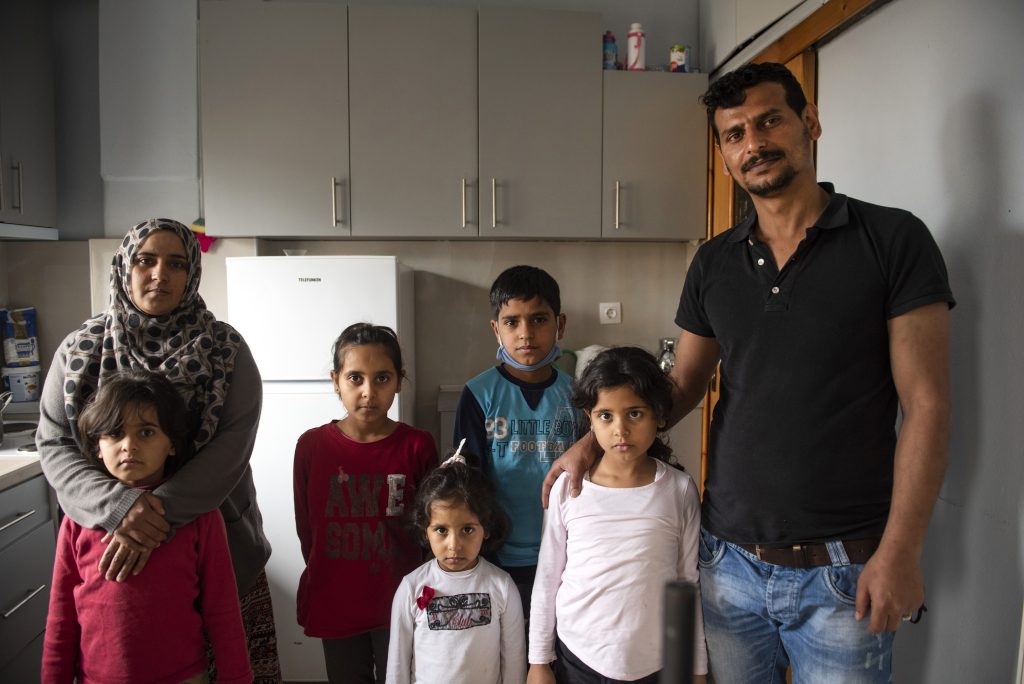
Abdul Salam Al Khawien, 37, right, and his wife Kariman, 32, left, pose with their children for a family photo, at their apartment in the northern city of Thessaloniki, Greece, Saturday, May 1, 2021. Sundered in the deadly chaos of an air raid, a Syrian family of seven has been reunited, against the odds, three years later at a refugee shelter in Greece’s second city of Thessaloniki. (AP Photo/Giannis Papanikos)
“That means that we will need to have added 750,000 people to the population by 2050—that’s some 30,000 migrants every year from 2025 to 2050. These must be skilled migrants. We must identify who can integrate best into Greek society.”
The current conservative New Democracy government has played the undocumented migrants’ card to the max, taking a series of measures to create a fortress Greece, which is a popular policy—particularly with its right-wing base.
In July, it took the extraordinary measure of denying undocumented migrants arriving on the island of Crete from Libya their right under international law to submit asylum applications.
The European Court of Human Rights (ECHR) temporarily blocked Greece from deporting the migrants in question.
Yet, the government acknowledges that the agricultural, construction, and tourism sectors are all facing a serious labor shortage. And is prepared to vet 200,000 new migrants qualified to meet the needs of each sector.
These sectors are reportedly asking the government to attract workers from abroad, despite the fact that there are currently about 290,000 pending applications for residence permits submitted by migrants currently in Greece.
At the Thessaloniki International Fair (TIF) in early September, Prime Minister Kyriakos Mitsotakis announced a bill which aims to cover labor market needs in a variety of sectors.
“I am not against legal immigration. I support organized, legal immigration, so that we ourselves determine who comes to our country and on what terms,” the PM said.
But for his part, Migration Minister Thanos Plevris, the staunchest anti-migration figure on the right wing of the ruling conservative New Democracy party (along with his predecessor, Makis Voridis), actually declared that the admission of tens of thousands of new migrants is in no way intended to address the demographic crisis.
A rapidly-aging population
The flip side of the current low birth rate, and curbs on immigration, is an aging population.
Today, one in five residents in Greece is over 65. By 2050, one in three will be over 65. So, when faced with an aging population whose life expectancy has increased, targeted policies are required.
“You need long-term senior citizens’ care structures. More and more people will grow old without having children. Who will care for them? Now it’s usually the children who care for their parents. In the future, that won’t be the case. You’ll need more workers to look after the elderly,” Makantasi concludes.