When German President Frank-Walter Steinmeier uttered the phrase “great power competition” at the 2020 Munich Security Conference, the words arrived wrapped in cautious quotation marks—as if to keep them at arm’s length. The discomfort was palpable, almost audible. For postwar Germany, steeped in pacifism and multilateral virtue, the vocabulary of raw geopolitical rivalry still sounds indecent, even vaguely un-German. But as Dominik Wullers noted in “War on the Rocks” that same year, the language is no longer theoretical. It is seeping into strategy papers, shaping diplomatic instincts, and—most strikingly—becoming a lived reality.
Since then, the Republic of Artsakh is no more. Russia invaded Ukraine. Europe rearmed. NATO grew teeth and new members. The Middle East lit up again, from Gaza to Tehran. American drones returned to the Red Sea. Syria collapsed, again. Sudan followed. Ethiopia never stopped burning. Military juntas took the Sahel. And somewhere along the way, BRICS started making plans to sidestep the dollar. The old world didn’t just shift. It cracked.
This isn’t theory. It’s the operating environment.
The rules that held the postwar order together, those unspoken understandings, have unraveled. Trust is out. Leverage is in. Power is visible again, unapologetically so. Quotation marks are no longer required. You can call it a new era. Or just call it what it is: Realpolitik, back in style. Think of it as geopolitics’ own L.A. Confidential: sunshine up front, shakedowns in the back rooms, everyone smiling for the cameras while trading leverage in the dark.
By 2019, it was obvious: the liberal international order was running on fumes. The foundation was shifting. No amount of summits or statements could hold it together. The truth? It was never built to last. Its contradictions were baked in from the beginning.
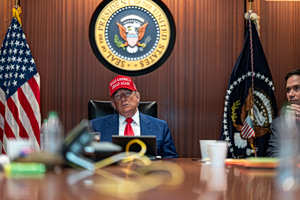
The fall of that order rattled (still does) the very people who designed it. Who profited most from it. The west clings to the idea that it kept the peace, spread prosperity, civilized the chaos. And when it started to collapse, many of them blamed Donald Trump. Sure, Trump mocked the system, campaigned against it, and governs like he means it too. But pointing the finger at him misses the point. He didn’t kill the order. He just said what everyone else was pretending not to see. The cracks were already there. Trump just walked through them.
There was no coup. No collapse. Just a slow, steady erosion of trust, of power, of narrative. The post-Cold War dream—that open markets, open societies, and American muscle would keep the world spinning—was a fantasy wrapped in strategy paper. And like all fantasies, it sold well. Until it didn’t.
What killed it? Start with the basics: the order tried to go everywhere, reshape everything. The U.S. didn’t just lead it, it tried to universalize it. Export democracy. Expand markets. Dismantle borders. All while assuming the rest of the world would fall in line. But people don’t like being told who to be. Especially by the powerful.
Nationalism didn’t disappear. It waited. Then it answered back—loudly, in Baghdad, in Kabul, in Donetsk, in Ankara, in Beijing. The very force the liberal order tried to suppress came roaring back as the dominant language of global politics.
The Iraq War was a warning. The financial crash of 2008 was another. The rise of China wasn’t just economic, it was ideological. Russia’s resurgence wasn’t about communism; it was about power, territory, and revenge. Western elites called it “revisionism.” Others called it gravity.
Globalization fed growth. It also fed inequality, resentment, and crisis. The working classes in liberal states got hollowed out. Borders blurred. Identity cracked. The liberal project overreached abroad and lost confidence at home. And in that vacuum, something old returned:
Realpolitik.
No slogans. No illusions. Just interests. Managed risk. Cold calculus. That’s what’s sexy now. Not institutions, not integration, but leverage. Pressure. Deals. You don’t have to like it. You just have to live in it. It feels, increasingly, like a sun-drenched Los Angeles noir, where everything gleams and nothing’s clean. Where civility is a costume, power trades hands behind tinted glass, and the truth (if it surfaces) comes bloodied. A world of ambition dressed as order, of diplomacy spoken through gritted teeth. The setting hasn’t changed. Just the scale. And the cameras never cut.
That’s the order rising now; thicker borders, harder states, spheres of influence. A realist world of bounded blocs and cold cooperation, where rules are tools, not principles. America has one. China is building its own. Europe is deciding whether it still matters.
The liberal order didn’t fail because of Trump. He was just the first to say it out loud. The system was built for a unipolar world. That world is gone.
The new one doesn’t wear quotation marks. It doesn’t apologize. And it doesn’t wait for permission.