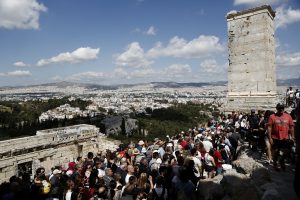
In classical Athens, the ancient spirit of beauty exhausted itself in the public sphere. For public buildings to be imposing, they had to be grand—and their grandeur was meant to reflect the wealth and power of the city.
Private homes, by contrast, showed no such ambition. They were not built to impress, nor even to please the eye. They obeyed the modest rules of makeshift construction; Athenians did not practice aesthetic exercises in their bedrooms or their sitting rooms. Beauty, in those days, existed out there—in the temples, the baths, the statues. In every space where citizens gathered and shared life.
That sense of proportion, and the conviction that both the wealth of the state and the very texture of daily life were bound up with public space, would later become a cornerstone of Western civilisation. In 19th-century Paris, Baron Haussmann, the king’s urban planner, levelled the city’s medieval quarters—its own kind of Parisian favelas—to create an urban landscape of straight boulevards, open squares, parks and uniform façades. Grand, of course. In the French vision of la grandeur de la France, this was to be “the most beautiful city in the world.” Or perhaps simply the Paris we know today—and yes, it is beautiful.
Across the Atlantic, from courthouses to universities, Anglo-Saxon settlers adopted the columns and colonnades of ancient Greece as symbols of civic dignity and authority. Even as modern architecture later found its own paths to beauty, the old rule held fast: respect for the public realm—its form, its use, its care—was unconditional.
Even totalitarian kitsch paid homage to it. At Rome’s Olympic Stadium, a Roman-style obelisk still stands, inscribed with Mussolini’s name. Around it, a park of gleaming white marble statues—oversized athletes, each representing an Olympic discipline—remains untouched. The fascist obelisk, the archer, the javelin thrower—all unvandalised. The tifosi release their adrenaline elsewhere. Their fanaticism finds another home, not here.
It is doubtful that modern Greek spirit will ever achieve the same immortality as its ancestral one. Yet it remains stubbornly alive. Contemporary Greek life still refuses to connect itself to the public sphere. Not only does it decline to respect or care for it—it appropriates it, shrinking it in the process. We fill in streams, build over coastlines, scrawl on walls to release our frustrations, and express our discontent by “reclaiming” public space. In every version of this, the act is treated as a right. An individual right? Hardly. It comes cloaked in the authority of the vox populi—and is ultimately sanctioned by a state whose own culture leaves no real room for public space.
How else can one put it? We exhaust our sense of beauty—and our sense of respect—within our own four walls. In the safety of our living rooms, we consume our impressions and shape our beliefs, isolated and weary of an outside world where the state feels too hostile to believe it respects or protects us.
What remains, then? To build not one, but many monuments. Each of us, our own.
A monument in the living room.