 Μake us preferred on Google
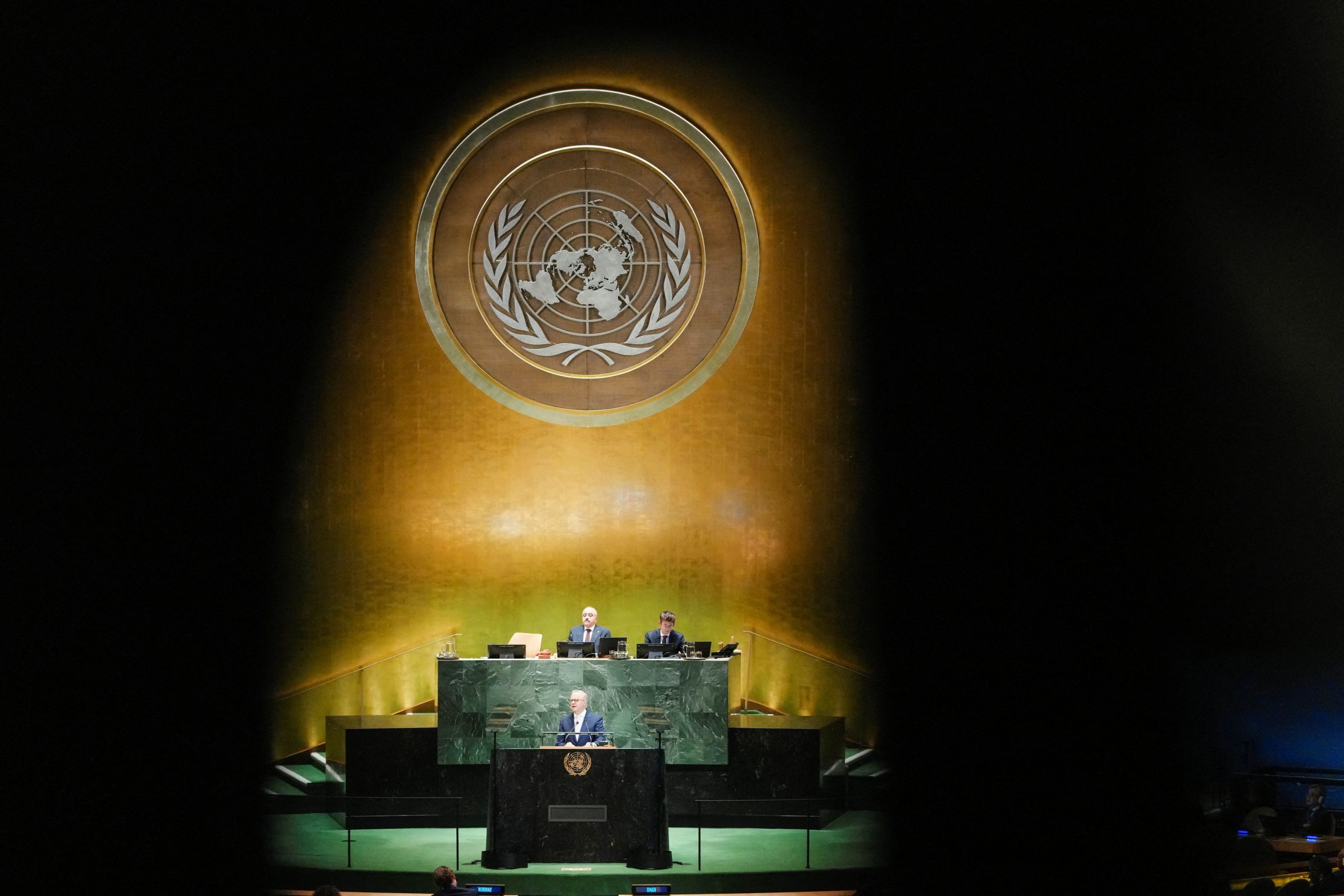
 New York in September is ceremony with a motorcade. The United Nations General Assembly gathers and the world rehearses its most durable nouns—sovereignty, security, peace. Speeches land in orderly paragraphs. Resolutions inch forward. If diplomacy were theatre, this would be opening night.
And yet the week’s most consequential conversation rarely reaches the microphone. It lives in side meetings and marginalia, in the quiet acknowledgements of people who know how systems actually work. In our time, this is about space. Not as romance or frontier, but as infrastructure and leverage. It is about who owns the arteries beneath modern statecraft, and who answers when they fail.
Nowadays, there’s enough experience and material to recognise when the public script and the private brief diverge. This year, the gap is wide. We talk climate, but not enough about the satellites that make climate policy real: the orbital eyes that measure heat, moisture, and loss with the precision that budgets require. We talk migration, but not the persistent maritime coverage that prevents tragedies and frustrates traffickers. We talk artificial intelligence, complete with principles and panels; we barely touch orbital traffic management, debris, and refuelling, unglamorous verbs that will decide whether the next decade is safe or brittle.
Call it the paradox of the age: the UN hears states, but space increasingly runs on platforms. Flags speak in the hall; service-level agreements rule the sky. Governments underwrite capability; companies determine cadence. When everything works, no one notices. When it stutters, ministers learn the hard way what “single point of failure” means.
Look closely at the American effort to return to the Moon, and you see the new order in miniature. A public program is married to a private lander. Novel operations (extreme reusability, orbital refuelling) are stacked atop schedules already tightened by politics. The logic is clear: harness commercial speed, discipline cost, scale innovation. The risk is equally clear: if the keystone slips, the arch does not hold. In Washington and Beijing alike, the race is not nostalgia; it is norms. First arrival matters less than first architecture—whose safety thresholds, data protocols, and operational assumptions become the default that others quietly adopt because they must.
None of this is an indictment of the companies that have brought launch costs down and resiliency up. We’ve seen, in war and disaster, how commercial constellations keep lives connected when towers fall and cables snap. But states are elected to manage systemic risk; firms are rewarded for velocity and scale. Those imperatives align until they don’t. What is the remedy when national emergency communications hinge on a platform optimised for a quarterly cadence? What happens to an alliance plan when a private milestone slips beyond a political window? We have built a world in which public legitimacy often rests on private throughput.
That is a problem of accountability disguised as a technicality. It has no villains. Governments asked for fixed-price contracts and “space-as-a-service”; the choice unlocked a boom and shifted uncertainty to the most delicate link. If delay or failure comes due, the invoice is paid in strategic time and political capital.
So what belongs on the agenda this week, beyond adjectives in a resolution? Three ordinary, unromantic moves.
Guardrails. If private platforms carry public risk, they merit public obligations: transparent milestones for critical services; minimum safety standards that travel across borders; continuity rules that trigger when one node fails. This isn’t punishment for success; it’s recognition of consequence. We already know how to do this in other utilities (aviation, power, and finance). It is slower to agree than to launch, but more durable once agreed.
Redundancy. A system that depends on a handful of providers for navigation, Earth observation, or military backhaul has chosen fragility in advance. Parallel architectures; “Plan B” concepts that may be less elegant but are more available; deliberate avoidance of identical points of failure across allied systems. These are the boring virtues of serious states. In space, as in banking, stress tests are policy.
Rules that keep pace. Refuelling in orbit, debris mitigation at scale, human-rating thresholds before crewed phases, deconfliction in congested shells; none of these can live as footnotes to committees that meet annually. They require living standards, iterated with industry, adopted by coalitions large enough to matter and open enough to spread. Voluntary codes have their place; so do obligations that bite. The test is whether the rule works on a Tuesday afternoon without fanfare.
If that sounds technocratic, good. Durable power in an age of entanglement is built with practicable norms, not slogans. The UN at its best is exactly this: a factory for workable expectations. The temptation, especially in a year dense with crises, is to sell poetry and postpone plumbing. “We’ll take this up later,” people say. Later, in my line of work, is where problems metastasise.
We should also say plainly why space belongs in the first paragraph of more than one agenda item. Climate adaptation without robust Earth observation is theatre. Food security without seasonal monitoring is guesswork. Safe migration without persistent maritime coverage is a slogan. Even electoral integrity rides, indirectly, on time signals and network backbones that begin in orbit. The ledger is unromantic and decisive: satellite services make other promises real.
There is another change worth noting: the roster of actors. The hall recognises states; the market recognises performance. But the ecosystem that now governs space is larger: insurers that price risk and, by doing so, discipline it; standards bodies that allocate spectrum and shape traffic; research labs and startups that turn raw imagery into decisions at scale; militaries that depend, increasingly, on commercial links they do not control. Power still prefers to wear a flag in public. It wears a platform in practice.
So let’s keep the theatre. Ceremony has its uses. But let’s also write the instructions. The General Assembly theme this year is togetherness by design. In space, togetherness will be measured in common guardrails, shared redundancy, and rules that admit iteration—fast enough to match the technology, sturdy enough to survive politics. That is how you prevent a private delay from becoming a public crisis, how you hedge against a sprint that stalls, how you keep a frontier from becoming a choke point.
When the speeches end and the motorcades dissolve into Midtown traffic, the test is simple. Did we merely perform the nouns, or did we govern the verbs? Space does not require new poetry. It needs practical law, enforceable commitments, and a candid admission that twenty-first-century sovereignty rests on platforms few states fully own.
If any could whisper one sentence into the hall before the doors close, it would be this: power in our decade will belong to those who can braid technology, narrative, and rules—and do it before the orbit fills up.
Dimitris Kollias is a Junior Research Fellow at ELIAMEP