Turkey is not waiting at Europe’s gates. It has already entered. Not by treaty, but by architecture. While Brussels negotiated for two decades, Ankara embedded itself within European societies without opening a single accession chapter. Since 2018 enlargement has been frozen: sixteen chapters opened, one provisionally closed. Phased and reversible engagement is not membership. It is containment. Without a fundamental shift in Turkey’s orientation, accession is fiction.
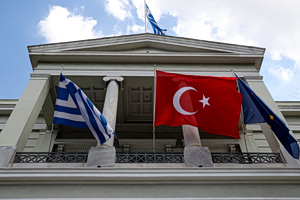
Cyprus pays for Europe’s choice. The island is divided. Turkey does not recognize the Republic of Cyprus and promotes a two-state formula. Brussels has no urgency to resolve it. Even without Cyprus, Turkey will not join.
Membership is defined by rule of law, judicial independence, civil liberties, institutional checks and alignment with EU law. Turkey does not meet them and is not converging. It remains outside.
Cyprus covers the gap between rhetoric and reality. Enlargement continues in language. Incompatibility is structural. Brussels keeps the file open. Ankara expands influence. Membership closed. Influence open. Turkey built the apparatus accordingly.
Using religion as the ‘instrument’ of influence
The Diyanet, Turkey’s Presidency of Religious Affairs, is the instrument. European debates still treat it as religious. In practice it is administrative statecraft. Its 2025 budget exceeds 130 billion Turkish lira. That is not a chaplaincy budget. It is a strategic instrument. Its 2024 to 2028 strategic plan outlines an overseas cadre and expansion targets. The language invokes citizens, kin and coreligionists abroad and the preservation of their religious and national ties. What appears theological is transnational continuity.
More than five million people of Turkish descent live across Europe. In Germany nearly three million residents have a Turkish migration background, and more than one and a half million Turkish nationals reside there. These Europeans are not a fifth column but part of Europe. The sovereignty breach begins when a foreign state treats them as an extraterritorial extension and European governments tolerate it.
In the 2023 presidential run-off, Erdogan’s vote shares among Turkish voters in several European countries were significantly higher than inside Turkey. That reflects mobilisation. Consular networks and state linked religious infrastructure form a command chain of political outreach in European civic space. When participation is organized through these structures, the boundary between democratic choice and managed mobilisation narrows.
Germany is the clearest case. Through DITIB, the Diyanet’s German branch, Ankara maintains influence across roughly nine hundred mosque communities. Intelligence operations on German soil forced Berlin to confront a premise: why should a foreign state perform sovereign religious functions inside Germany by default. Berlin stopped arguing and began localisation. Germany expanded domestic imam training and is reducing reliance on Turkish deployed clergy.
Austria reached similar conclusions earlier and more confrontationally. The 2015 Islamgesetz restricted foreign financing and required German speaking clergy. Enforcement actions signaled that state administered religion would be treated as governance, not cultural pluralism. Elements remain contested and safeguards are essential, but Vienna shifted the debate.
In Flanders, mosque recognition criteria hinge on transparency and local financing. France embedded the shift into national law through legislation reinforcing republican principles and a foreign influence transparency regime requiring registration for those acting on behalf of non-EU states. The logic across the Union is consistent: state administered religion is a governance question.
Democracy initiatives now focus on counter interference. The EU is constructing a civilian doctrine for foreign governance.
Breaching open gates
Ankara’s method works because Europe is open. It exploits freedoms of association and religion within a plural civic order. The mechanism is administrative. Salaries are paid. Sermons are approved. Textbooks are supplied. Youth programmes are organized. Cultural centres are opened. Scholarships are offered. The ecosystem integrates consular mobilisation. It is influence built on normalisation, not coercion. Not conquest but re anchoring.
In Tirana, the Turkish funded Grand Mosque opened with governance ties to Ankara’s religious authorities. Across the Balkans, mosque construction, scholarships and educational pipelines anchor local elites to Istanbul. The Yunus Emre Institute and the Maarif Foundation extend that network globally. Combined with religious staffing and mobilisation, this is not outreach but infrastructure.
Cyprus exposes the same method at state level. Observer status for Northern Cyprus in the Organisation of Turkic States reframed isolation as recognition. The European Union maintains non-recognition. Ankara builds parallel legitimacy. Borders remain. Authority shifts.
Since 2016, European debates have focused on surveillance of opposition networks and extraterritorial coercion. Even without prosecutions, the effect holds: distance from Turkey does not guarantee insulation. When a foreign state can monitor, mobilise and pressure European civil society, sovereignty is compromised.
The EU’s Turkey file is misdescribed. The question is no longer when Turkey will join but how Europe defends civic sovereignty while managing a strategically assertive neighbor not converging with EU norms. Official language still calls Turkey both key partner and candidate country while citing rule of law concerns. The result is limbo, creating incentives for backchannels of influence.
Cyprus
The accession theatre is closed. The fiction of imminent membership ends. Turkey cannot frame transparency as obstruction, and Brussels cannot hide behind Cyprus. Cyprus is a strategic wound. It is resolved on its own terms, not as cover for a stalled enlargement policy.
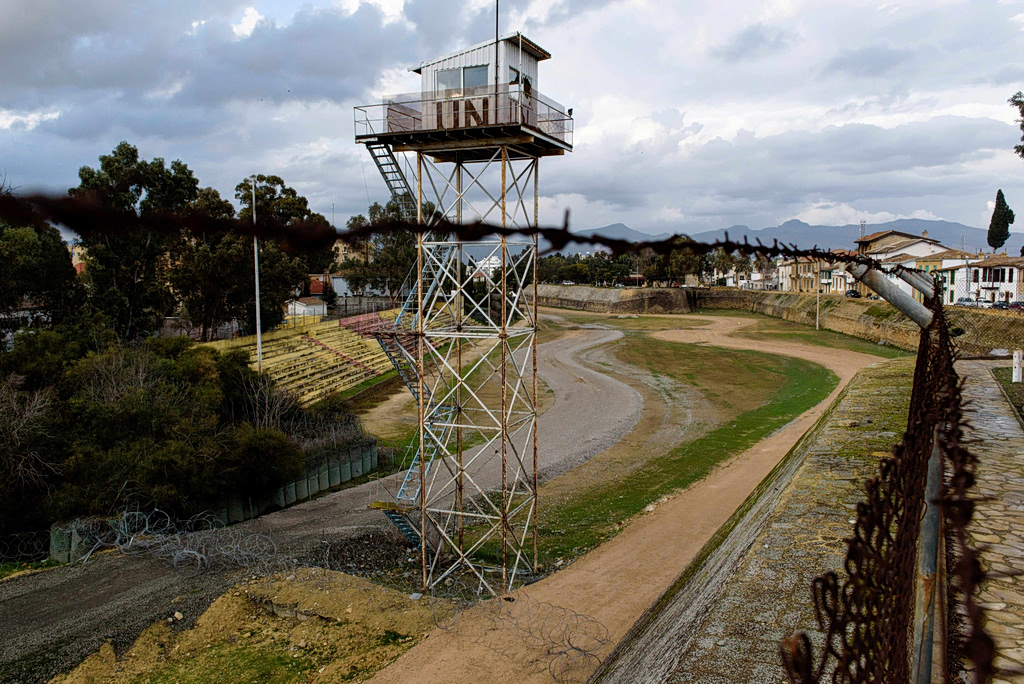
A view of the UN-monitored ‘green line’ separating the internationally recognized Republic of Cyprus from the Turkish-occupied areas in one-third of the island republic.
The response is governance. Financial disclosure of foreign state funding. Influence registers where state direction is demonstrable. Transparency for sermons and curricula approved abroad. Domestic training to end habitual outsourcing of sovereign functions. Clear safeguarding and consumer standards in religious education and youth work. Belief is not policed. Its instrumentalisation as governance ends.
Turkey did not fail to enter Europe. It entered differently. Europe does not require illiberal reflexes. It requires statecraft and strategic honesty. The centre of gravity has shifted. Europe must adjust accordingly.
Shay Gal is a strategic analyst in international security and statecraft, advising governments and senior decision makers on power, sovereignty and geopolitical risk.