Μake us preferred on Google
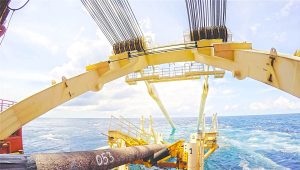
 At a moment when the United States is signaling renewed interest in turning the Eastern Mediterranean into a strategic energy hub, Greece and Cyprus are striving to project unity—insisting that the long-planned electrical interconnection project is merely on hold, not derailed. They want to show that it will not remain trapped forever in Greek-Cypriot disagreements or overshadowed by Turkish threats.
In reality, though, both governments have effectively frozen the project, at least temporarily. The goal is to reassess its economic and technical parameters and to search for potential investors. Early indications from Athens point toward possible involvement by the U.S. International Development Finance Corporation (DFC), Washington’s public development bank.
This joint shift in approach by Greek Prime Minister Kyriakos Mitsotakis and Cypriot President Nikos Christodoulides was finalized shortly before last Wednesday’s Intergovernmental Summit in Athens.
A Project Wrapped in Geopolitics
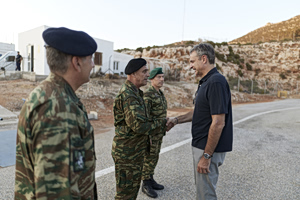
Mitsotakis framed the deepening U.S. role in the Eastern Mediterranean as an opportunity, arguing that large-scale connectivity projects—such as the electricity cable linking Greece, Cyprus, and potentially Israel—now carry even greater strategic weight. He assigned the initiative a broader geopolitical significance.
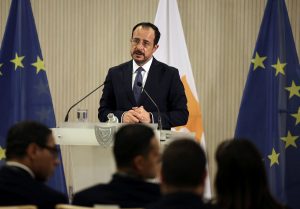
Christodoulides, however, struck a more cautious tone. He spoke of the need for “substantive actions” that can ensure “the effective implementation of projects with tangible economic benefit,” notably avoiding any explicit reference to the interconnection itself.
Notably, the project did not appear in the Joint Communiqué issued after the Intergovernmental Summit. The two sides instead agreed to revise the financial aspects of the project—effectively acknowledging doubts about its viability and aligning, willingly or not, with Nicosia’s position.
Opportunity—and a Widening Gap
“The American presence is clearly an opportunity to push the interconnection forward,” a senior diplomatic source familiar with the entire tumultuous process tells To Vima. That process has included rare levels of tension between Athens and Nicosia—tensions unprecedented in the post-1974 era of Greek-Cypriot relations.
The Trump administration (as the Greek text refers to the broader U.S. posture) views the region through an unmistakably economic lens: commercial gains for American companies help shape geopolitical balance. At the same time, the 3+1 format—a regional cooperation scheme involving Greece, Cyprus, Israel, and the United States—has regained momentum, though now largely at the level of energy ministers.
Sources in Cyprus with first-hand knowledge of what was discussed in the latest 3+1 meeting say the reference in the Communiqué to “projects already under way” refers specifically to the Greece–Cyprus, and potentially Israel, GSI interconnection. The omission of explicit naming was deliberate, to maintain delicate balances with Ankara.
Yet that same senior Greek diplomat stresses that “problems with the Republic of Cyprus will not disappear easily,” regardless of U.S. involvement.
Cyprus Never Accepted the Project’s Viability
Nicosia has never formally committed to the project’s financial viability—nor has it shown willingness to pay the €25 million tranche owed to Greece’s Independent Power Transmission Operator (ADMIE), as required by their most recent agreement.
Several Cypriot cabinet members have for months doubted whether Athens is truly prepared to defend the project, particularly since the remaining areas to be surveyed lie far from Greek territorial waters. This skepticism is widely shared among Cypriot society, where the summer 2024 incident off the island of Kasos—linked to Turkish interference—remains a vivid memory.
“The problem was never the money. The problem is Turkey,” a senior Cypriot minister tells To Vima—a view Athens has never embraced. Greek officials involved in the project insist, increasingly publicly, that Cyprus’s objections are driven by other motives, including the business interests of energy-sector players.
The divide between Athens and Nicosia—over both the financial fundamentals and the specter of Turkish interference—will not be easy to close.
Costs Rise Sharply—and Trust Erodes Further
After receiving assessments from American consultants Charles River Associates, the Cypriot government—led by Finance Minister Makis Keravnos—raised the projected cost of the interconnection from €1.9 billion to at least €3.1 billion.
Cyprus also questioned whether the project would actually benefit Cypriot consumers. Meanwhile, ADMIE’s repeated requests that Nicosia recognize €250 million already spent on the project have gone unanswered.
These disagreements, along with several unresolved issues, have now been placed in a state of “updating”—with no clear indication of when, or how, they can be resolved.
To formally reassess the project’s economic and technical foundations, a new international tender will be required. Only after an independent evaluator determines the capital needs for GSI’s viability can any new investors step in. A well-informed source expresses cautious optimism that the process might be completed within three months.
“We are in an exploratory phase. The Americans want the data to understand what, how, and where,” Greek Energy Minister Stavros Papastavrou told Open TV.
Who Would Invest—And Why?
This is not the first time rumors of foreign investment in the GSI project have surfaced. U.S. interest dates back to 2016. Christodoulides even traveled to the United Arab Emirates to attract capital. But after the Kasos incident, investor appetite faded due to “geopolitical risk”—a polite way of referring to Turkish intervention.
Seasoned observers now ask the obvious question:
“Who would invest money in a project with doubtful returns and exposure to Erdogan?”
The intuitive answer might be the United States or Israel, since Israel is part of the planned interconnection. Still, the latest chatter about DFC involvement remains unconfirmed—at least for now—from Nicosia.
One thing is not in doubt: the expanded U.S. presence in the Eastern Mediterranean. The GSI project now falls under the 3+1 framework, treated as part of regional energy cooperation. Yet, as one veteran diplomat notes, this is not a panacea. If U.S. capital were to be invested directly—much like in the Ionian Sea and south of Crete—then the project would indeed gain stronger protection from external interference.
Is Cyprus Looking for an Exit Path?
Last week, Minister Papastavrou and his Cypriot counterpart George Papanastasiou met in Brussels with the relevant EU Commissioner to explore the possibility of expanding the European Union’s participation in the project.
Simultaneously, however, Nicosia seems to be exploring escape routes. During a May visit to Israel, Christodoulides and Prime Minister Benjamin Netanyahu discussed potentially integrating the GSI into the IMEC corridor—the India–Middle East–Europe economic pathway.
Just last Sunday, Israel’s Energy Minister suggested (in an interview with Kathimerini) a separate Israel–Cyprus electrical interconnection.
Christodoulides himself referred to ongoing “consultations with American companies and neighboring states” on energy matters, promising “specific announcements.”
Whether Cyprus is seeking to exit the GSI or simply diversify options, one thing is clear: movement is happening in Nicosia.
Time Gained—But No Real Resolution
There is no sign, however, that the core disagreements between Greece and Cyprus have been resolved. Both sides have merely bought themselves time. Avoiding escalation in Greek-Cypriot tensions might be politically useful, but it also leaves Athens facing an uncomfortable reality: Greece appears unable to enforce its sovereign rights—even in an area Ankara explicitly claims as part of its “Blue Homeland” doctrine.
The implications extend far beyond the fate of a single energy cable.