The Greek government has finalized a presidential decree establishing the South Aegean Marine Park I, covering much of the southern Cyclades maritime region, less than two weeks after the NATO summit in Ankara.
The development furthers a flagship environmental initiative that Athens also views as consistent with its sovereign rights throughout much of the Aegean Sea.
Environment and Energy Minister Stavros Papastavrou signed the decree on Wednesday, alongside Defense Minister Nikos Dendias and Agriculture and Food Minister Margaritis Schinas. The draft decree will now be submitted to the Council of State (CoS) for final legal review before issuance, a standard procedure. Papastavrou said a second presidential decree establishing a marine park in the Ionian Sea will follow in the coming weeks.
The government says the initiative fulfills a commitment by Prime Minister Kyriakos Mitsotakis by advancing Greece’s obligations under European biodiversity targets.
According to Papastavrou, Greece expects more than 35% of its marine waters to fall under protected status by early 2027, exceeding the European Union’s target of protecting 30% of marine areas by 2030.
The announcement comes amid continuing annoyance expressed by official Turkey, which has objected to the designation of marine protected areas in parts of the Aegean, even in areas within Greek territorial waters. Officials anticipate renewed peevishness on the part of Ankara, which has linked the initiative to its unilateral – and revisionist, according to Athens – maritime claims and recent discussion surrounding the proposed “Blue Homeland” legislation.
The decree introduces a new regulatory framework for extensive island and marine areas in the Southern Cyclades. It imposes a complete ban on bottom-towed fishing gear, including trawling, introduces new restrictions on both commercial and recreational fishing, and limits large-scale infrastructure and engineering projects within environmentally sensitive zones.
Core Natura 2000 conservation areas will remain subject to the strictest protection, with virtually no new human intervention permitted. Surrounding sustainable management zones will allow carefully regulated activities, including new residential construction, tourism accommodation and selected infrastructure projects under tighter environmental conditions.
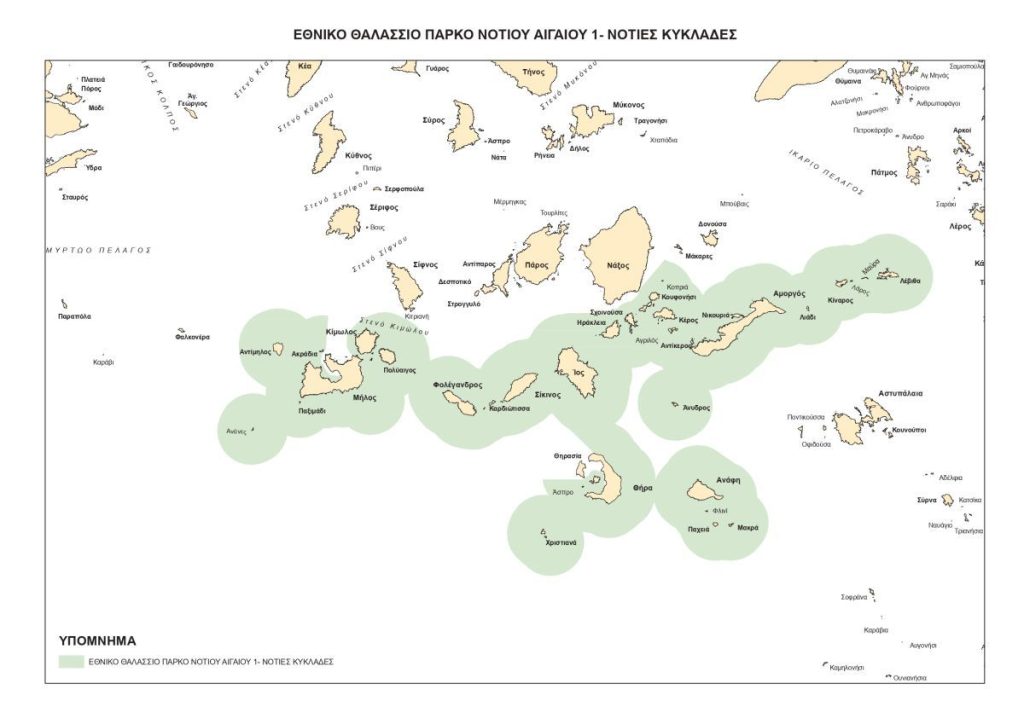
The protected area encompasses off-plan islets and Natura-designated zones associated with the islands of Milos, Kimolos, Folegandros, Sikinos, Santorini, Anafi, Amorgos, Irakleia, Schinoussa, Koufonisia, Kinaros and Levitha, together with their surrounding marine waters.
The decree also establishes zones of absolute nature protection.
Permanent or supporting infrastructure will be prohibited on the Megas Avelas and Mikros Avelas islets and along the steep rocky coastline of Irakleia, one of the handful of isles known as the “lesser Cyclades”. In other highly protected areas, including key Mediterranean monk seal breeding habitats around Polyaigos, Kimolos and northern Anafi, only facilities directly supporting ecosystem conservation, management and scientific research will be permitted.
The government has argued over the past year that the marine parks are designed to strengthen biodiversity protection, improve management of marine ecosystems and reinforce surveillance across protected waters, while remaining fully consistent with international law and Greece’s environmental commitments.
Separately, Papastavrou took delivery of the Syrna, one of three new patrol vessels acquired by the Natural Environment and Climate Change Agency to strengthen monitoring and enforcement in Greece’s marine protected areas. The vessels are designed to operate safely in adverse weather conditions and will support surveillance, biodiversity protection and rapid response operations.