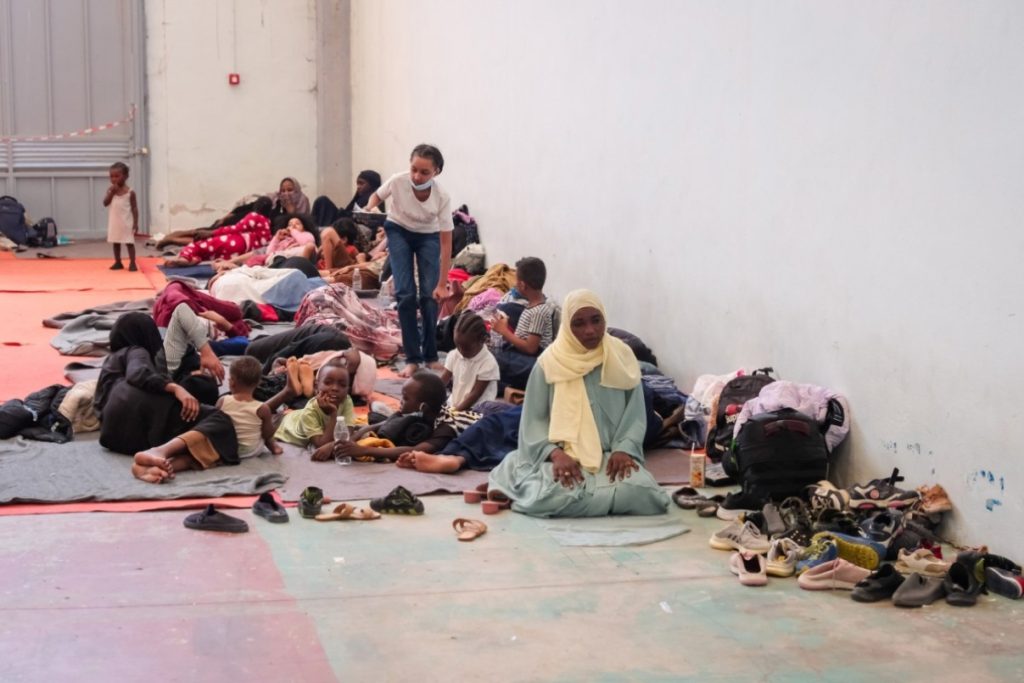
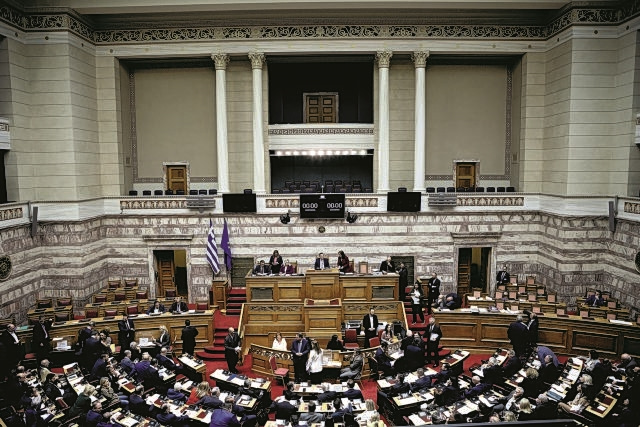
The “hot button” issue in Greece of migration, undocumented and legal, generated a rancorous debate in Parliament on Tuesday over a draft bill revising the immigration code, with the relevant minister underlining that the “primary rule” behind the proposed new framework is the idea that “illegal immigration is a problem”.
In presenting the rationale behind the proposed revisions, Minister of Migration and Asylum Thanos Plevris emphasized that draft bill ensures that “no possibility is given to anyone in an illegal status to change this into a legal status…the rules of the game are now clear. Anyone who arrives (in the country) illegally will never become legal.”
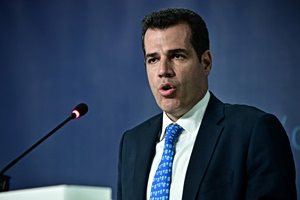
Migration & Asylum Minister Thanos Plevris
In eschewing the more “politically correct” terminology increasingly used in western media over previous years, he said he rejects the term “irregular” in favor of “illegal”.
“This reflects the ideological differences between the center-right and center-left in their views on the movement of peoples,” he characteristically said.
According to Plevris, the main thrust of the draft bill is to “crack down on illegal entry and residency, while at the same time simplifying procedures for those who are in the country legally.”
In terms of the latter, he said the number of foreign nationals residing and working legally with residency permits is around 800,000, amid a native-born population of approximately 10 million. Plevris added that the goal is for residence permits to be valid for two years, with a provision for “guaranteed” renewals when administrative checks are unduly or unnecessarily delayed.
Conversely, he announced from Parliament’s podium that the center-right government is particularly interested in linking legal residency with employment. As he explained, legal immigration is intended to meet market needs, noting that if a permit holder remains unemployed for a certain period of time, then a revocation of the residency permit is envisioned.
“The reasoning behind this is not to come here with a permit and end up staying in the country without working.”
Legality, returns and international cooperation
With regards to recruitment of foreign nationals, he said the government is only interested in meeting labor market demand “only through legal channels.”
In terms of cooperation with other European countries, Plevris said discussions are underway with Denmark, Austria, the Netherlands and Germany to create a repatriation center outside Europe, seen as a deterrent for those who cannot be returned immediately because to their home countries refuse to accept them.
Asylum regime changes, NGO, minors
In detailing proposed changes to the asylum regime, something that has generated sharp reactions by the opposition to the left of ruling New Democracy (ND) party, he referred to a “model” that links residency with integration into the labor market, along with a geographical distribution far from large urban areas. A policy of integration, he maintained, cannot be equated with welfare benefits, as asylum is, in principle, temporary and repatriation should be the rule when the reasons for international protection no longer exist.
In terms of ever-ubiquitous NGOs involved in all aspects of immigration, he said the ministry is promoting a stricter framework for their registration. He also cited stricter measures applied to individuals associated with registered organizations judged as being involved in trafficking. He also announced the abolition of direct contracts and the introduction of competitive procedures, citing observations by the Court of Auditors.
Finally, he also referred to the contentious and complex issue of unaccompanied minors, assessing that the majority of individuals in this group are “on the verge of adulthood”, with the current legal framework acting as a “magnet”.
Opposition reactions
As mostly expected, opposition parties to the left of New Democracy were sharply critical of the draft legislation.
Main opposition PASOK MP Nadia Giannakopoulou described the bill as “below par”, saying that it bears the minister’s personal stamp. She also stressed that it poses “very serious risks to social cohesion” and accused Plevris of “deciding to declare war on our fellow citizens who are migrants.”
A deputy with leftist SYRIZA expressed his party’s total disagreement with the proposed changes, saying that “with this bill, immigrants are presented as necessary on the one hand and treated as a threat on the other.” He called on the government to withdraw the bill and engage in a dialogue “on integration”.
The rapporteur of the Communist Party (KKE) charged “hypocrisy” on the part of the government and the European Union, arguing that the bill “serves the diktaks of (big) capital”.
A New Left party MP accused the government of “maintaining a system of migrants’ exploitation” and even a “policy of death.”
On the other side of the political spectrum, an Elliniki Lysi (Greek Solution) party deputy argued that the bill “first allows and then legalises illegality”, accusing the government of “transforming Greece from a sovereign state into a manager of populations”.