
In Greece today, faith in public life has all but evaporated. According to a new nationwide survey by Kapa Research for the Heinrich Böll Foundation, citizens view nearly every institution, from parliament to the press, with suspicion, frustration, or outright contempt. The findings sketch a portrait of a society where cynicism has become a kind of civic instinct.
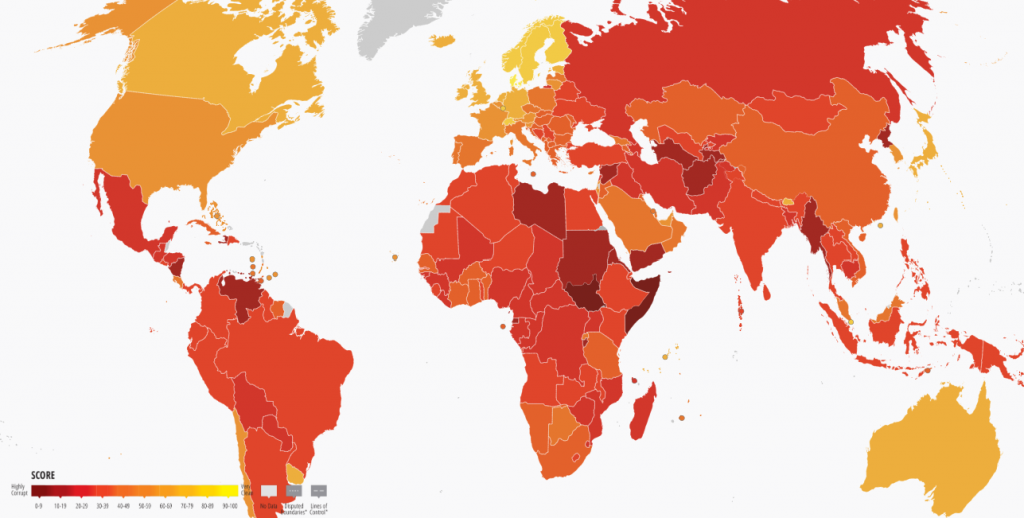
As in.gr reported, the findings could be captured in one blunt phrase: “Corruption everywhere and justice nowhere.” This sentiment might sound hyperbolic but it is merely an accurate reflection of public mood. An overwhelming 97% of respondents believe corruption is “very” or “fairly” widespread in Greece. Only 3% say they personally experience justice in their lives. The judiciary, often viewed as the last guardrail, fares marginally better. More than 70% of Greeks say they have little or no trust in the system.
Anger replaces hope
When asked to describe their dominant feelings about their personal situation, more than half of Greeks chose disappointment (54%) or anger (46%). Thirty-seven percent named injustice as the emotion that best captures their daily experience. Just 23% expressed optimism or hope; only 5% said they felt happy.
These are not simply statistics about political discontent. They suggest something more profound: a society that feels unrepresented, unseen, and unfairly treated. Among younger Greeks, this alienation runs especially deep. Political parties, they say, do not speak for them -precisely because of the opacity of the existing system.
And yet, despite this general sense of detachment and disappointment, there are traces of engagement. Young people are the most likely to say they would participate in public life, motivated by issues of social and economic inequality—the very injustices they feel most acutely. Nearly one in two Greeks overall say they would become more politically active if a new party emerged that “represented people like them.” The longing for representation, it seems, has not entirely died; it has merely gone unanswered.
Trust in uniforms, not microphones
The survey, titled “Citizens and the State: Trust, Equality of Opportunity, Political Participation”, examines how Greeks view institutions, the state’s performance in key areas of life as well as general socio-economic phenomena. The patterns it reveals are both familiar and unsettling.
Only one institution enjoys majority trust: the armed forces, with 64% of respondents expressing confidence. That trust, though, is uneven. Younger respondents, women, and those on the political left are significantly more skeptical, perhaps wary of what militarization can symbolize in a country still haunted by memories of the dictatorship.
Everywhere else, confidence has collapsed. The media sit firmly at the bottom of public esteem, distrusted by 92% of Greeks. Political parties fare almost as badly, with 87% expressing little or no faith in them. Parliament is only marginally better regarded, and the main opposition is viewed negatively by three out of four citizens. Banks and trade unions hover near the same depths of distrust.
The state fails in its own report card
Asked to evaluate the state’s performance across critical sectors, Greeks hand down a sweeping indictment. The economy, health care, education, housing, migration, and demographics, all are rated poorly. Only technology earned a positive mark from more than half of respondents.
Behind these numbers lies a pervasive sense that those without money or connections face insurmountable barriers at every level. Equal access to opportunity, once a democratic promise, is seen as either beyond the state’s ability -or its will- to deliver.
What remains when trust disappears
The portrait that emerges from the data is stark. Greeks are angry. They are disappointed. They are wary of their institutions and skeptical of the people who run them. And beneath that skepticism lies something even more corrosive: the belief that corruption is not the exception but the rule.
The challenge for Greece is no longer simply one of governance or policy. It is emotional, almost existential—the need to restore faith in fairness itself. Until that happens, the country’s most enduring crisis may not be economic or political at all, but psychological: a collective loss of trust in the very idea that justice can still be found somewhere.