
Ukraine’s combat-tested naval drones, known as “Sea Babies,” drew the interest of Greek officials during President Volodymyr Zelensky’s recent visit to Athens. While the trip focused primarily on an energy agreement between the two countries, discussions at the prime minister’s office also touched on potential defense cooperation in unmanned maritime systems.
Ukraine has developed significant expertise in naval drones, a capability sharpened by its ongoing war with Russia. Kyiv has scored major successes in the Black Sea using small, fast, remote-controlled vessels that have damaged or forced the retreat of much of the Russian fleet. These operations have helped Ukraine keep vital trade routes open toward Europe.
Last month, Ukraine’s Security Service (SBU) unveiled the latest version of its Sea Baby drone. The upgraded model offers far greater range, exceeding 1,500 kilometers, and can carry payloads up to 2,000 kilograms, roughly twice the previous limit. President Zelensky signaled openness to exporting the systems, remarking that Ukraine could sell around 2,000 units to partner countries.
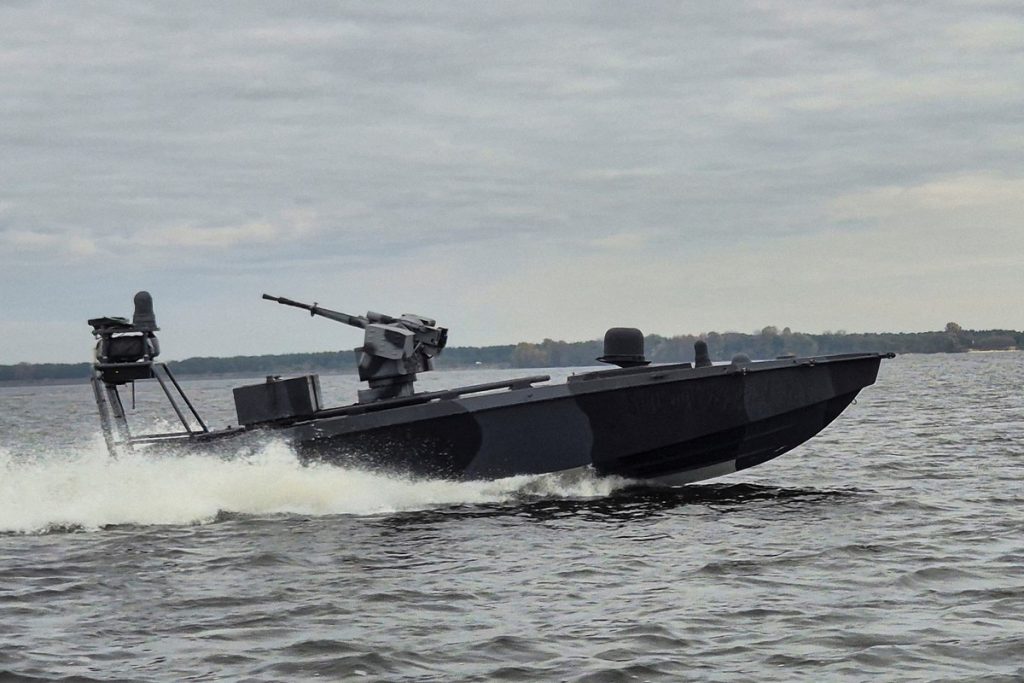
The latest version of Ukraine’s Security Service (SBU) “sea baby” naval drone sails, amid Russia’s attack on Ukraine, in an undisclosed location in Ukraine October 17, 2025. REUTERS/Vlad Smilianets
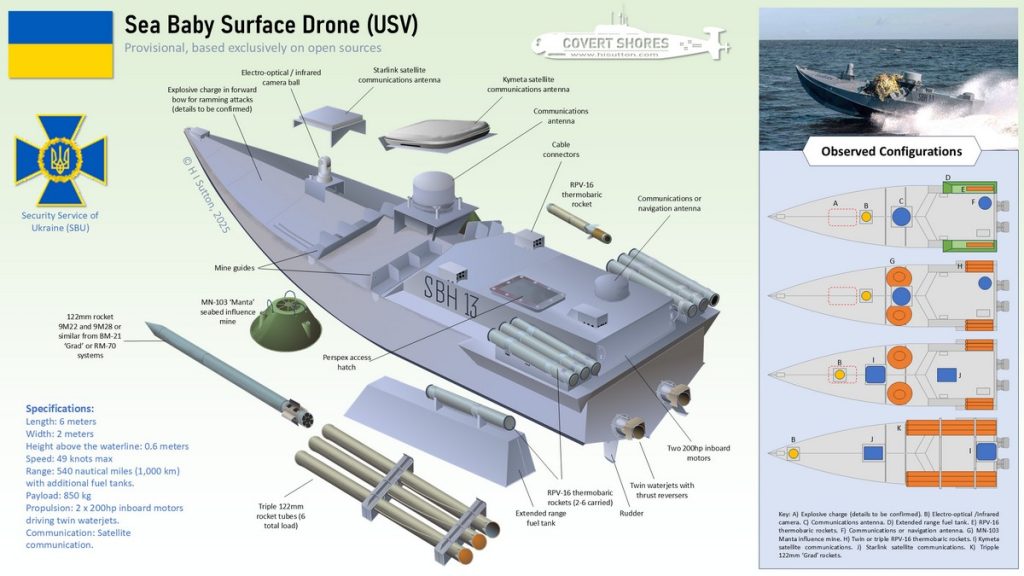
Beyond their main explosive payloads, Sea Babies can be equipped with thermobaric rockets, naval mines, or artillery rockets depending on mission needs. They have been observed operating with various weapons configurations, from short-range rockets used to suppress defenses to Italian-made Manta sea mines, which can target vessels at depths of 2.5 to 100 meters. Ukrainian drones equipped with such mines have previously been linked to damaging Russian warships.
Some versions also appear to carry remote weapon stations used against low-flying aircraft and helicopters, though details remain limited.
The core specifications of the Sea Baby reflect its role as a swift, compact strike platform: a 6-meter hull, 2-meter width, minimal profile above the waterline, a top speed of 49 knots, and a range of 540 nautical miles with additional fuel tanks. Powered by twin 200-horsepower engines and water-jet propulsion, the drone is designed for rapid, precise operations at sea.