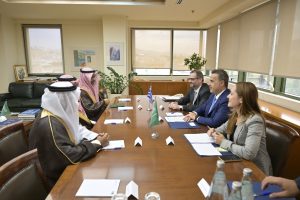
Greece is positioning itself as a key energy bridge between the Middle East and Europe, according to Environment and Energy Minister Stavros Papastavrou, who outlined three major cross-border projects during a recent television interview following his visit to Riyadh.
Speaking to Greek broadcaster Mega, Papastavrou described what he called a “strategic trajectory” of bilateral cooperation centered on three flagship initiatives: the Saudi-Greek Interconnector, collaboration on green hydrogen, and the East Med Corridor (EMC). Together, the projects aim to strengthen regional energy security while supporting Europe’s transition away from fossil fuels.
Greece as an energy hub
Saudi Arabia, Papastavrou noted, remains a global energy powerhouse and intends to retain that role while expanding investments in renewable energy. Greece, he said, can serve as a hub to channel Saudi-produced electricity into European markets.
In practical terms, this would create a second major energy route into Europe, alongside the so-called Vertical Corridor that brings U.S. liquefied natural gas (LNG) northward through Greece. The proposed Saudi-Greek Interconnector would link power systems across regions, reinforcing Greece’s strategic role at the crossroads of Europe, the Middle East and North Africa.
Anchored in EU policy
Papastavrou stressed that all such initiatives are firmly embedded within the European framework in which Greece operates. Both the Saudi energy corridor and Greece’s cooperation with the United States, he said, align with the European Union’s RepowerEU plan and the bloc’s decision to fully phase out dependence on Russian natural gas.
Green hydrogen also features prominently in this strategy. Papastavrou pointed out that hydrogen is included in two of the eight “energy corridors” announced by European Commission President Ursula von der Leyen in her 2025 State of the Union address. These corridors are intended to underpin the completion of the EU’s Energy Union through large-scale strategic interconnections.
Shipping and the energy transition
The minister also addressed the challenge of decarbonizing global shipping, an issue of particular importance for Greece, home to one of the world’s largest merchant fleets. He acknowledged that discussions at the International Maritime Organization (IMO) are currently at an impasse.
Greece, he said, is working first with European partners to develop a realistic and mutually acceptable approach. The goal is to reach a common European position that can then be discussed with the United States and other interested countries over the next year.
Investment talks and hydrocarbons
During his Riyadh visit, Papastavrou also held contacts with Eric Trump, son of the US president and executive vice president of the Trump Organization. He noted that the company is active in the Middle East and has expressed interest in expanding into Europe, adding that Greece should naturally be among the investment destinations under consideration.
On energy exploration, the minister said recent approval by Greece’s Court of Audit for contracts involving the Chevron–Helleniq Energy consortium clears the way for parliamentary submission. If finalized, the first seismic and geophysical surveys could begin in 2026.
Should those surveys lead to commercially viable hydrocarbon discoveries, Papastavrou said, the benefits would translate into significantly increased public revenues for Greek citizens.
Power prices and interconnections
Addressing household energy costs, the minister pointed to Greece’s current standing within the EU. According to European Commission quarterly reports for the second quarter of 2025, released on Jan. 15, Greece ranks 19th in the bloc for residential electricity prices, below the EU average.
While cautioning against complacency, Papastavrou emphasized that accelerating electrical interconnections remains key to further price reductions. “The faster we expand interconnections, the lower prices will go,” he said, calling the figures a useful benchmark rather than a final destination.