Positive signals from both Sofia and Tripoli regarding the diplomatic objectives Athens has set as part of its active foreign policy strategy emerged yesterday following the completion of two key diplomatic missions. Greek Foreign Minister Giorgos Gerapetritis traveled to Bulgaria for the Summit of the South-East European Cooperation Process (SEECP), while Deputy Foreign Minister Alexandra Papadopoulou visited western Libya as head of the Greek delegation participating in a new round of technical talks on the delimitation of Exclusive Economic Zones (EEZs).
Regarding Libya, and with continued focus on Ankara and the controversial Turkey-Libya maritime memorandum signed between Turkey and the government of Abdul Hamid Dbeibeh, Athens and Tripoli yesterday reaffirmed their commitment to continuing constructive dialogue based on international law. The discussions come as energy projects in the maritime blocks of both countries are being developed. Both sides also emphasized their commitment to further strengthening bilateral cooperation across a broad range of areas of mutual interest.
During her meeting in Tripoli with Libyan Foreign Minister Taher Al-Baour, Deputy Foreign Minister Alexandra Papadopoulou reaffirmed Greece’s desire to strengthen the traditionally close relationship between the two countries. The Greek side also sent a clear message that it remains committed to EEZ delimitation talks with Libya, guided by the principle that the dialogue is taking place between two states with opposite coastlines and in accordance with the United Nations Convention on the Law of the Sea. In doing so, Athens sought to send a message in every direction, particularly as a proposed Turkish bill remains under discussion, that Greece conducts its planning and negotiations on the basis of principles and with full respect for international law.
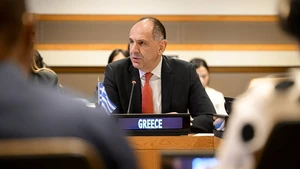
At the same time, in Sofia yesterday, the foreign ministers of Greece and Turkey held talks on the sidelines of the South-East European Cooperation Process. Speaking during both the summit and the ministerial meeting in Bulgaria, Giorgos Gerapetritis highlighted Greece’s initiative to promote the European integration of the Balkans, describing it as “the only way forward.”
The foreign minister had recently told the Greek Parliament that accelerating the accession process of the Western Balkans into the European Union requires what he described as a “proactively active foreign policy” during a critical period for a region that remains particularly vulnerable to outside influences.
Against the backdrop of renewed tensions in Greek-Turkish relations, Athens and Ankara were in clear need of yesterday’s one-hour meeting to send a signal that the current period of relative calm should continue, especially ahead of the NATO Summit scheduled for early July, where U.S. President Donald Trump is also expected to attend.
According to diplomatic sources, Gerapetritis raised with his Turkish counterpart the issue of a proposed Turkish maritime zones bill, stressing that unilateral actions produce no legal consequences and do not contribute to maintaining a calm atmosphere.
The Greek foreign minister also reminded his Turkish counterpart that the one and only dispute between Greece and Turkey—contrary to recent reports appearing in parts of the Turkish media—remains the delimitation of the Exclusive Economic Zone and continental shelf.
On that issue, and following signals Turkey has reportedly received from other European countries warning that the rumored content of the proposed Turkish legislation would be unacceptable and could trigger significant penalties, including the suspension of the EU-Turkey Customs Union and the freezing of European funding, Turkish Foreign Minister Hakan Fidan stated that “the bill concerning maritime zones constitutes national legislation.”
At the same time, according to sources from Turkey’s Foreign Ministry, Fidan reiterated—consistent with what Ankara reportedly tells European partners when the issue is raised—that “Turkey is a country that respects international law and the principles of good neighborly relations.”
Ahead of visits expected in the coming weeks by the Personal Envoy of the UN Secretary-General to Athens, likely next week, and Ankara, Gerapetritis and Fidan also discussed the Cyprus issue. The talks focused on preparations for an informal expanded meeting that now appears likely to take place in late July or early August.
While the two foreign ministers made visible efforts yesterday to lower tensions and project a willingness for cooperation and dialogue amid an exceptionally complex geopolitical environment, Turkish President Recep Tayyip Erdoğan issued new warnings toward countries in the region cooperating with Israel. He stated that if the rights and interests of Turkey and Turkish Cypriots in the Eastern Mediterranean are threatened, the response would be “very clear and very harsh.”
Earlier, Greek Prime Minister Kyriakos Mitsotakis also referred to Israel within the framework of the “3+1” cooperation format, emphasizing that Greece has developed a long-term strategic partnership with Israel. At the same time, he noted that Greece has criticized the current Israeli government on numerous issues, while stressing that this does not call into question the validity of a long-term alliance that is increasingly developing a strong defense dimension.