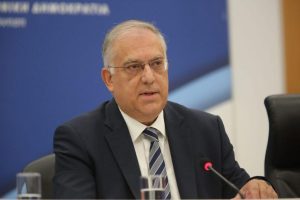
Greece will support 282 productive investments in Macedonia and Thrace with €510 million through the country’s Development Law, Development Minister Takis Theodorikakos said Aug. 26, highlighting industrial investment and job creation in northern Greece.
The investments have a combined budget of about €1 billion and are expected to create more than 5,000 new jobs. About 80% of the projects concern manufacturing and industry.
Theodorikakos said strengthening industry is a central part of the government’s strategy to transform Greece’s economic model and reduce its reliance on tourism. “We cannot live only from tourism. We want good tourism, both quantitatively and qualitatively. But we must also have a strong industry.”
He said Greece needs a strong industrial and productive base and noted that the government has established, for the first time, a dedicated development framework for border regions, particularly northern Greece.
Investment and jobs in northern Greece
According to Theodorikakos, 15,000 industrial jobs have been created in northern Greece over the past seven years.
The government has also supported 14 industrial parks in Macedonia to prepare them to host new productive investments.
“If we want young Greeks to stay in the areas where they were born or in the areas their parents come from, there must be jobs and infrastructure there,” Theodorikakos said. “And we are working hard on this with results.”
More broadly, he said 600,000 new jobs have been created across Greece since 2019 as a result of government policies.
The minister also highlighted the relatively higher pay in the industrial sector. Average annual gross earnings in industry are about €25,000, compared with approximately €18,000 across the economy as a whole, he said.
Supermarket price cuts
Theodorikakos also addressed the cost of living, announcing that the National Price Reduction Initiative will begin in Greek supermarkets on Monday, Aug. 31.
The initiative will provide price reductions ranging from 5% to as much as 20%-25%, with the measures expected to last between two and four months.
The reductions will focus on everyday products, including basic food items, household necessities and personal hygiene products.
However, Theodorikakos said temporary price reductions alone cannot provide a permanent solution to the cost-of-living problem.
“The recipe for every person and every Greek family to be able to live better is better wages and better incomes in a stronger economy,” he said.
He added that the minimum wage has risen by 40% in recent years, while the average gross monthly salary has now reached €1,500.
Government steps to control the market
Theodorikakos said the government has adopted some of the most interventionist market-control measures used in Greece during exceptional circumstances, including a cap on profit margins.
He said inspections have resulted in €25 million in fines being imposed and collected.
The minister also pointed to the new independent authority responsible for market oversight, inspections and consumer protection, saying it is significantly strengthening the enforcement mechanism with the aim of creating a fairer, more competitive and better-functioning market.
No early elections, minister says
Asked about opinion polls and the timing of the next elections, Theodorikakos said polls reflect voters’ assessment at a particular point in time.
He expressed confidence that the election result would be better for New Democracy than its current polling position suggests.
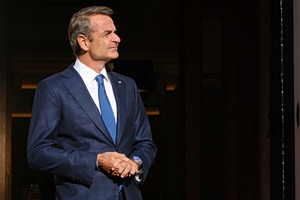
At the same time, he said there is no question of early elections, “as the prime minister has made completely clear.”
Theodorikakos said New Democracy’s objective is to secure a parliamentary majority, while emphasizing that the final decision will be made by voters at the ballot box.
He added that New Democracy should remain the main political force representing “a social majority of moderation and reason” and a coalition bringing together healthy businesses, the middle class, professionals, workers and the younger generation.