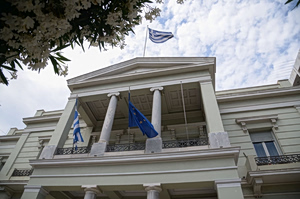
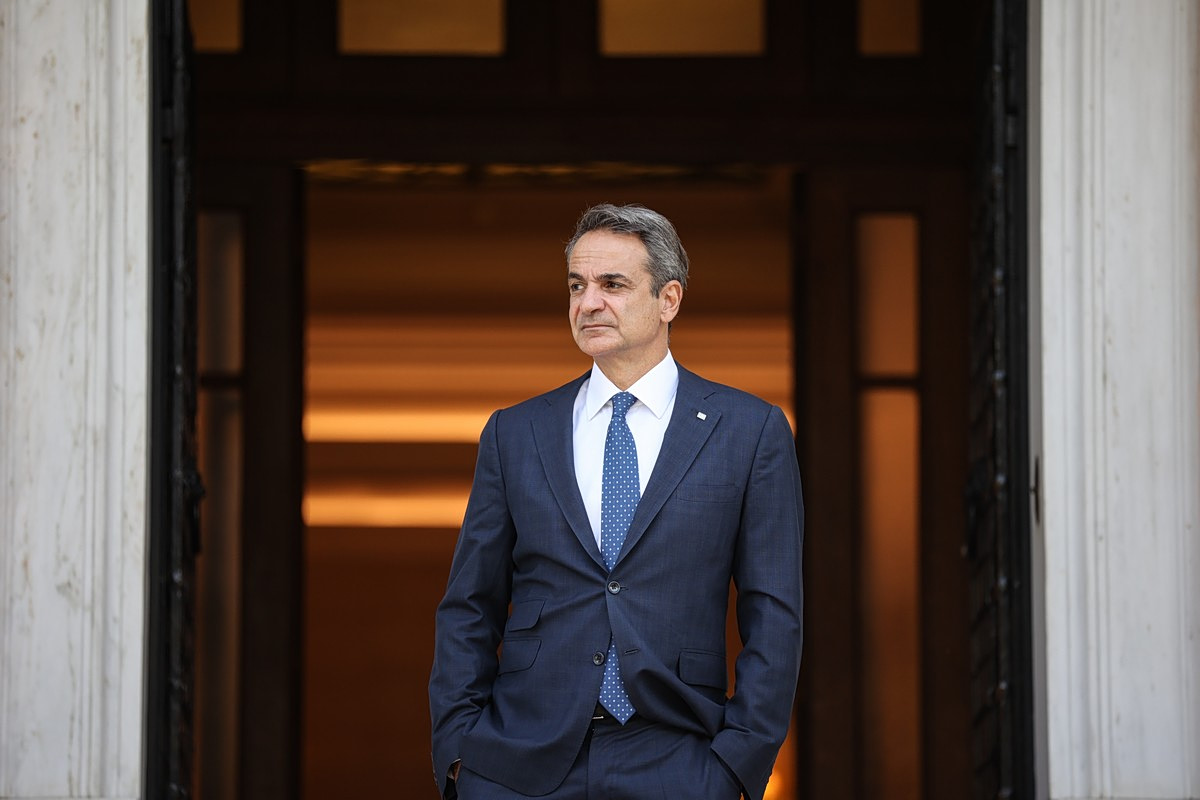
What unfolded ahead of a scheduled meeting at Greece’s Maximos Mansion—the prime minister’s official office—resembled a political game of “hot potato” over who would represent the protesting farmers. Just minutes before the talks were due to begin, the majority of farmer roadblocks announced they would not attend their meeting with Prime Minister Kyriakos Mitsotakis.
Instead, at 3:00 p.m., the prime minister will meet representatives from a minority faction of the protesters.
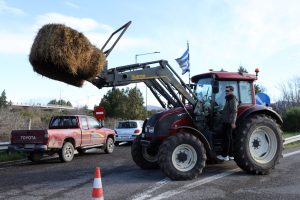
The dispute has effectively torpedoed meaningful dialogue between the government and representatives of Greece’s primary production sector, whose members have been blocking highways and major routes across the country for more than six weeks. At the heart of the breakdown lies a tug-of-war over both the structure of the talks and who would legitimately speak on behalf of the farming community.
A Boycott at the Eleventh Hour
At the very last moment before the scheduled meeting, the majority of roadblock groups—largely dominated by hardline agricultural union leaders who have adopted a confrontational stance toward the government—decided not to enter the prime minister’s office.
Their objection centered on the government’s proposal to hold two consecutive meetings, each with a different composition of participants. Despite overnight back-channel negotiations, by early morning it was clear that Prime Minister Mitsotakis would proceed with a meeting at 3:00 p.m. with representatives from roadblocks in Macedonia and Crete.
These groups, considered a minority within the broader protest movement, had publicly distanced themselves days earlier and declared their support for initiating dialogue with the government.
Two Meetings, Two Visions
The government agreed to hold two separate meetings but insisted that the first include those who had previously rejected dialogue altogether, with the second reserved for the remaining representatives.
The majority of agricultural union leaders countered with a different proposal: two meetings divided not by protest groups, but by profession—one for farmers and another for livestock breeders, fishermen, and beekeepers.
When no compromise was reached, the talks collapsed.
Mutual Accusations After the Collapse
Following the breakdown, government officials accused agricultural union leaders of remaining inflexible and having no genuine interest in dialogue. From the farmers’ side, the response was equally sharp: they accused the government of pursuing a “divide and rule” strategy, arguing that it sought to impose its positions rather than engage in substantive discussions.
Waiting Since December 6
Government sources point out that as early as December 6, Prime Minister Mitsotakis had proposed a meeting with protesting farmers—on the condition that they agree on clear representation and specific demands.
“Forty days later,” these sources argue, “it became clear that the intentions of certain roadblock representatives had nothing to do with addressing the legitimate demands of Greek farmers.”
According to the government’s version of events, the collapse occurred because “one group of roadblock representatives refused to attend the meeting together with the second group.”
Officials also emphasized that the cap of 20 representatives per meeting was a basic prerequisite for any meaningful discussion with the prime minister. “It is not acceptable to question after the fact something that was clearly communicated from the outset,” they said.
A ‘Shell Game’ Over Representation
The Ministry of Rural Development did agree to increase the number of representatives from Thessaly roadblocks allowed to attend—from the originally agreed 20 to 25. However, this concession came with a condition: the delegation could not include “individuals under investigation by authorities for illegal subsidies or unlawful conduct.”
Beyond this, the government signaled that it has exhausted its capacity to meet additional demands from the farming sector, while reiterating its criticism that party-political motives lie behind the continuation of the protests.
“Dialogue Is for the Many, Not the Few”
“Dialogue exists to deliver solutions for the many—approximately 600,000 farmers, livestock breeders, fishermen, and beekeepers across the country—not to serve the personal choices or party agendas of a few,” government officials said.
“The government—and society above all—has no more time for those who, for whatever motive, wish to continue this revolutionary calisthenics.”
As for what comes next if farmers whose representatives refuse dialogue continue blocking roads, officials were blunt: “All measures already announced for the benefit of farmers and livestock breeders will be implemented. If protests escalate, responsibility will lie solely with the authorities.”