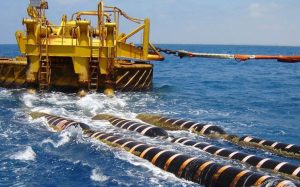
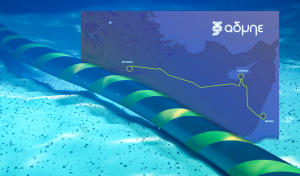
Greek Foreign Minister Giorgos Gerapetritis addressed the challenges facing the Great Sea Interconnector, the Greece–Cyprus electricity link, in an interview, on Tuesday, August 9. The minister stressed that attempts to undermine the project’s strategic importance will be firmly resisted.
“Anyone who thinks they can weaken the project—the Greece–Cyprus–Israel interconnection—through attacks will find us standing against them,” he warned.
The minister underlined that the initiative is vital for all three countries, as it will end Cyprus’s energy isolation. He noted that Cypriot President Nikos Christodoulides has already called it a project of “geostrategic importance,” while adding: “The technical and financial issues will be resolved. Its geopolitical value outweighs the economic considerations. There is a protection plan in place, the project is of European interest, and any obstruction will have consequences at the EU level.”
Gerapetritis went on to condemn “gross excesses by private interests” seeking to block progress, accusing them of doing so because of Cyprus’s high energy prices. “We will be relentless,” he said.
On the Turkey–Libya maritime accord, the foreign minister insisted that even if ratified, it would not be legally valid. “Turkey and Libya do not have opposite coasts, unlike Greece with Libya and Egypt,” he explained. He added that by the end of the year, a roadmap would be in place for talks with Libya on delineating exclusive economic zones (EEZs).
Gerapetritis also emphasized that Greece has never abandoned its relations with Khalifa Haftar’s administration in eastern Libya. Instead, Athens has sought to rebuild ties with both eastern and western Libya in order to counter Ankara’s 2023 illegal agreement with Tripoli.