
Greece’s road to economic recovery and digital transformation continues to be a complex balancing act.
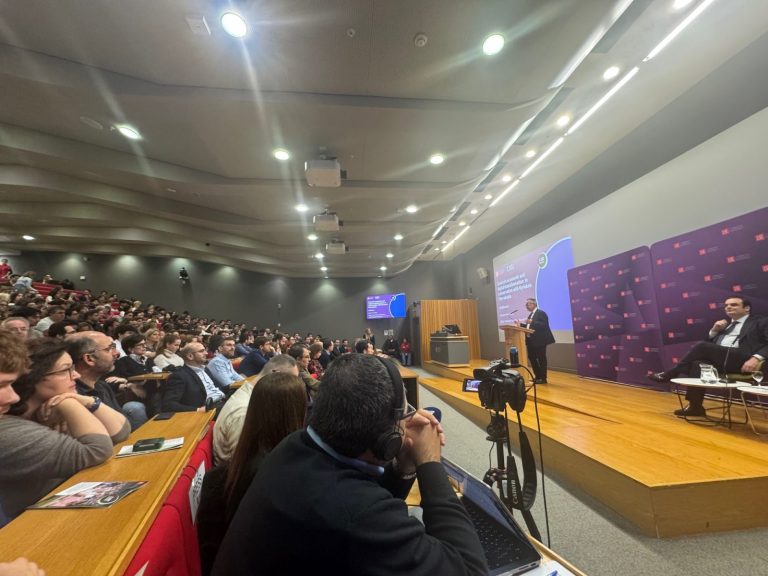
Speaking at a session hosted by the Hellenic Observatory and the Hellenic Bankers Association (UK) at the Sheikh Zayed Theatre at the London School of Economics in London, Greek Minister Kyriakos Pierrakakis compared national progress to the game of Tetris: “The most political game in history is Tetris… Successes evaporate, mistakes accumulate.”
The minister framed the discussion around Greece’s institutional reforms, economic recovery, and social challenges.
Responding to concerns about the high levels of subjective poverty highlighted in a recent EU survey, Pierrakakis stressed both progress and ongoing hurdles:
“There are still challenges to be met, citizens to be supported, businesses to be supported, and many moves that need to happen at the Greek level. If I look at the macro data… real income GDP was 62% in 2018 and 70% now.”
He highlighted key reforms aimed at improving fiscal governance:
“Through two mechanisms. The first one was digital. We introduced digital technologies in our tax system. The second one was institutional. We created an independent tax authority, which was responsible for collecting taxes and for taking its own decisions… and it works. It worked.”
Pierrakakis also acknowledged the limitations of these successes, particularly for vulnerable populations:
“If you look at the spike of electricity prices, spike of food prices, or the spike in rents… we fully understand that there are specific citizens… who need a different sort of support. We’re doing our best to achieve this.
“We fully understand that there are specific citizens, and many people that we know, who are facing very significant challenges if they even rent. And if they have income challenges through basically at the lowest income brackets, they need a different sort of support.
We’re doing our best to achieve this. And if you look at the last act we finally delivered, it had this mindset at its core. This is what we tried to do.”
Despite the optimism, he cautioned against expecting quick fixes:
“Is there a magic wand to solve for all of those problems in your country and converge with the EU average at once? I think that modern history teaches you that whomever ever promised that this would be delivered by a single piece of law… fundamentally ended up costing more to the economy.”
Pierrakakis emphasised the importance of a culture of correction:
“We have a different culture, a culture of correcting mistakes, a culture of acknowledging mistakes, and a culture of understanding what needs to be corrected quite quickly, through the mechanisms that work.”
The conversation highlighted a nuanced reality: Greece has made measurable progress in institutional reform, digitalisation, and economic growth, but social inequalities remain acute, particularly for those in low-income brackets. As Pierrakakis put it, the challenge is ongoing:
“What we have already delivered is a given, and what we still need to deliver is there. But… we have the culture, the mindset, and the will to deliver it.”
A ‘lasting impact’ from the RRF – or overreliance on temporary support?
Pierrakakis argued strongly that the Recovery and Resilience Facility (RRF) represents not just external funding but a catalyst for reform.
He insisted its significance lies in its design, not merely its scale:
“The RRF is something that is unique for Europe and is unique for Greece as well, because it’s not only about funding, right, it’s about targeting funding I would argue, because every penny has been matched to a reform so this means that the impact of the RRF will be lasting. This is extremely important to internalise. The reforms are not only stories of funding in the sense of a large funding story. Growth is not only a funding story, but also a reform story. I would say a regulatory burden story. Growth is a barrier-removal story for Europe. For me, this has been the most important thing to know here.”
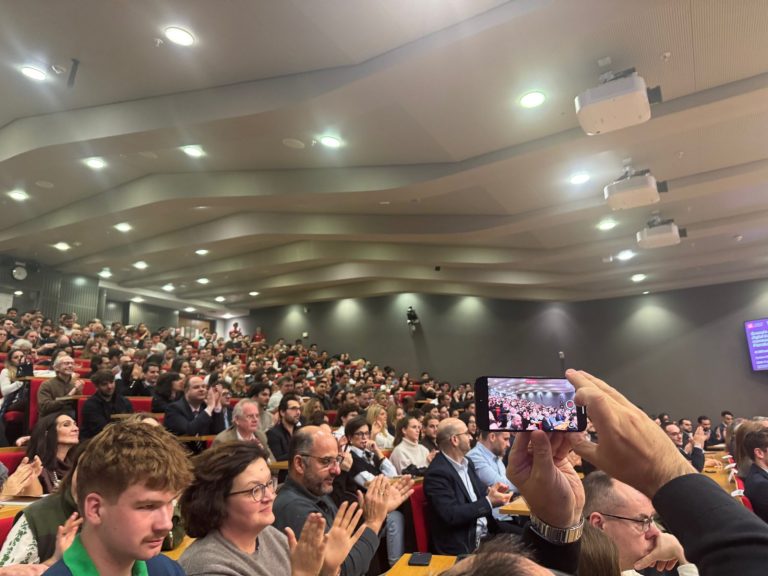
But several audience members pressed him on whether Greece risks being overly dependent on a temporary European instrument, particularly as RRF disbursements decline after 2026.
Demographics, tax incentives and the risk of ‘policy symbolism’
Much of the discussion focused on Greece’s demographic crisis – one of the most acute in Europe. Pierrakakis emphasised the government’s new tax incentives:
“Let me begin by saying that we have tried to simplify taxes. The second thing that we have done is that we have created a logic of incentives. The effective tax rate of a family with four kids and above is 0%. The effective tax rate for an under-25 worker is 0%. So we have applied a set of tax incentives to alleviate what I would describe as a challenge that we need to overcome.”
But when challenged on whether tax cuts alone can meaningfully reverse population decline – something demographers widely dispute – he offered a more cautious acknowledgement:
“I’m not claiming that this will solve the acute demographic problem, let me be clear on that from the outset. What I’m describing here is a unified cohesive policy approach on demographics. At the same time, we are working on eliminating the real estate taxes for villages that have below 1,000 citizens. There are many things that we need to do.”
Capital markets, Euronext and the thin participation of Greek households
The event also touched on the low level of household participation in Greek equity markets, a long-standing structural imbalance.
When asked whether Greece risked copying the laissez-faire American model – with all its volatility – Pierrakakis emphasised a rules-based European environment and the government’s efforts to make capital markets more attractive:
“Let me begin by saying that we recently had a capital markets reform. These things take time. The Euronext acquisition should become material next week. That’s the expectation at least. Being part of a European liquidity pool changes things for Greece very very easily. Because being part of a broad liquidity pool in Greece, a European liquidity pool, changes things. It’s different to have an isolated stock market monopoly. And different to be part of a European liquidity pool with 700 countries. I think we need additional reform on the capital markets. We need to pass even better laws and remove extra barriers that might still exist. I would ideally like to see the most innovative capital markets institutional framework in Greece.
At the same time, it’s important to have the literacy as well. Financial explaining, I was previously the Minister of Education, financial explaining was something that we introduced.”
During the session, a student from the Department of Economics at the LSE, Thodoris, questioned the government’s approach to public debt management.
He noted that Greece’s debt is currently very well hedged, with an average rate of around 1.8%, and asked why the authorities continued to pursue early repayments instead of potentially using the funds more productively.
Kyriakos Pierrakakis responded that the Public Debt Managing Authority (PDMA) operates within EU directives, which limits flexibility in redirecting these funds.
He praised the PDMA staff for their professionalism, describing them as “the most phenomenal public servants that you can meet” and suggesting they deserved recognition for their work.
Pierrakakis highlighted that the real average interest rate is 1.75%, with a weighted average maturity of 19 years, well above the European average of 8.5 years.
He added that early repayments serve not only to stabilise key sectors such as healthcare but also to signal to international markets that Greece is a responsible and capable borrower.
Institutional credibility: success stories – but persistent weaknesses
One of the strongest parts of his presentation related to institutional reform, where he drew directly on personal experience: “To paraphrase a very quoted politician, there is nothing wrong about Greece that cannot be solved through what is right about Greece.
“By definition, you cannot have sustainable economic growth without quality of institutions, especially in Greece or places like Greece. The headline ten years ago was tax evasion in Greece is high. Did we manage to solve for this to a large extent? We did. Through two mechanisms.
“The first one was digital. We introduced digital technologies in our tax system. The second one was institutional. We created an independent tax authority, which was responsible for collecting taxes and for taking its own decisions… And it works. It worked. So we have institutional failures in Greece, most of them, I would say, acutely chronic, which now, one after another, we need to continue resolving.
“On others, we also made mistakes, and the mistake was not acting fast enough. It’s not by accident that I’m using the independent tax authority, because in the agricultural subsidies case, for instance, which I’m mentioning myself, which is a story of failure…
“We know how to correct it, and we’re correcting it through the institutions, through the mechanism of the independent revenue authority, which was the same institution, that is solving for capital tax evasion. So I am optimistic that one after another, we know how to bring the visiting courts without saying that those problems that don’t exist or aren’t still there.”
Pierrakakis acknowledged that institutional failure remains a powerful force: “One of my former professors would say successes evaporate, mistakes accumulate.”
Still, he insisted that Greece is now on a path of positive momentum created by necessity during the crisis.
Finally, one member of the audience asked whether Greece, after its long crisis, now feels confident enough to offer advice to Europe. Pierrakakis cautioned against overconfidence:
“I don’t plan to fall into that trap. But what I can say is, we have learned many lessons out of this experience, and the core lesson is that Greece incurred a lot of collective social pain because of what happened in the previous decade. Let’s not do it again.