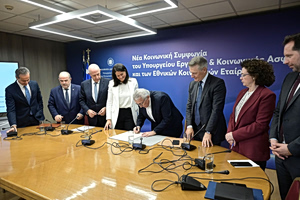
Greece’s Parliament is debating a new labor bill on collective agreements introduced by the Ministry of Labour and Social Security, drawing sharp criticism from opposition parties and a forceful defense from Labor Minister Niki Kerameus.
Speaking at the relevant parliamentary committee, Kerameus challenged critics over their stance, arguing that collective labor agreements strengthen workers’ positions and reinforce employment protections. She said society and social partners have called for easier procedures to conclude collective agreements, which the draft law facilitates.
At the heart of the government’s proposal is what it describes as a “National Social Agreement,” the result of seven months of consultations between the Labor Ministry and Greece’s national social partners from May to November 2025. According to the ministry, the agreement marks the end of restrictions imposed during the country’s bailout years and ushers in a new era of collective bargaining and social dialogue.
Government: A “Historic” Reform
The government has described the National Social Agreement as historic, noting that it is the first time such a broad tripartite agreement has been reached between the state and all national social partners on labor issues.
It says the overarching goal is to increase the number of collective agreements signed and extended, expand worker coverage, and ensure quicker resolution of collective disputes. The reform, officials argue, will provide security for workers, stability for businesses and clear rules for the labor market.
Kerameus framed the debate in stark terms, asking whether lawmakers ultimately want more collective agreements and broader worker coverage. “We do,” she said, emphasizing that the initiative was undertaken jointly with social partners to ensure workers receive a greater share of economic growth.
Opposition Pushback
The main opposition party, PASOK – Movement for Change, has tabled its own amendment. Party officials argue that the bill is incomplete and does not guarantee that the minimum wage will be set through the national general collective agreement.
They have indicated that unless changes are made, they will vote against the bill in principle. Party leader Nikos Androulakis is expected to address the plenary session during the debate.
SYRIZA has also announced it will vote against the bill in principle, while reviewing each article individually. Sokratis Famellos is expected to speak during the session.
Meanwhile, the Communist Party of Greece (KKE) has strongly criticized the proposal, arguing it reinforces what it describes as a framework serving competitiveness and profitability at workers’ expense. In a statement, the party said the bill does not genuinely safeguard labor rights and claimed it continues policies introduced by previous governments.
What the Collective Agreements Bill Changes
Under Greek labor law, an individual employment contract is signed between a worker and an employer. A collective labor agreement, is signed by workers’ unions and employers’ organizations (or an individual employer) and sets wages, working hours, leave and other key employment terms for those covered.
The government argues that collective agreements act as a “safety net,” since individual contracts may only improve, not worsen, the terms set out in a collective agreement.
Lower Threshold for Extension
One of the bill’s key provisions concerns the “extension” of collective agreements across an entire sector or profession.
Currently, for an agreement to be extended to all workers and businesses in a sector, it must cover at least 50% of employees. The proposed reform lowers that threshold to 40%.
The bill also creates an alternative way to extend collective labor agreements beyond the companies that originally signed them. Normally, an agreement must cover at least 40% of workers in a sector before it can be applied to all employers. Under the new provision, however, that threshold would not apply if the agreement is co-signed by national-level employer associations and labor unions. In such cases, the agreement could be extended more easily, potentially bringing a much larger number of workers under its terms.
Full Protection After Expiration
Another major change involves what happens after a collective agreement expires.
Under the proposed framework, once an agreement ends and the automatic three-month extension period passes, all of its terms will continue to apply to covered workers until a new collective agreement is signed or an individual contract is concluded. The government says the measure restores the full force of collective agreements, undoing bailout-era restrictions that curtailed how long labor protections remained in effect after contracts expired.
New hires during the three-month extension period would be fully covered by the agreement’s terms.
The bill also reforms collective dispute resolution procedures.
What Comes Next
The bill is now before Parliament’s plenary for debate and vote. The vote is expected to be held later today.