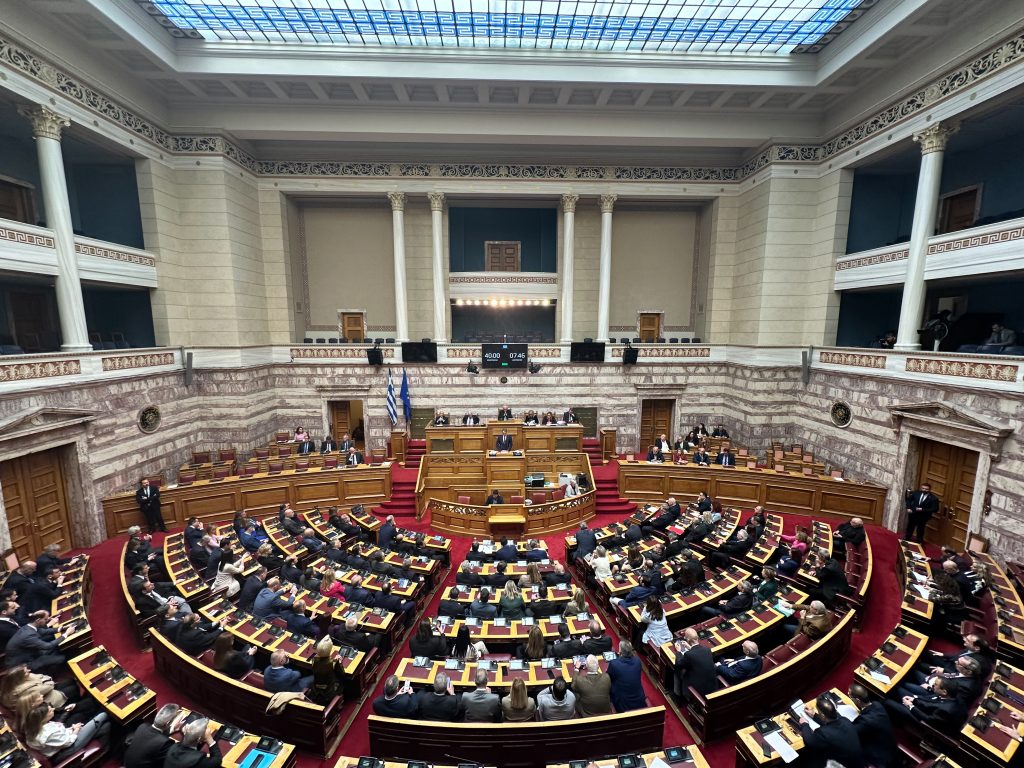
The Greek Parliament is set to debate and vote on a bill that would grant exploration and potential extraction rights for hydrocarbons to a consortium by Chevron and HELLENiQ Energy in four offshore areas.
The legislation, introduced by the Ministry of Environment and Energy, is being presented by the government as a pivotal step in the country’s energy strategy. Officials say the agreement could potentially expand Greece’s role in the regional energy landscape while reinforcing its geopolitical position in the East Med.
Expanding offshore exploration
According to government sources, the agreement would effectively double the maritime areas available for hydrocarbon exploration and exploitation.
Officials argue that expanding exploration zones increases the chances of discovering commercially viable energy deposits. Such exploration, they note, requires advanced technology and significant financial investment and those costs would be borne by the companies involved rather than the Greek state.
Government representatives also say the deal could strengthen Greece’s position as an energy hub in the region, potentially transforming the country from a transit point for energy into a producer of natural gas.
They have also attempted to frame the agreement as a geopolitical strategic win, claiming that the move weakens the “illegal and unfounded” Turkey-Libya maritime memorandum — a 2019 agreement between Ankara and Libya that Greece strongly disputes.
Government sources say that despite a diplomatic protest by Libya, Chevron — described as the world’s second-largest private energy company — is “proceeding with investments worth millions of euros in offshore areas south of Crete and the Peloponnese”.
If commercially exploitable deposits are discovered, the state could receive between 38% and 41% of the profits, according to government estimates.
Opposition parties split on energy exploration bill
PASOK, has indicated it will support the bill in principle. During the final session of the relevant parliamentary committee, PASOK lawmaker Fragkiskos Parasyris said the broader strategy of exploiting Greece’s hydrocarbon resources dates back to policies introduced by PASOK governments starting in 2011.
“For this reason, we cannot disagree with the bill in principle,” Parasyris said, arguing that the current government has effectively adopted a policy direction first developed by center-left PASOK.
Still, the party has raised concerns about specific provisions. Parasyris said the main opposition party had reservations about wording related to exploration blocks south of Crete, noting that a particular clause, namely Article 3053, was added shortly before review by Greece’s Court of Audit despite lengthy prior discussions between authorities and companies.
The left-wing Syriza party, which had initially stopped short of stating its final position ahead of the parliamentary debate, now appears likely to vote against the bill. Speaking during committee discussions, Syriza lawmaker Miltos Zambaras questioned whether Greece has a coherent long-term energy strategy. “What we see in recent years is not a stable national energy policy,” he said. “It is a government that changes its narrative depending on its political needs.”
What will happen today
Despite criticism from some opposition parties, the bill is expected to pass in Parliament.
The governing New Democracy party is expected to secure approval with the support of PASOK, although PASOK lawmakers have indicated they will raise objections to specific provisions. The nationalist Elliniki Lysi party may also vote in favor.
By contrast, the Communist Party of Greece (KKE), New Left and the Plefsi Eleftherias party have said they will vote against the bill. The Niki party has not yet announced its position ahead of the plenary vote.