Greek Prime Minister Kyriakos Mitsotakis is making a whirlwind visit to Sofia Thursday before traveling to the coastal city of Tivat in Montenegro. During what is shaping up to be a distinctly Balkan-focused 24 hours, the prime minister is opening discussions on defense and energy cooperation while also expected to send another message to Tirana against the backdrop of serious incidents and the injury of a Greek citizen during unrest that took place last Saturday in Zvërnec, Albania.
His meeting with Bulgarian counterpart Rumen Radev follows the recent formation of Bulgaria’s new government. The leaders are scheduled to hold private talks with their respective delegations before delivering joint public statements. As Mitsotakis is expected to emphasize publicly, Athens places significant importance on strengthening relations with Bulgaria at a time of mounting geopolitical challenges facing both Europe and the wider region.
During the prime minister’s brief stay in Sofia, discussions are expected to focus heavily on air defense and energy—areas in which Greece is seeking to play a leading regional role.
Patriots and LNG
Athens is aiming to identify opportunities for deeper cooperation on cross-border projects in both energy—such as the Vertical LNG Corridor—and transportation with Bulgaria, a fellow member of both the European Union and NATO.
The visit is not solely about signaling Greece’s ambition to contribute to the energy security of Central and Eastern Europe. It also comes at a time when energy prices and broader energy policy remain prominent issues in Greece’s domestic political debate.
Another significant factor is Greece’s decision in March to assist Bulgaria’s air defense capabilities following a request from Sofia to help address potential threats. A Patriot missile battery was deployed to Didymoteicho, in northeastern Greece, providing anti-ballistic coverage for a large portion of Bulgarian territory.
However, the withdrawal of Patriot systems from both northern Greece and the island of Karpathos in May, following decisions by Greece’s Government Council for Foreign Affairs and Defense (KYSEA), sparked considerable discussion and questions domestically.
During meetings in Sofia at the time, Greek Defense Minister Nikos Dendias spoke of the “shared will” of Greece and Bulgaria to deepen defense cooperation, particularly in innovation. He also highlighted what he described as “significant opportunities for cooperation” under the EU’s SAFE regulation aimed at strengthening Europe’s defense industry.
The Western Balkans
Later in the afternoon, Mitsotakis will arrive in Tivat, Montenegro, where he will join European Union and Western Balkan leaders for a dinner hosted by Montenegrin President Jakov Milatović.
Greece’s support for EU enlargement remains clear and consistent. Government sources describe enlargement as “an investment in security and stability.”
At the same time, Mitsotakis is expected to reiterate Greece’s long-standing position that the accession process for Western Balkan countries must be based on each candidate’s individual performance—particularly regarding reforms and compliance with all required conditions.
“The future of the Western Balkans lies in the European Union” remains a core position repeatedly voiced by Mitsotakis. Greece continues to support the region’s European integration prospects, but only if countries meet the necessary requirements, particularly concerning good-neighborly relations, respect for fundamental rights, and adherence to binding international agreements.
A Strategic Priority
Government officials also stress that advancing the European perspective of the Western Balkans is a priority as Greece prepares to assume the rotating presidency of the Council of the European Union during the second half of 2027.
Speaking on Wednesday in Thessaloniki at the opening of the 19th Balkan Countries’ Chiefs Of Defense Conference, Defense Minister Nikos Dendias described stability in the Balkans as a vital national interest for Greece.
“Anything that strengthens one of us, when it is part of a framework of genuine cooperation, strengthens all of us,” Dendias said. “Because the security of the Balkans is also a European matter.”
In the background remains Greece’s warning regarding Albania’s EU accession path. Athens has repeatedly stressed that respect for and protection of the rights of the ethnic Greek minority in Albania constitute a non-negotiable red line.
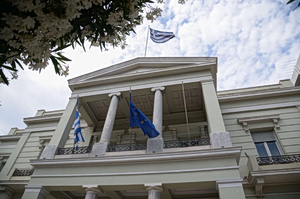
From the outset, Greece’s Foreign Ministry expressed concern over the incidents of May 30, which occurred during a protest by local residents over property rights issues.