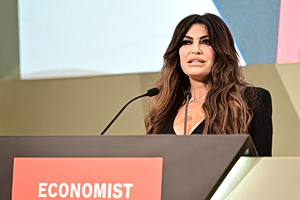
The relationship between Greece and the United States is “bolder and stronger than ever,” according to Kimberly Guilfoyle, the US Ambassador to Athens, in a wide-ranging interview with the Athens-Macedonian News Agency conducted on the occasion of her recent visit to Thessaloniki.
Guilfoyle described Greece as an exceptionally stable and reliable ally, one into which Washington — at both governmental and private level — is eager to channel investment. Mapping out the landscape of American investment, defense cooperation and energy diplomacy vis-à-vis Russia and China, the ambassador also spoke of the bonds of faith and humanity linking the two peoples, prompted by her recent visit to the Monastery of the Annunciation of the Theotokos in Ormylia, Halkidiki, and its affiliated “Panagia Filanthropini” medical center.
Turning to the prospects of Thessaloniki and northern Greece more broadly, Guilfoyle did not hesitate to compare the region’s momentum to that of the world’s leading technology hubs. “I would say that the region of Northern Greece reminds me, in a way, of Silicon Valley at its peak,” she said, pointing to major infrastructure and technology investments such as Deloitte’s local facilities and the data-center infrastructure being developed by Greece’s Public Power Corporation (PPC). Businesses are choosing to invest in the area, she noted, channeling American capital to support local economies precisely because they can genuinely turn a profit and grow there.
She singled out infrastructure as one of the region’s principal advantages. “You’ve organized things here very well. It’s really impressive. This isn’t just another beautiful destination in Greece — it’s a place that is developing dynamically,” she said, adding that Washington places great weight on an open business environment free of red tape.
Energy remains central to American strategy in the region. Guilfoyle argued that Greece is now positioned to play a leading role in shaping the region’s energy future, citing progress on the Vertical Corridor and crediting much of that progress to the Greek government. She stressed the importance of deepening cooperation with Serbia and North Macedonia through the memorandum signed days earlier in Thessaloniki at the 10th Southeast Energy Forum, in which she herself took part. “Greece and the United States feel the same way,” she said of the corridor’s expansion, “that all these countries matter when it comes to energy cooperation.”
She also highlighted Greece’s transition toward becoming an energy supplier for the wider region, pointing to exploration activity by Chevron, HELLENiQ and ExxonMobil, as well as the first oil exploration off Crete in 40 years. Northern Greece was central to this picture too, she said, noting that Alexandroupoli possesses infrastructure of exceptional importance and further growth potential, and that investment there strengthens not only the Greek economy but Europe’s overall energy resilience.
Guilfoyle pointed to Russia’s use of energy as a weapon against Ukraine, recalling how Moscow had tried to trigger blackouts over the winter in order to cut off Ukraine’s energy supply and weaken its position at the negotiating table. She noted that Greece and the United States had stepped in to ensure Ukraine had access to LNG to get through the winter, strengthening its hand to keep negotiating and fighting for its country, and warned that the world is increasingly witnessing a form of energy terrorism, with infrastructure itself becoming a target of war.
She also pointed to the strategic importance of Greek ports in countering Chinese influence, arguing that increasing throughput at ports such as Alexandroupoli, Elefsina and Revythousa would be highly strategic for both Greece and the wider region.
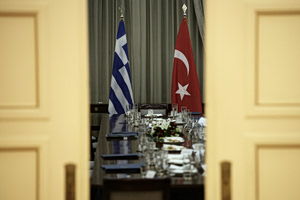
Asked about Greek-Turkish relations and Washington’s role, Guilfoyle emphasized the need to keep communication channels open between NATO allies.
On defense cooperation, Guilfoyle noted there are numerous plans underway on the military and defense front, with Greece acquiring F-35 jets as well as additional munitions for its F-16 fleet, and said a comprehensive defense package is in the works. She stressed that Washington relies very heavily on Greece, which has made a strong commitment to spend 5% of GDP on military defense capabilities — putting it well ahead of many larger EU countries, a fact she said has not gone unnoticed by President Trump.
She described existing military interoperability as impressive and Souda Bay as “of critical importance,” citing operations Midnight Hammer and Epic Fury as vast, complex missions that showcased this cooperation. She also referenced Greece’s role in operations and evacuations from the Middle East, noting that missions of such scale and global reach require reliable partners, particularly in that part of the world, and that Greece occupies a unique and highly significant geopolitical position that the United States values greatly.
On the upcoming visit of Secretary of State Marco Rubio to Greece, Guilfoyle said the choice was significant and no routine gesture. Unlike a NATO summit, she explained, the trip was meant for substantive discussions and to thank Greece for its cooperation with the United States — a gesture she called substantive rather than symbolic, reflecting Washington’s deep gratitude for all that had been achieved together.
She also referred to recent talks in Athens between Under Secretary for Political Affairs Allison Hooker and Greek Deputy Prime Minister Kostis Hatzidakis, Defense Minister Nikos Dendias, Maritime Affairs and Insular Policy Minister Vassilis Kikilias, and Deputy Foreign Minister Alexandra Papadopoulou, and announced a further visit by Under Secretary Jacob Helberg within the coming month on artificial intelligence and digital infrastructure issues.
In an emotional passage, Guilfoyle spoke of her visit to the Ormylia monastery and its medical center in Halkidiki calling it “one of the most powerful and moving experiences” of her life, recalling her Catholic upbringing under the Sisters of Mercy and saying the relationships she’s built with the Patriarch, the Archbishop and the Greek Orthodox Church have been among the best parts of her tenure. She praised the nuns’ breast-cancer prevention work as “wonderful.”
She closed by praising the new US Consul General in Thessaloniki, Matt Hagengruber, who “hit the ground running,” and the American diplomatic team there — a city, she said, that holds a special place in her heart.