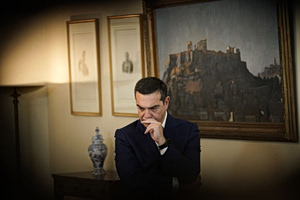

A book begins with an omen. In the early hours of 29 June 2023 — just hours before announcing his resignation as leader of SYRIZA, Greece’s main left-wing party — Alexis Tsipras released a pigeon trapped on his apartment balcony. The image is instantly freighted with meaning for the author; a few lines later he writes simply: “Now I am absolutely sure of my decision.” It’s an ideal opening to lure the reader into a 762-page work: a small episode (barely a page and a half) loaded with symbolism that exposes the human side of its protagonist while pushing politics gently into the background — at least at first.
That private, humane prologue is deceptive. Politics soon takes full command. After a brief autobiographical section sketching origins, childhood in the 1980s and the formation of his ideas, Ithaca becomes, in practical terms, an account of Tsipras’s governments, a defense of his choices and an outline of his proposals for the future.
Political memoirs are a consecrated literary species. They thrive elsewhere in Europe — nearly every outgoing prime minister prepares one — and in the United States almost every president of the last century has written one, from Calvin Coolidge to Barack Obama. For many leaders, such a book marks the start of the “second act”: a life of paid speeches, advisory roles and a place among elder statesmen. That function distinguishes modern memoirs from earlier political tracts: publishers now expect a lighter structure, episodic scenes, signposted moments that can be excerpted for reviews and speeches.
Good guys, bad guys
Ithaca tries to follow that modern playbook. Characters stage their entrances: villains (Yanis Varoufakis), heroes (François Hollande), and ambiguous figures who ultimately tilt toward the “good” side (Angela Merkel). Flashbacks ferry us into the past; sparse holiday snapshots and private moments puncture the density of policy detail. For roughly 350 pages — essentially the arc from SYRIZA’s rise through the January 2015 election to the 17-hour negotiation on 13 July that secured Greece’s stay in the eurozone — the method works. That half-year was so intensively covered by domestic and international media that even insiders have little new to add beyond personal impressions and feelings.
The book’s difficulties begin after that point. It gradually loses momentum, veering into long, ropey descriptions of policy minutiae, intra-party purges, and blistering polemics against the former opposition (now governing parties). Significant events — the Prespa Agreement on North Macedonia, or the backstage days that led to Tsipras’s resignation as SYRIZA leader — appear only as flashes amid a crowded narrative.
A performative denial
All political memoirs, like memoirs generally, aim to vindicate their authors. By their nature they can’t be fully detached, don’t claim historic objectivity and are personal testimony rather than archival scholarship. It is therefore telling that Ithaca begins with a protestation: Tsipras explicitly declares in his preface that the book did not arise “from a need for personal vindication.” The denial is performative. His very detailed explanations of motive, repeated insistence on personal responsibility, and robust defense of key decisions make clear the book’s purpose: vindication.
After all, nobody writes a 762-page political memoir to renounce their past.