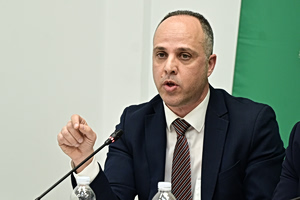
The wiretapping scandal is the biggest scandal of Greece’s Third Republic, given its scope, the people who were targeted, the use of illegal spyware and the direct violation of fundamental rights, lawyer Zacharias Kesses wrote in a piece published in Ta Nea on Friday. Those factors, he argued, should have demanded speed, thoroughness and the exhaustion of every available investigative tool from the outset.
Kesses, who represents several victims in the case, wrote that Greece’s Supreme Court Prosecutor’s Office has failed to meet that standard.
According to Kesses, the investigation has been marked by delays and serious gaps. He wrote that the file was removed from prosecutors at the Court of First Instance shortly before charges were filed, that no felony charges were ultimately brought, and that the indictment that was drawn up covered only misdemeanors, applying what he called a scientifically flawed approach to how the offenses overlapped. He also wrote that a preliminary technical assessment was carried out by people outside the official register of experts, with no opportunity for victims to appoint their own technical advisers, that victims were never called in to give statements, that their mobile devices were never examined, and that defendants who had separately been the subject of criminal complaints were treated inconsistently under procedure. The file was then sent back by the Athens single member misdemeanors court, he wrote, without the substantive further investigation that new evidence in the case required.
Kesses also wrote that a prosecutorial official who worked on the file had grounds for recusal that were not disclosed. He described this as another episode in the same pattern of failures.
Under that order, Kesses wrote, certain Intellexa executives cannot be questioned because they may themselves be suspects. Their testimony, under certain conditions, could not later be used as evidence against them. Kesses argued that this reasoning confuses two separate things: a rule barring a statement from being used as evidence, and the prosecutor’s duty to investigate the crime itself.
Kesses said the contradiction is sharpened by an earlier finding from prosecutor Konstantinos Tzavellas. That finding had concluded there was no evidence against the same individuals to justify further investigation. Now, Kesses wrote, the possibility of their involvement is being used as the reason not to question them. He said the same underlying assumption, that they may be involved, is being used to reach opposite conclusions each time, but with the same result: the investigation stops.
Kesses argued that if prosecutors believe questioning these individuals could produce evidence of criminal involvement, the consistent approach would be to summon them as suspects, with full legal safeguards in place.
He said prosecutors have applied similar reasoning to new evidence introduced in the case. Rather than using it as a starting point for further investigation, he wrote, prosecutors have treated it as though it needed to already amount to final proof. As an example, he cited public statements by Tal Dilian, the businessman linked to Intellexa, about selling Predator to state authorities. Kesses wrote that these statements did not lead to an investigation into whether they were true. Instead, he said, prosecutors focused on interpreting what Dilian meant.
Kesses concluded that the pattern amounts to more than an inadequate investigation. He described it as a sustained institutional decision to limit scrutiny of a case that damaged public trust in the rule of law. He wrote that the wound left by the wiretapping scandal remains open, and that responsibility for keeping it open now rests increasingly with the Supreme Court Prosecutor’s Office itself.
Source: TA NEA