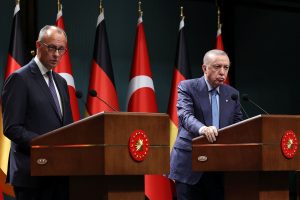
Friedrich Merz has called on Germans to work harder and longer hours, arguing that limited working time and high sick leave are weighing on economic growth as Germany’s economy remains stagnant.
“Don’t be lazy,” Merz told the public in a blunt appeal that has opened a risky political confrontation with Germany’s roughly 46 million-strong workforce. In recent weeks, he has repeatedly argued that Germans do not work enough hours and take too much sick leave, slowing the country’s economic performance.
Speaking to industry representatives in eastern Germany, Merz said national productivity is not high enough and singled out part-time work as a problem. He warned that work-life balance and four-day workweek models would not be enough to preserve the country’s current level of prosperity. “We need to work harder,” he said.
According to Politico, the message may be politically sensitive in a year with key regional elections, even in a country where diligence and hard work are often seen as civic virtues.
Pointing to Greece
Merz has also pointed to Greece as an example on working hours. Greece ranks at the top in the European Union for the most hours worked, despite having been labeled “lazy” by many German conservatives during the European debt crisis more than a decade ago.
During a visit by Greek Prime Minister Kyriakos Mitsotakis to Berlin last year, Merz praised labor market deregulation in Athens that allowed a six-day workweek. He said Germans who consider a 40-hour week unreasonable should “take a look at Greece,” adding that Germany could learn from the country in this area. He acknowledged, however, that German labor productivity remains much higher.
Limited Room to Act
Merz faces strong domestic resistance to labor changes and leads a coalition with the center-left Social Democratic Party of Germany, which supports existing labor protections. That leaves him with limited immediate tools to tackle Germany’s long-running skilled labor shortage and weak productivity.
At the same time, deeper problems may be emerging in the job market. Unemployment in Germany has recently exceeded 3 million, reaching a 12-year high, amid growing job losses in the industrial sector that has long powered the country’s export-driven economy.
“We have already decided on many measures to help the economy,” Merz wrote on X after the data was released. “But it is not enough.”