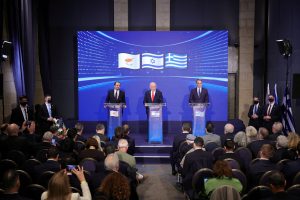
From Jerusalem, Greek Prime Minister Kyriakos Mitsotakis, Cypriot President Nikos Christodoulides and Israeli Prime Minister Benjamin Netanyahu cast the Greece–Cyprus–Israel trilateral partnership as a guarantor of security and stability at the strategic crossroads between East and West. Their message comes at a time of profound transition, as the Middle East map is being redrawn and the precise future role of the United States in the region remains fluid.
For Athens, cooperation with Tel Aviv is viewed as the most effective counterweight to Ankara’s revisionist ambitions in the Eastern Mediterranean. Against this backdrop, Mitsotakis spoke of the “deep changes” unfolding across the wider region—changes that carry risks but also opportunities. One such opportunity, he argued, lies in strengthening trilateral cooperation among “three democratic states” and in their leading role in shaping a new regional security architecture, guided by international law and the principles of good neighborly relations.
The reference to “democratic states” was well received in Israel, where leaders often describe the country as a Western “beacon” in a region marked by theocratic, fundamentalist and terrorist regimes—most notably Iran. At the same time, the phrase was widely interpreted as an indirect jab at Turkey, which has openly supported groups such as Hamas and plays a controversial role on Syrian territory. Mitsotakis also touched on developments in Lebanon and Syria, reiterating that protecting Christian Orthodox communities in the Middle East remains a top priority for Greece.
Netanyahu’s Sharp Warning to Erdogan
Netanyahu, however, was far more explicit—and biting. Addressing what he described as threats to Israel’s security, he warned against “imperial ambitions” in the region.
“To anyone who fantasizes about establishing an empire and ruling our land, I say: forget it. It will not happen,” he declared—words clearly aimed at both Iran and Turkey.
The Israeli prime minister again identified Turkish President Recep Tayyip Erdogan as a “real enemy,” pointing to Ankara’s aggressively anti-Israel stance throughout the Gaza war and Erdogan’s efforts to present Turkey as an emerging hegemonic power in the Middle East. Israel and Turkey, in reality, see their opposing interests colliding most sharply in Syria, with analysts increasingly warning that the country could become a theater for direct confrontation.
Netanyahu also referred to security agreements with Greece and Cyprus—remarks certain to further irritate Ankara. In recent weeks, Turkish officials and pro-government media have repeatedly accused Athens, Nicosia and Tel Aviv of attempting to “encircle” Turkey, both in Northern Cyprus and across the Eastern Mediterranean. Whether this cooperation will expand into a more formal trilateral military framework remains an open question. Notably, while Mitsotakis and Christodoulides were in Israel, Turkish Foreign Minister Hakan Fidan and intelligence chief İbrahim Kalın were conducting high-level visits in Syria.
Energy at the Core
The revival of the trilateral partnership—its first such high-level meeting since Hamas’ October 7, 2023 attack on southern Israel—has also drawn strong interest from Washington. The United States has consistently promoted alliance-based formats not only as anchors of stability, but also as vehicles for advancing American strategic and economic interests.
Energy cooperation is central to this vision, particularly in a “3+1” framework that includes the United States. So too is the ambitious IMEC corridor (India–Middle East–Europe), a flagship project of U.S. foreign policy since Donald Trump’s first term, designed to enhance connectivity and counter Chinese influence. Energy prospects and broader connectivity issues within the Athens–Nicosia–Tel Aviv triangle featured prominently in the statements of Cypriot President Christodoulides.
In their joint declaration, the three leaders reaffirmed their commitment to advancing common energy projects as the backbone of regional cooperation. They explicitly referenced the UN Convention on the Law of the Sea and the need to respect sovereign rights in Exclusive Economic Zones (EEZs) and continental shelves. Greece, Cyprus and Israel also reiterated their support for the Great Sea Interconnector (GSI), the planned electricity interconnection linking their grids. For now, however, Athens and Nicosia have agreed to review the project’s financial and technical parameters and to seek private investors.
Netanyahu, Trump and the Bigger Picture
Behind the scenes, U.S. President Donald Trump’s longer-term objective remains broader regional convergence—including de-escalation between Israel and Turkey, a need recently highlighted by U.S. Ambassador to Turkey Tom Barrack. As long as Netanyahu remains in power, however, most observers agree that Ankara would have to make the first significant concessions.
Mitsotakis underscored Greece’s emerging role as a major energy hub for Southeastern Europe—a development that could also benefit Israel if Israeli liquefied natural gas were eventually routed northward through Greek infrastructure. More broadly, Athens intends to keep energy at the heart of its geopolitical strategy: deepening U.S. engagement in the Eastern Mediterranean while safeguarding Greek interests.
“We see great potential in cooperation on these projects,” Mitsotakis said, expressing confidence that Netanyahu would brief Trump—during their scheduled Washington meeting on December 29—on the prospects of the updated 3+1 energy framework, revitalized at the P-TEC conference in Athens earlier this November.
“I believe U.S. participation clearly adds value, especially in energy and infrastructure,” the Greek prime minister noted.
For Athens, one additional concern looms large: the possibility of Turkey re-entering the F-35 fighter jet program. On this issue, Mitsotakis and Netanyahu appear fully aligned in their determination to prevent such an outcome.