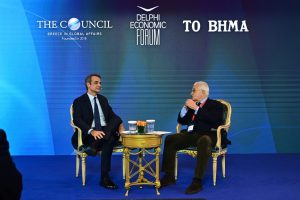
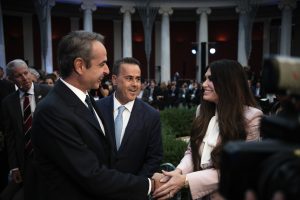
Greek Prime Minister Kyriakos Mitsotakis closed out the second annual Athens Policy Dialogues event on Friday, fielding a series of question in a “conversation format”, and ranging from foreign policy to domestic developments to election scenarios.
In terms of foreign policy, Mitsotakis told To Vima publisher Yiannis Pretenteris that his government’s goal is to maintain an “operational” relationship with an often-difficult neighbor, namely, Turkey.
Mitsotakis argued that Greece has charted its strategy that aims primarily at stability in the region, which include a reduction of tensions with Turkey, a step towards forming a more functional relationship — an effort which, he said, has already yielded results.
At the same time, he insisted that this approach is accompanied by the consolidation of national positions, attempting to show that dialogue with Ankara is not at the expense of Greek interests.

In closing out the well-attended two-day Athens Policy Dialogues event, which this year revolved around the theme of ‘The Eastern Mediterranean in Flux’, Mitsotakis told Pretenteris that conditions, in fact, were now ripe for another session of the High-Level Cooperation Council (HLCC) between Greece and Turkey, which is expected to take place in the first part of 2026.
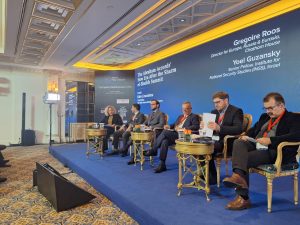
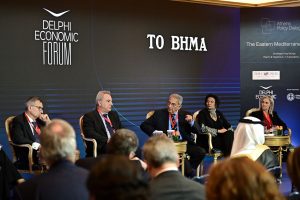
The event was organized and hosted in a downtown Athens hotel by the Delphi Economic Forum, The Council – Greece in Global Affairs and the historic Athens weekly “To VIMA” (Το Βήμα).

To Vima (To Βήμα) publisher Yiannis Pretenteris
He also maintained that bilateral relations with the neighboring country were “alarmingly tense” prior to the signing of the “Athens Declaration”. The latter understanding, Mitsotakis added, confirmed that the two countries can maintain a functional relationship, as evidenced by cooperation to stem migration flow, “an area where tangible positive results have been achieved.”
At the same time, he made it clear that Athens had set clear-cut limits where necessary, such as regarding the participation in European defense programs, stressing that de-escalation does not mean retreating on matters of principle. Specifically, he pointed to Turkey’s failure to join the SAFE defense procurement and production scheme in the present. The Greek government had demanded that Turkey move to rescind a 1995 grand assembly resolution declaring Greece’s right to extend territorial waters in the Aegean beyond six nautical miles as a cause of war (casus belli).
Conversely, he again pointed to the massively successful fast-track tourist visa scheme that has witnessed tens of thousands of Turkish citizens visiting 12 eastern Aegean islands after much of the “red tape” previously plaguing Turkish citizens was eliminated and the process streamlined.

Libya issue
Regarding Libya, Mitsotakis acknowledged that the situation remains complex. However, he stressed that Greek foreign policy has achieved something important: maintaining a stable channel of communication “with both sides of the Libyan reality”, reference to rival governments in the strife-plagued North Africa country, one in Tripoli and the other in Benghazi.
Libya came directly under Athens’ radar in 2019 when the internationally recognized provisional government in Tripoli signed a controversial maritime delimitation agreement with Turkey. Athens, the EU and other regional countries have called the agreement baseless and illegal. Tellingly, the agreement essentially “erases” all Greek island territory, including the large island of Crete, from the map in an attempt to show that the Asia Minor mainland and Libya’s North African coasts “border”.
On the issue of illegal migration emanating from Libya, another reason that the large country now figures in the “calculus” affecting the east Mediterranean and Greece, he said that we are in a better position compared to the previous six months.

‘Our relationship with Israel is long-standing’
Turning to another and closely watched part of the eastern Mediterranean, Mitsotakis emphasized that Greece’s strategic relationship with Israel now has deep roots and real substance, with the “3+1 format” (Greece, Israel, Cyprus and the US) being a prime example.
He stressed that from the outset, Greece supported Israel’s right to defend itself after the Oct. 7 Hamas attack. At the same time, he acknowledged that the Israeli side often went too far in its military response to the terrorist attack.
Cyprus
On the long-standing Cyprus issue, Mitsotakis stressed that with the previous Turkish Cypriot leadership in the Turkish- occupied areas of the north “there was no real room for progress”.
At the same time, he pointed out that Ankara’s position over a “two-state solution” is unthinkable and unacceptable, not only for Greece, but for anyone involved in the process.
“I am not pessimistic about the Cyprus issue, but I am a realist,” he added.

‘Excellent relations with US’
Turning away from the “immediate neighborhood” and the eastern Mediterranean, when asked by Pretenteris about relations with Washington, the Greek prime minister first said that beyond the timing of any official to the US capital, what matters most is the overall context of Greece-US relations.
He underscored that bilateral relations have been and remain excellent, with strategic cooperation unburdened by circumstantial issues or timetables.
Regarding the war in Ukraine and Athens’ now very strained relations with the Kremlin, Mitsotakis pointed out that beyond the principle that Greece supports the defender, there was also a deeply rooted mentality by which “others should help us, but we shouldn’t help them,” something he categorically rejects.
He added that he supports a clear strategic orientation for the country, saying a policy of “fence-sitting” cannot be a guide for Greece’s foreign policy.
“Ten years ago, we (Greece) were seeking (loan) money from Russia, risking the very foundations of the country, a reference to the then SYRIZA-ANEL government’s attempts to secure emergency borrowing in a bid to avoid a possible “Grexit”.
We’re in favor of single-party governments
Turning to the domestic front, when asked if political stability is at risk in the country, Mitsotakis said he’s not concerned ahead of the elections, noting that his center-right government has a comfortable majority and remains far ahead of all rivals in all opinion polls. Along these lines, he presented his ruling New Democracy (ND) party as an “anchor of stability” in the nation’s political system.
He also stressed that such stability is not a given in many European countries and that if the government had to negotiate every reform with other partners, it would not be able to move at the same pace.
Speaking before an audience at the Athens Policy Dialogues, he said a third consecutive election victory for ND would be unprecedented in Greece but stressed that his own political agenda is already looking ahead to a third four-year term.
Finally, he referred to 2030 as a major national milestone — marking 200 years since the founding of the modern Greek state — and an occasion for citizens to consider where they want the country to be in five years.
Many of the reforms announced by his government, he said, are part of this longer-term plan.
Mitsotakis Athens Policy Dialogues