Μake us preferred on Google
 Can Greece and Turkey build a new dialogue while the Cyprus problem remains unsolved?
Could the major players in the Eastern Mediterranean find common ground without addressing the decades-old conflict that has repeatedly fueled multilayered crises for at least seven decades between Athens, Ankara, and Nicosia — and, by extension, Washington?
The answer to both questions is almost certainly no.
A Frozen Conflict, a Flicker of Hope
Few disputes have stayed as intractable as the one dividing Cyprus. Since Turkey’s 1974 invasion and continued military occupation of the island’s north, the conflict has defied every peace effort.
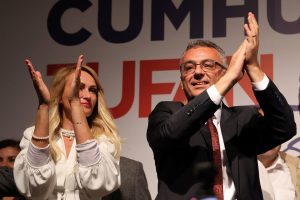
Now, however, the election of Tufan Erhurman in the Turkish-occupied north of Cyprus has revived a faint flicker of hope that negotiations might be restarted after the collapse of the 2017 talks in Crans-Montana, Switzerland.
But is that realistic? What does the leadership change in the north actually mean — and what dangers might lie ahead?
Erhurman and Turkey
Erhurman projects moderation. He supports a “decentralized federation” and criticizes the two-state solution Ankara has pushed in recent years. Yet his first statements quickly cooled expectations: “Foreign policy will be conducted in full coordination with Turkey — there should be no doubt about that.”
Hours before his swearing-in and his first official visit, naturally, to Ankara he fell the need to clarify that: “There may be some prejudices about me in Turkey, but I’m confident they will fade. My role is to strengthen relations between our governments and our peoples.”
This balancing act is familiar. With the exception of hardliner Ersin Tatar, Turkish-Cypriot leaders have often had their own internal agenda, proposing meaningful confidence-building measures and showing genuine willingness for dialogue with Greek Cypriots. But whenever negotiations touch on the core issues — territorial adjustments, security guarantees, and the presence of Turkish troops — Ankara calls the shots.
Can Erhurman do what even the more charismatic Mustafa Akıncı could not — persuade Turkey to shift its stance?
“Erhurman’s election is definitely a positive development,” says Andreas Mavroyiannis, a long-time Greek-Cypriot negotiator and former presidential candidate. “He’s a moderate, progressive politician with European values. His political momentum wasn’t neutralized by Turkish interference. I expect at least some movement toward serious negotiations — without indulging in wishful thinking.”
Indeed, Turkey’s decision to rejoin informal five-party talks — first in Geneva last March, then in New York in July — was read as a small step back from its previous hardline position. Ankara had said it would only participate if sovereign equality of the Turkish-occupied north of Cyprus was recognized. In both meetings, though, the parties discussed little beyond minor confidence-building measures, except for the discussion over the reopening of border crossings. Meanwhile Turkey publicly continued to speak of two states, with President Erdogan championing a two-state logic, from the United Nations General Assembly podium
Moves with an eye on the SAFE
Why the tactical softening? A senior Greek diplomat offers one explanation:
“By engaging in a relatively low-risk process, Turkey aims to look constructive in the eyes of the international community, especially Europeans. The Cyprus issues is a European issue and Ankara doesn’t want to be blamed for deadlock especially while seeking influence in Europe’s new security architecture and access to EU-related defense funds such as SAFE.”
Some analysts even believe that if Mr. Erhurman, in cooperation with Turkey, submits to the UN Secretary-General a framework of proposals — aligned with UN decisions but leaning toward a more confederal direction — and it is adopted by António Guterres, then the Greek-Cypriot side risks bearing the blame for yet another failed restart, or in the worst case a new collapse of formal talks.
For Mavroyiannis, the core problems remain unchanged: security, foreign troops, and property rights.
“Substantive negotiations require that the Turkish side stop insisting on a two states and sovereign equality as preconditions,” he says. “Our commitment to the existing UN framework and prior convergences is the best safeguard against attempts to redefine the essence of a federal settlement.”
The “Realities” on the Ground
Turkey, however, points to what it calls the “realities” on the ground: two communities living apart, the impact of settlement policy on property rights and more significantly for Turkey the entanglement of the occupied north of Cyprus into Turkey’s military and security system.
Turkish forces are currently stationed across dozens of bases in the north give Ankara strategic depth reaching as far as Syria, while reinforcing its influence across the Eastern Mediterranean. Without the withdrawal of these troops, most diplomats agree, there can be no genuine progress in the negotiations.
As retired admiral Cem Gürdeniz, one of the architects of Turkey’s “Blue Homeland” maritime doctrine, wrote recently reflecting the hard-nationalist line in Erdogan’s environment: “Reality on the ground will test diplomacy at the table. Power gives meaning to diplomacy — and that power comes from Turkey’s military presence on the island. The motherland, the child-motherland, and the ‘Blue Homeland’ form an indivisible whole. The Turkish Republic and the “TRNC” were established by force of arms”.”
The history of Cyprus is written in blood, and for many in Greece — just as in Turkey — the Cyprus issue forms an integral part of national identity, where compromise is often seen as betrayal. Yet, this time, voters in the north didn’t cast their ballots solely on the Cyprus issue. “Corruption, political cronyism, lack of meritocracy, headscarf pressures, job insecurity, and high living costs: those were the reasons Erhurman won,” a Turkish-Cypriot community source told To Vima, requesting anonymity. Many Turkish Cypriots resist externally imposed identity politics and want self-determination vis-à-vis both Ankara and Nicosia, which supports the notion that the community could be receptive to a “loose” federation.
Athens and the hypothetical pressure of an “external actor”
In Athens, officials close to Foreign Minister George Gerapetritis say Greek diplomacy helped restart informal consultations. The prevailing view is that Cyprus and Greek-Turkish relations are inseparable; progress must happen in tandem. Hence Mr. Gerapetritis’s intention is to support the process all the way up to the restart of formal negotiations.
Meanwhile, Washington’s interest is quietly returning. Analysts see signs that the United States may again push for a comprehensive settlement in the Eastern Mediterranean, motivated by potential energy cooperation and regional stability.
“Who’s to say Donald Trump wouldn’t see opportunities in Cyprus — or the wider region — and pressure for a deal in his own way?” is one of the increasingly common, if somewhat simplistic, questions heard lately.
Even the five-party cooperation scheme floated by Prime Minister Kyriakos Mitsotakis would require, first and foremost, Turkey’s recognition of the Republic of Cyprus. As regional experts repeat, the key to solving the Cyprus question remains in Ankara’s hands.
If Turkey were to signal openness to something beyond a rigid two-state solution, attention would immediately turn to the Greek-Cypriot response. As Erhurman warned: “another failure would not mean a return to today’s status quo.” In other words, the longer the stalemate continues, the more the de facto partition hardens.
“Time is eroding hope,” says a Greek-Cypriot academic from a refugee family displaced in 1974. “The facts on the ground keep solidifying, and the generations now in power are the generations of reality.” If progress on Cyprus is indeed a prerequisite for a broader détente in the Eastern Mediterranean, one conclusion becomes clear: the current plan may need a rethink.