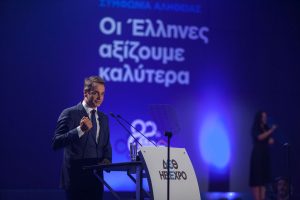
Prime Minister Kyriakos Mitsotakis will travel to Thessaloniki on Friday afternoon for the 89th Thessaloniki International Fair (TIF), carrying with him a package of tax measures aimed at easing pressure on Greece’s middle class.
Tax Cuts for Families
According to government officials, the central theme will be the reduction of direct taxes, which they argue is the most effective way to ensure relief reaches citizens directly. The plan, they say, is a matter of fairness and common sense, particularly for families with children.
Unlike short-term handouts, the government stresses that lowering direct taxes will raise disposable income in a lasting way, providing double value amid the ongoing cost-of-living crisis that has gripped both Greece and other European countries.
Officials also dismissed opposition proposals such as reintroducing a 13th salary, claiming it would leave no fiscal room for broader relief measures. They pointed out that since public sector wage freezes were lifted in 2022, employees have already seen increases equivalent to 1.3 monthly salaries.
Tension Over Energy Interconnection
The government’s positive messaging ahead of the fair has been overshadowed by statements from Cypriot Finance Minister Makis Keravnos, who said the planned electricity interconnection between Greece, Cyprus and Israel is “not viable under current terms.”
The comments drew swift reactions in Athens. Energy Minister Stavros Papastavrou warned that such remarks send an “ambiguous signal” regarding a project of strategic importance for Cyprus, one that would end its energy isolation. Labor Minister Kostis Hatzidakis also emphasized that the project cannot be funded solely by Greek taxpayers and requires burden-sharing, as with other cross-border infrastructure.
Athens insists that its commitment to the interconnection stands firm but has called on Nicosia to clarify its position. Greek officials noted they have not been given access to the viability studies Keravnos referenced. They further pointed out that on July 31, Cyprus’s own Energy Regulatory Authority (RAEK) approved €25 million in funding for the project, which is already backed by the European Union.
Government sources underline that the project is of “major significance” for Cyprus, as it will eliminate its energy isolation once completed.
Background
TIF is Greece’s most prominent annual trade and political event, where successive prime ministers traditionally announce new policies. This year’s edition comes amid persistent inflation and public debate on energy security in Southeast Europe.