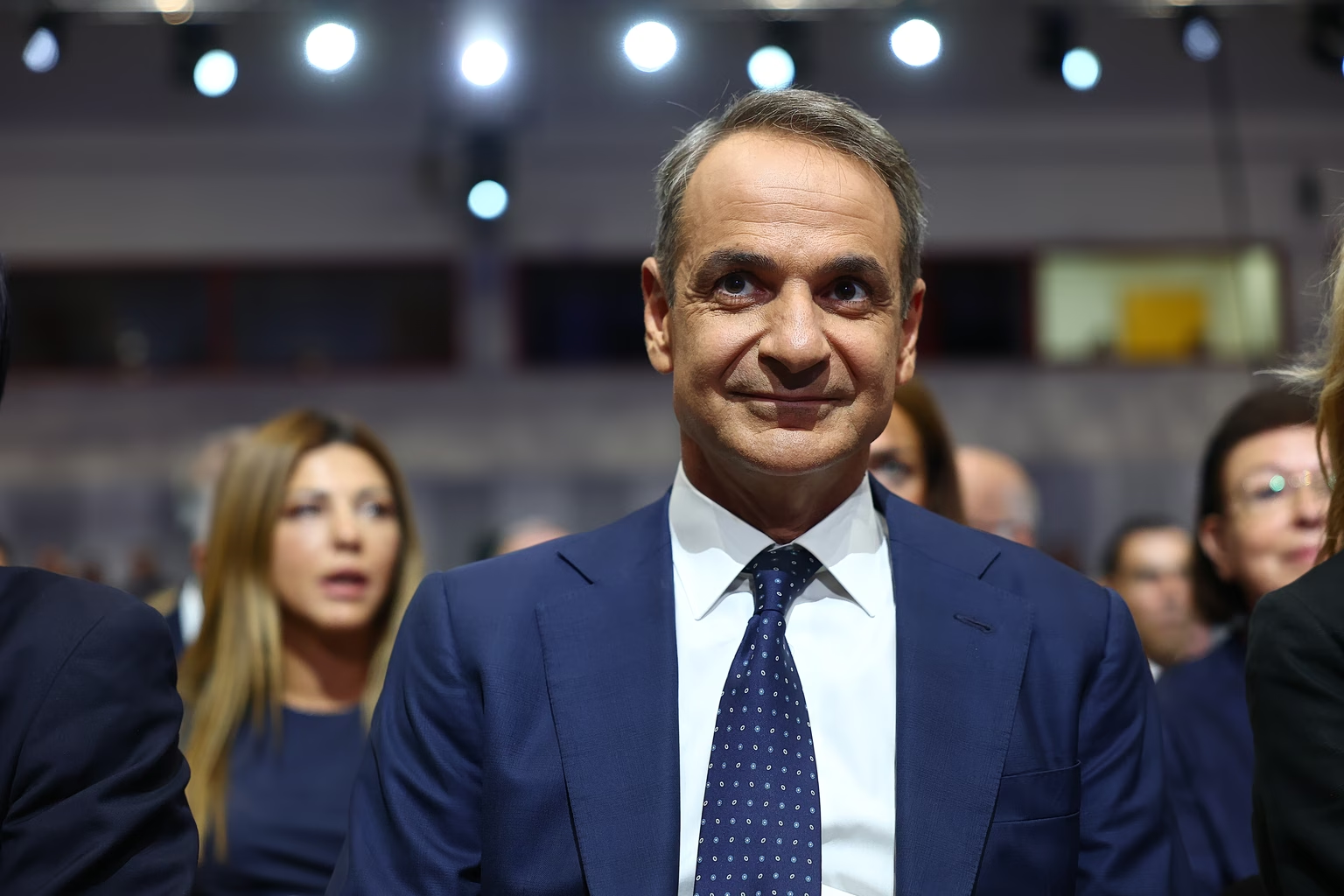
Greek Prime Minister Kyriakos Mitsotakis used his traditional press conference at the 90th Thessaloniki International Fair on Sunday, September 6, to defend his government’s economic record, address tensions with Turkey, outline Greece’s regional diplomacy, and candidly acknowledge missteps of his tenure.
Asked whether the support measures he had just announced were sufficient to meet social needs, Mitsotakis argued that Greece’s economic performance had earned it room to manoeuvre that most of its European peers simply lack. “The country is in a position to distribute a growth dividend because the performance of the Greek economy allows it,” he said, crediting restored fiscal discipline and higher state revenues. He was careful to temper expectations, however, stressing that the support package had been strictly costed and that citizens should harbor no illusions about the conditions attached to its implementation.
Pressed on how he would govern without a parliamentary majority after the next election, whenever it is held, the Prime Minister returned to a familiar theme: the stability a single-party government provides. “We respect and honor the verdict of the people. But it is my duty to point out the risks,” he said, insisting that Greece needs “a stable government from July 1st” and reaffirming that New Democracy would fight the coming election with an outright majority as its goal.
He raised the spectre of a post-election vacuum “at a difficult international juncture,” placing responsibility squarely on opposition parties that have already ruled out cooperating with his party through their own congressional resolutions. A caretaker government, he added, “would not be the best outcome,” yet he insisted the current impasse was not of his making. “Before the 2023 election, no one gave us an outright majority either. So the goal is achievable,” he noted.
Turning to the cost of living, the prime minister framed the sweeping tax reform set to begin next year, alongside the broader package of support measures, as efforts squarely aimed at Greek households. “If the economy is growing, citizens should feel it in their pockets. Have we reached the level we would like? No, but we are moving in that direction,” he said.
On relations with Turkey, Mitsotakis addressed the disputes over marine parks and Ankara’s “Blue Homeland” doctrine, affirming that the Athens Declaration remains in force and continues to underpin communication between the two countries. He was unequivocal on sovereignty, however: “Greece’s marine parks are an exercise of national sovereignty,” he said, adding that “Greece will not ask anyone’s permission for how it arms itself.”
Asked about the defence balance with Turkey, including Ankara’s F-35 ambitions, Mitsotakis pointed to Greece’s standing as one of only five NATO members allocating 3.5% of GDP to defense, crediting this commitment with driving the modernisation of the country’s armed forces and a broader cultural shift that reinforces national defense. On Washington’s arms sales to Turkey, he was measured: “We cannot dictate to the United States where and to whom it sells.”
On the Middle East, the prime minister described the recent Mecca agreement as “a development worth watching,” while insisting it does not alter Greek foreign policy’s core priority: maintaining strong ties across the Gulf, including Saudi Arabia, which he said he expects to visit shortly. He referenced the recent visit of Lebanon’s president and cordial relations with Jordan, Qatar and the UAE, singling out Egypt for what he called a “strategic relationship” set to be reaffirmed.
On Israel, he described a strategic partnership that does not preclude Greece playing a role in seeking solutions, noting a broader geopolitical shift toward the East that he said strengthens Greece’s own position.
In a candid self-assessment of his government’s record, Mitsotakis acknowledged that mistakes are inevitable when governing, but warned that repeating them is the real failure. He openly conceded specific missteps, including the OPEKA farm benefits scandal, admitting it was an error not to have moved sooner to transfer the agency’s responsibilities to Greece’s tax authority.
At the same time, he called for the government to pick up the pace on reforms and clear away obstacles to investment, while pushing back firmly against opposition criticism: “I believe I have engaged in self-criticism. But there is a difference between self-criticism and self-flagellation. I am not erasing our record — one need only compare where Greece stood in 2019 with where it stands today.”