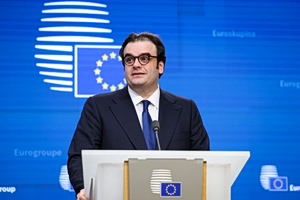
Kyriakos Pierrakakis , Greece’s Minister of National Economy and Finance and President of the Eurogroup, has outlined four major global forces reshaping politics, business, and leadership, warning that decision-makers must adapt to accelerating change across economic and geopolitical systems.
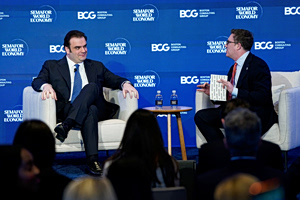
Speaking at a “Leadership in the New Era” event organized by Stanton Chase, Pierrakakis said his generation is driven by a desire “to do more, faster, and better,” arguing that leadership today is defined by execution rather than titles or formal authority.
Four global forces reshaping leadership
Pierrakakis identified four structural shifts shaping the global environment.
The first is a gradual transfer of global influence from the West toward the East. The second is a broader diffusion of power away from the state toward businesses, civil society organizations, and citizens themselves.
The third, he said, is rapid digital transformation, driven by accelerating advances in technology and artificial intelligence, where change now unfolds in weeks rather than years.
The fourth is the return of geopolitics as a dominant force, pointing to heightened global tensions and instability affecting energy, trade, and security systems.
Leadership in an era of rapid change
Describing leadership as a function of context as much as content, Pierrakakis argued that effective decision-making depends on understanding the broader environment in which choices are made.
He highlighted the challenge of aligning human and political systems, which often operate slowly, with exponential technological change, stressing that institutions frequently struggle to keep pace with innovation.
Crisis management and transformation in Greece
Reflecting on recent years, Pierrakakis referred to overlapping global disruptions including the pandemic, energy shocks, and geopolitical instability, noting that governments have had to respond to unprecedented crises while also pursuing long-standing reforms.
He cited Greece’s digital transformation efforts, including tools introduced during the COVID-19 lockdown period, as examples of rapid institutional adaptation under pressure.
Delivery over titles
The minister emphasized that leadership is not defined by formal positions, but by the ability to deliver change. “What matters is not what is written on a business card,” he suggested, but the capacity to implement meaningful reforms.
He also pointed to Greece’s recent economic performance, including debt reduction, stronger-than-expected fiscal results, and higher growth rates compared with the European average, describing them as outcomes of sustained collective effort.
A generation focused on execution
Concluding his remarks, Pierrakakis said his generation of leaders is focused on translating strategy into tangible results, stressing that progress depends on turning intentions into action.
“We want to do more, faster, and better,” he said, framing leadership as a continuous process of delivery, adaptation, and improvement in an increasingly complex global environment.