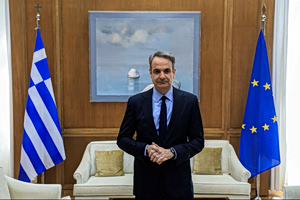
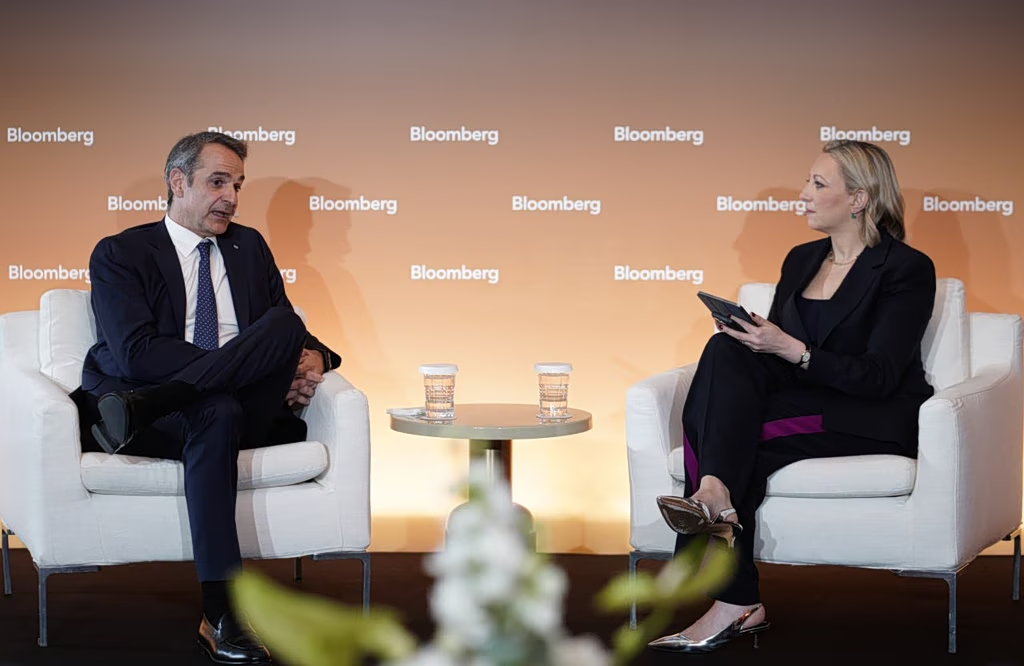
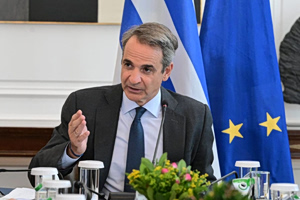
In an interview with the Australian Greek-language newspaper Neos Kosmos, Greek Prime Minister Kyriakos Mitsotakis focused on the international climate, Greece’s role in a volatile region, the global Greek diaspora, bilateral ties with Australia, and the importance of postal voting.
He began by addressing the postponement of his planned visit to Australia, which had been scheduled to coincide with celebrations for Greece’s March 25 Independence Day. Mitsotakis said the decision had been difficult, but necessary in light of developments in the Middle East.
“My decision to postpone this visit was not easy at all. It was, however, a decision made out of responsibility,” he said. “As you know, the broader Middle East region is currently in the midst of an extremely intense military conflict.”
Speaking directly to the Greek community in Australia, he stressed that the visit had not been cancelled, only delayed, and would be rescheduled soon. “For me, Australia is not simply a country where Greeks live; it is a part, a living part, of global Hellenism,” he said.
On postal voting, Mitsotakis underlined the government’s determination to give Greeks abroad a stronger voice in the country’s future. “We want the Greek community in Australia, the global Greek diaspora — and now I am speaking directly to you — to participate in and help shape developments in the motherland,” he said. “And there is no better way than for as many Greeks as possible who have the right to vote to take part in the next national elections through postal voting.”
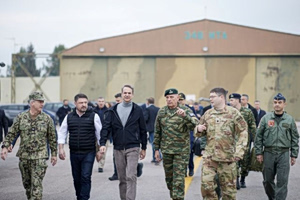
Looking ahead to the European Council summit in Brussels, he said Greece had stood by Cyprus from the very first moment of the conflict, dispatching two frigates and two pairs of armed F-16 fighter jets to help protect the island against potential attacks from Lebanon or Iran.
“It was a move of great strategic importance for global Hellenism,” the prime minister said. “But it was also a move that highlighted the need for a broader European mobilisation to protect European territory under attack.” He noted that he had recently visited Cyprus alongside French President Emmanuel Macron, describing the trip as highly symbolic and a tangible demonstration of support.
Mitsotakis said the crisis had brought renewed urgency to the debate over how Europe can assume greater responsibility for its own defence — what he described as “European strategic autonomy.”
At the European Council, he added, leaders would also discuss European competitiveness, at a time when the impact of the Gulf crisis is already being felt. Rising fuel prices, he said, are a pressing concern.
“We are already seeing increases in fuel prices, and it is extremely important, not only as a country but also as Europe, to build the necessary safeguards so that, at a time when our societies are already under strain, they are not burdened further by additional increases — whether in electricity prices or fuel costs,” he said.
On tourism, the prime minister struck a reassuring tone, saying there was no cause for concern and encouraging Greeks in Australia who are considering visiting Greece this summer to go ahead with their plans.
Mitsotakis also argued that Greece has made major strides in recent years, pointing in particular to a drop in unemployment from 18.5 per cent to 8 per cent, rising investment, and the strengthening of the armed forces.
He also said the government’s strategy for global Hellenism goes beyond ensuring equal participation in elections. Referring specifically to Australia, he revealed that his intention had been to announce during the visit that Greece and Australia had, in practical terms, reached agreement on a long-pending double taxation avoidance treaty.
“In any case, we will announce it as soon as it is ready, but in practical terms it has been agreed,” he said. “There is only one small exception relating to shipping matters, which we will defer to a later stage, but the core of the agreement has essentially already been settled.”
Elsewhere in the interview, Mitsotakis said strengthening global Hellenism also involves facilitating access to Greek citizenship. He described Greece-Australia relations as excellent and, when asked when the postponed visit might finally take place, said it could potentially happen as early as this summer.