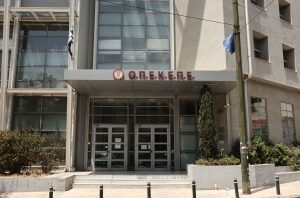
A new case file tied to the OPEKEPE farm subsidy scandal is expected to be delivered within days to European Prosecutor Popi Papandreou, marking a significant escalation in the investigation into the alleged misuse of EU agricultural funds in Greece.
The file was compiled by Greece’s Financial Police Division and first reported by TA NEA. It includes evidence of suspicious communications involving about 17 lawmakers -14 from the ruling New Democracy party- with officials at OPEKEPE, the scandal-plagued agency handling EU farm subsidies. The alleged interventions took place between 2021 and 2025 and involved requests for payments that bypassed official procedures.
Papandreou has reportedly requested that the investigation be fast-tracked, with the case file expected to reach the European Public Prosecutor’s Office by the end of March, in part to avoid potential statute-of-limitations issues.
A Second Wave of the Scandal
The development effectively marks a second major phase of the OPEKEPE investigation — an “OPEKEPE-part 2” in a way — and is expected to create serious political fallout within the governing party. According to the findings, lawmakers sought preferential treatment, that in many cases led to the misuse of EU funds. Authorities are now expected to request the lifting of parliamentary immunity for those implicated, opening the way for possible criminal prosecution.
These revelations build on earlier findings that emerged last summer, when thousands of allegedly unlawful subsidy payments and alleged attempts at concealment were uncovered, placing former Agriculture Ministers Makis Voridis and Lefteris Avgenakis under scrutiny.
Re-examining Overlooked Evidence
A key component of the new case is the re-examination of 140 CDs containing recorded conversations from the initial phase of the investigation between 2021 and 2022.
That earlier inquiry, which was not conducted under the supervision of the European Public Prosecutor’s Office, had largely been shelved.
The new review of the recordings — including conversations that had not been “properly examined,” till now as sources said — has already helped identify a new group of lawmakers under suspicion. It also drew on evidence of “tricks” used inside the scandal-hit organization that were uncovered in later investigations.
According to Hellenic Police officials who served at the time, “behind-the-scenes actions led to the suspension of the investigation,” even though it was known that “prominent members of the ruling party could be heard” in the recordings.
According to reliable information, two of the politicians named in the new findings, both from the governing party, had held ministerial posts linked to OPEKEPE. Others are said to have had questionable contacts with officials at local subsidy support centers (KYD). Some allegedly pressured officials to speed up payment approvals.
Broad Police Investigation
The latest probe was carried out by three specialized units of the Hellenic Police: the Internal Affairs Service, the Directorate for Information Management and Analysis, which operates systems for monitoring communications, and the Financial Police Directorate.
Investigators not only analyzed recorded conversations but also examined OPEKEPE’s electronic records and other databases to determine whether political interventions resulted in illegal acts or financial transactions.
According to sources familiar with the investigation, requests made by lawmakers from the governing party often resulted in documented illegal actions and financial damage to the European Union. By contrast, similar interventions attributed to opposition lawmakers did not consistently lead to unlawful conduct.
Earlier Investigations
The first investigation was conducted between July 26, 2021, and Oct. 24, 2022, at a time when the European Public Prosecutor’s Office was not involved. It followed a complaint from OPEKEPE employees, who reported serious misconduct by senior OPEKEPE officials. That inquiry relied primarily on phone surveillance of 16 suspects and did not extend to a broader examination of financial transactions, reportedly due to concerns over potential leaks. The case file was submitted to the Athens prosecutor’s office but did not lead to further judicial action.
A second investigation, carried out from early autumn 2024 to summer 2025 under the supervision of the European Public Prosecutor’s Office, brought to light much of the evidence now associated with the OPEKEPE scandal. That probe formed the basis for subsequent developments, including ministerial departures and a parliamentary preliminary investigation.