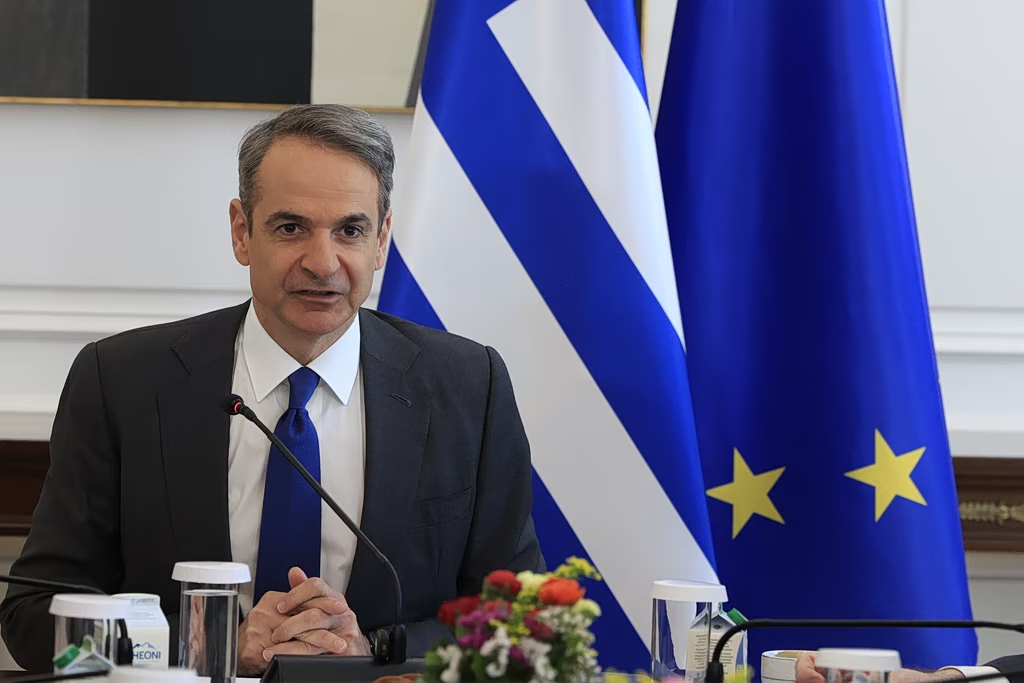
“If we don’t show it, Mr. President, across all social media, using the language and codes of each platform itself, it’s as if it never happened.” The remark could have come from a member of Generation Z advising a political leader—even Antonis Samaras, a politician whom few expected to see on TikTok, and even fewer expected to capture the attention of both the public and the Prime Minister’s Office with just two posts.
“The strong debut of an unmistakably traditional politician such as Antonis Samaras on TikTok shows just how much the rules of political communication have changed,” observes political communications consultant Maria Sotiropoulou. Beginning in the United States—from Barack Obama’s 2008 campaign to the Trump era—platform-based communication gradually found its way into Greek politics as well.
Political communications consultant Filippos Petropoulos notes that “political leaders were slow to fully embrace social media, perhaps because they underestimated it, or because they failed to recognize early enough how influential it would become.” But once that transition occurred, “it happened with remarkable momentum,” with the 2023 elections being fought largely “on TikTok’s terms.” Even so, “Kyriakos Mitsotakis was the first to break the taboo,” Sotiropoulou remarks, at a time when, according to political analyst Giorgos Sefertzis, “New Democracy had begun losing touch with younger voters,” who nevertheless “contributed decisively to its victory” in 2023.
From Maximos Mansion to the Neighborhood
The Prime Minister’s systematic presence on social media is described by Nikos Romanos, Director of Digital Communications for the Prime Minister.
“Ever since Kyriakos Mitsotakis entered the world of social media and TikTok, he has maintained the most systematic and professionally structured presence,” he says.
As he explains, “our approach differs from one platform to another,” because each platform has its own audience. Within that strategy fall the Prime Minister’s weekly Sunday reviews on Facebook, “a more traditional, now less youth-oriented platform where New Democracy continues to enjoy strong support,” as Sotiropoulou notes.
According to Romanos, the goal is to present “the Prime Minister’s real face” and “his human side, beyond his technocratic profile,” while also projecting the image of someone who “inspires confidence in discussions with foreign partners.” The next step is “direct, unmediated contact with citizens, neighborhood by neighborhood,” through content such as “the backgammon game we saw him playing in Nea Smyrni,” distancing him from the image of an “elitist Prime Minister.”
An Unexpected Debut
While the government’s communications team rolls out its strategy, “Antonis Samaras’s arrival on TikTok—and more recently Instagram—unexpectedly changed the rules of the game on social media,” Sefertzis observes, since it was perhaps “the last place where Maximos Mansion expected him to open a front against the government.”
The tone of the posts is described by Nikos Tsioutsias, director of Samaras’s press office.
“Through relaxed and friendly conversation, Antonis Samaras’s approachable and completely unpretentious side emerges naturally—a strong sense of familiarity that resonates with citizens.”
The videos will continue throughout the summer, aiming, as Sefertzis notes, “to build on the success of the previous ones.” Meanwhile, Maximos Mansion has sought to downplay the development, with Romanos commenting that “what we did first was later copied by the others, especially Tsipras and Androulakis.”
PASOK Searches for Spontaneity
PASOK has responded directly to accusations of imitation. Stefania Mourelatou, the party’s communications director, replies that “there is no immaculate conception in politics,” adding that, if there were, “Kyriakos Mitsotakis would not have borrowed Hillary Clinton’s slogan about who answers the phone at three in the morning.”
For PASOK, TikTok is a platform for showcasing Nikos Androulakis’s political identity. As she explains, “we are not trying to present an unfamiliar face to the public,” but rather a leader who “doesn’t appear staged,” who comes across as “spontaneous,” “deeply pro-European,” “a defender of the rule of law,” and “someone with whom many Greeks can identify.”
Petropoulos also acknowledges improvements, saying that “Nikos Androulakis has improved considerably in the way he presents both himself and his party’s proposals.” Sefertzis believes his social media presence has had a positive impact “on public opinion” and on his relationship with younger voters.
Sotiropoulou notes that Androulakis has shed the image of “a sterile politician,” though she believes “there is still room for him to loosen up a little more.” Petropoulos adds that “he needs to show more down-to-earth aspects of his personality.”
The New Language of Amalias Avenue
A similar mobilization is underway in Alexis Tsipras’s camp.
According to deputy press spokesperson Giorgos Balatsoukas, “in the coming period ELAS’s policy proposals will have an intensified presence on social media and TikTok,” with the goal of “communicating them in a way that is clear and appealing.”
Tsipras’s previous digital presence now serves as a point of comparison. Sotiropoulou observes that “his communications campaign during the previous elections was not only delayed, but also carried out with less professional standards,” whereas with his return “he has clearly understood the importance of it.” After all, she adds, “these channels are managed by young people who are better able to decode the language of each platform.”
Balatsoukas emphasizes the videos’ “new aesthetic,” “new style,” and the “element of a moral revolution.” Petropoulos is more cautious, arguing that “heavy emotional and moral messaging in short videos” may not necessarily resonate with younger audiences, who are looking for “fast, engaging content.” Concepts such as “moral revolution,” “a new era of democratic transition,” and “a new patriotism” require careful translation into TikTok’s language.
Edited… with Authenticity
As election day draws nearer, TikTok is expected to become even more active.
Romanos says that the Prime Minister’s presence on the platform “will continue,” with short-form videos increasingly incorporating artificial intelligence. A notable example was the video marking Kyriakos Mitsotakis’s ten years as leader of New Democracy, “a video created using artificial intelligence tools.”
Beyond visuals and editing, however, authenticity remains the key objective.
Sefertzis insists that “the crucial issue is the credibility of the messenger,” and that political leaders “must preserve their authentic characteristics.” Sotiropoulou echoes this view.
“If authenticity is lost, it won’t succeed,” she says, noting that younger audiences in particular “can very quickly tell when something is genuine and when it is contrived.”
Petropoulos points to one additional risk: striking the right balance between institutional seriousness and content that is lighter, more immediate, and, where appropriate, humorous.
“Going viral once can work in your favor. But if you start going viral repeatedly for the wrong reasons, then it stops being an advantage and becomes a problem.”