As the car winds down the narrow, rock-hewn “snail trail” road, the eerie atmosphere feels almost cinematic—like a scene from a science-fiction film. Perhaps a war movie, too, since the final destination—a broad plateau 40 meters below ground level—could easily function as a bunker. In a way, this space, located in the Lavrio Technology and Cultural Park, is a refuge. Only it isn’t meant for people. Instead, it shelters over two tons of arsenic, stored in sealed blue and yellow barrels behind metal fences that stretch up to the ceiling.
But where did all that arsenic come from—the colorless, odorless chemical infamous for claiming both fictional characters like Madame Bovary and countless real lives—and how did it end up in its newly created “sanctuary”?
An Ancient Legacy
To answer these questions, one must travel back 2,500 years, to the Lavrio mines that fueled Athenian prosperity and helped finance the Golden Age of Pericles. In the 19th century, the Italian mining engineer Giovanni Battista Serpieri revived these mines, founding the French Lavrio Mining Company in Paris. The resumption of mining and the influx of workers gave rise to the town of Lavrio around the industrial complex built for ore processing. The company operated for over a century, producing lead and lead products, before ceasing activities in 1982.
After long negotiations, the sprawling industrial complex—covering over 200 acres—was transferred to the Greek state, specifically the Ministry of Culture, which entrusted its restoration and operation as the Lavrio Technology and Cultural Park to the National Technical University of Athens in the mid-1990s. Today, thousands of visitors to the park attest that this decision was a wise one.
A Pioneering Project
The park’s most recently restored building, named after Konstantinos Konofagos, together with the underground arsenic repository, represents an invaluable contribution to the region. For decades, the arsenic had been stored in the Konofagos building, posing a serious environmental hazard.
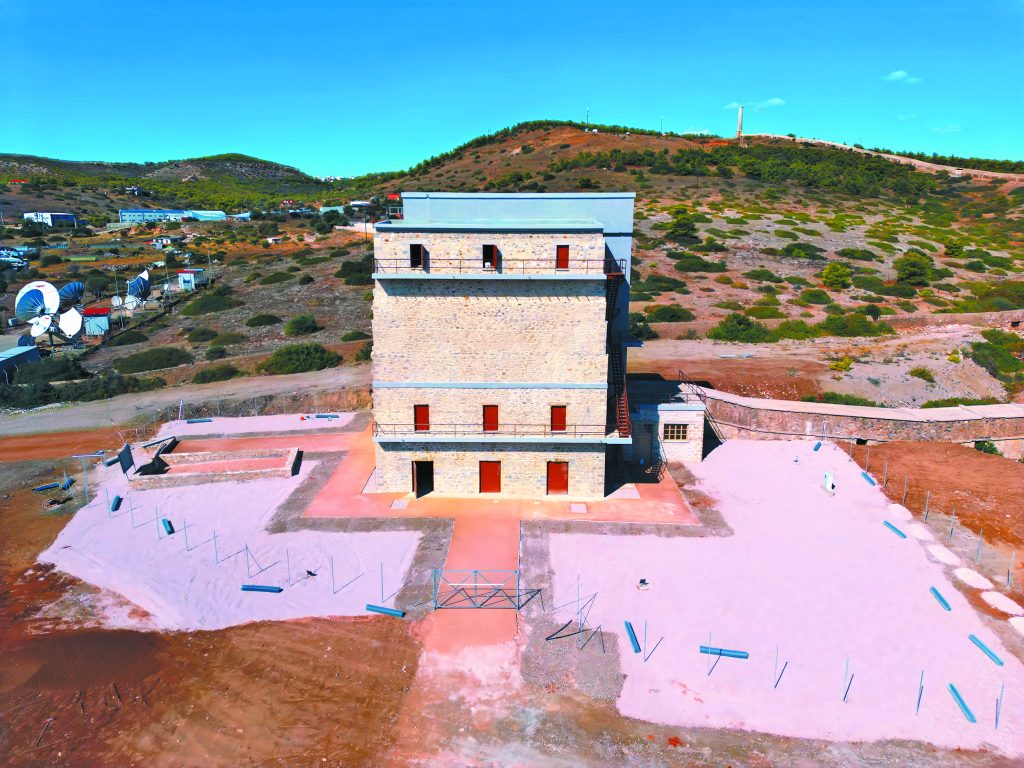
The restored Konofagos building at the Lavrio Technological and Cultural Park. Its specialized function is evident in the architecture: the windowless floors once housed the cloth filters that trapped hazardous pollutants.
In the late 1940s, the chief engineer of the mining company, professor and later rector of the National Technical University, Konstantinos Konofagos, noticed that workers were falling ill and dying at unusually young ages. He traced the cause to inhalation of fumes from ore processing and designed a “filter building” to capture the toxic emissions. Fumes were channeled through specially designed tunnels into the building, where they passed through cloth filters that trapped dangerous pollutants. The building literally saved the lives of Lavrio residents and became one of Greece’s first environmental protection projects.
A Ticking Time Bomb
Arsenic was among the main toxins captured in the filter building, and its quantity had steadily increased over the company’s operational years. By the time the National Technical University took over, the team discovered that the building—now called the Konofagos Building in honor of the scientist—was a ticking time bomb. The structure was unstable, and the volume of arsenic posed a potential catastrophe. Under EU Seveso regulations for facilities handling hazardous industrial waste, any quantity of arsenic over 100 kilograms requires special management. The Konofagos Building contained enough arsenic to far exceed that threshold, and the building itself was at risk of collapse.
Gradual Resolution
The solution took nearly 17 years. First, the building’s structure had to be stabilized to prevent imminent collapse, using a metal exoskeleton later covered in protective plastic. This reinforcement made it safe to begin decontamination: the careful transfer of arsenic from the Konofagos Building to the purpose-built underground repository. A specialist company handled the work, prioritizing both worker safety and environmental protection. Throughout, workers underwent medical checks, and air and water quality were regularly monitored. The operation was completed without incident, and the arsenic now rests safely underground, potentially for centuries, until science finds a way to neutralize or utilize it.
A Tradition of Innovation
The decontamination project was groundbreaking, requiring innovative methods developed specifically for this purpose. The achievement is now a model for similar projects worldwide. Those who worked on it, from professors and scientists to technical staff, see it as a continuation of the National Technical University’s longstanding commitment to applying science and technology to pressing social problems—a legacy of service with tangible societal impact.
The Konofagos Building, conceived to protect workers and residents of Lavrio, has now been restored and cleared, a testament to both foresight and technical expertise.